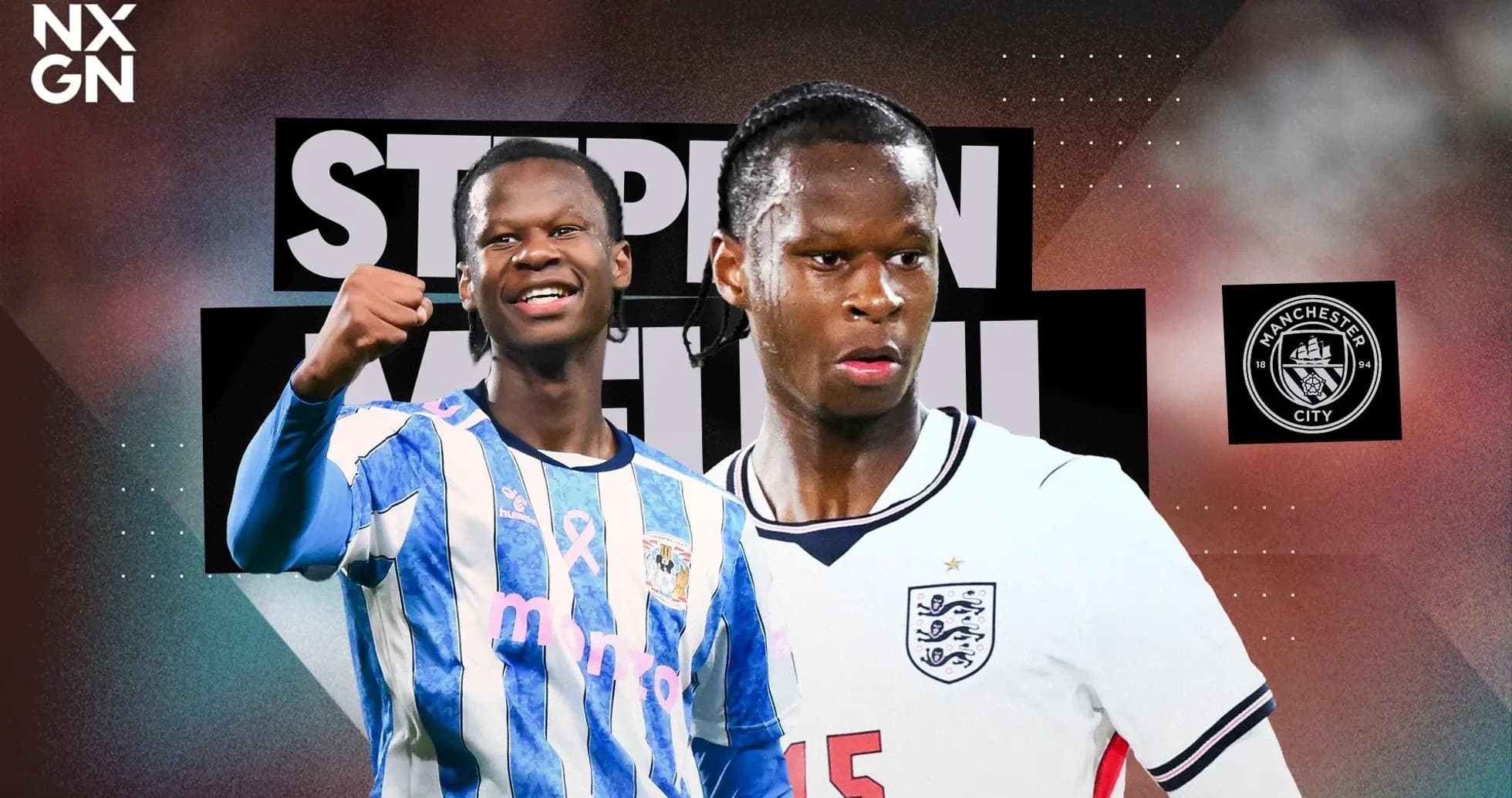
Mfuni's Rise: From City Academy to Premier League Impact
At nine years old, he stood at a crossroads most kids only dream about. Liverpool or City. Two giants, one choice. Mfuni picked the blue half, walked into Manchester City’s academy and never really stopped moving forward.
He tore through the age groups. By 16 he was already a standout for the Under-21s, playing with the composure of a seasoned defender rather than a teenager still learning to drive. Coaches pushed him up, opponents bounced off him, and word filtered back to the first team staff: this kid was different.
Pep Guardiola agreed.
Fresh from City’s 2023-24 Premier League title, Guardiola took him on the pre-season tour of the United States. For a boy who had grown up dreaming of Pep’s guidance, it was a jolt of reality at the highest level. He came off the bench in the friendly win over Chelsea, shared a pitch with Erling Haaland, and listened closely as Guardiola dissected his positioning and decision-making. It wasn’t a pat on the head. It was a signal. There is a path here, if you’re good enough.
He kept proving he was.
In 2024, he lifted the FA Youth Cup with City. A year later came the U21 Premier League title. The medals piled up, but the more telling reward came when Guardiola started naming him on the bench for Champions League and Premier League games. The first-team door was no longer just ajar. It was opening.
His senior debut arrived in brutal, unforgettable fashion: a 10-1 FA Cup demolition of Exeter earlier this year. He replaced Nathan Ake at half-time, stepping into a game that had already turned into an exhibition. For him, though, every touch mattered. Every duel, every pass was a line on the CV he was building in real time.
City wanted him tested. Properly tested. So came the loan to Watford, a move accelerated by Max Alleyne’s recall to Manchester amid a defensive injury crisis. Alleyne had already sold him on the club.
“Positive things,” Mfuni said of the recommendation. A warm environment. Welcoming players and staff. A place that prides itself on developing young talent. It sounded like the right next step.
Watford’s assistant to the sporting director, Valon Behrami, laid out the attraction clearly: an intelligent defender who reads the space in behind, carries the ball out confidently, quick across the ground, able to slot in at centre-back or left-back. Modern profile, old-school appetite.
He didn’t take long to justify the excitement. Mfuni walked into the starting XI and looked at home, his blend of height, speed and composure hinting at a breakout stretch in senior football.
Then came Stoke.
Late in a 3-1 defeat in March, an ankle injury stopped everything. The loan was cut short, his season ended, and he returned to City with a boot instead of momentum. For a teenager, it was a harsh lesson in how quickly a rise can stall.
The next chapter has come faster than anyone could reasonably have planned.
Now 18, he finds himself in the Premier League with newly-promoted Coventry, a club fighting to stay in the division and in need of players who can cope with the chaos. A calf injury to Aurele Amenda and Frank Lampard’s tactical shift from a back three to a back four have cracked the door open. Mfuni has barged through it.
Off the bench against Newcastle, he didn’t just steady things. He changed the game. A driving run, head up, ball under control, and a composed finish capped Coventry’s 4-1 win. A defender carrying the ball through the lines and finishing like a forward – that was straight from the Guardiola school.
He then started in the 3-1 victory over Sunderland, this time showing the other side of his game: clearances, blocks, the ugly work that managers trust. Lampard noticed.
“There are some players I think that are of a certain level and there are some players that are of another level,” the Coventry boss said. He was careful not to smother the teenager in praise, wary of it going to his head, but he didn’t hide his admiration either. A confident, humble character around the training ground. Settled. Talented.
“Delighted with him, he's going to go a long way in the game,” Lampard added. The words landed like a marker for what might come next.
The international pathway has opened up too. In his first England Under-21 call-up, Mfuni started at left-back in a 4-2 win over Kazakhstan, then shifted back into central defence for the defeat to Ireland a few weeks later. Two games, two roles, and the same calm presence.
On the ball, he looks like a City defender. Head up, scanning, waiting for the forward pass that hurts. His acceleration lets him burst past the first line of pressure and turn defence into attack in a few strides. He credits Guardiola for that evolution.
“He opened my mind, he sees things I didn't see before,” he told the Manchester Evening News after scoring in the FA Youth Cup last year. Driving forward wasn’t something he did often. Now it’s part of his identity. Goals from the back. Pressure from deep. A defender who thinks about how many goals his team needs to win, and how he can help supply them.
The goal against Newcastle was the clearest expression of that mindset yet.
He’s no slouch in the air either. Tall, strong, and surprisingly quick over the ground, he has started to look like the kind of defender who can dominate both boxes. No wonder the comparisons have come thick and fast.
City fans see shades of Josko Gvardiol in his game. The wider football world has reached for the most obvious aerial benchmark: Virgil van Dijk. Mfuni himself leans into those influences.
“I model myself on Josko, a bit of Van Dijk defensively, but mostly Josko,” he has said. The positional versatility appeals to him – left-back, centre-back – and he also mentions John Stones for his composure and quality on the ball.
He’s not yet as ferocious on the ground as Gvardiol. Not as utterly dominant in the air as Van Dijk. But he’s already picked up some of their key traits and is stitching them into his own game.
There are rough edges. He can go to ground too quickly when facing up to attackers, inviting fouls or a simple sidestep. In a relegation fight, those moments can cost points. The Premier League doesn’t wait for you to learn. It punishes every misstep.
He knows that, too. His time with Guardiola during that pre-season two years ago drilled home the need to be “more aggressive” defensively, to get “that one inch in front of the attackers and use your body shape.” It’s a mantra as much as a tactical note.
The bigger test now is mental. Having missed the end of last season at Watford, he lost a valuable run of senior games. Instead of easing into top-flight football, he has been dropped into a survival scrap with Coventry, where every fixture feels like a verdict and every mistake gets replayed from every angle.
Yet this is what he wanted: real pressure, real stakes.
He has already caught Guardiola’s eye at 16 and earned Lampard’s trust at 18. He has gone from academy promise to England Under-21 international, from a boy dreaming of Pep to a defender shaping Coventry’s battle to stay in the Premier League.
If he finds consistency, if he keeps tightening the details without losing that instinct to drive forward, Coventry’s relegation fight may be remembered as the season the wider league woke up to Mfuni – before he walks back through the doors at Manchester as something far more than just another talented kid.