Major League Soccer's Ambitious Journey Post-World Cup
“Thanks world, we’ll take it from here.”
It’s a neat slogan for a commercial, but it also feels like a line in the sand. Lionel Messi, Son Heung-min, David Beckham and a cast of Major League Soccer faces stare down the camera and tell the millions swept up by the World Cup: don’t drift away, come here instead.
The film is glossy, star-heavy and unashamedly ambitious. World Cup heroes now based in the US invite newcomers to follow them into MLS as the regular season kicks back into gear. The league is even dangling free tickets in front of first-time fans. This isn’t a gentle nudge. It’s a grab.
Dan Courtemanche has seen all of this grow from nothing. The MLS executive vice-president joined in 1995, before a single ball was kicked in anger, and now watches a league trying to ride the latest wave.
“The World Cup has now exposed millions of people to Major League Soccer,” he says. “We’re going to continue to capitalise on that momentum.”
The question hangs over everything: could this World Cup finally shove MLS into the same conversation as Europe’s elite?
From 10 teams and borrowed stadiums to a 30-club behemoth
MLS itself was born out of a World Cup promise. When the US won hosting rights for 1994, Fifa insisted on a professional league as part of the deal. Two years later, in 1996, MLS kicked off with 10 teams and not a single purpose-built stadium.
Three decades on, the landscape is unrecognisable. Thirty clubs. A near-matching number of football-specific stadiums. A footprint that stretches from Miami to Seattle and into Canada. The league that once begged for attention now sells itself with Messi’s face.
This latest World Cup has deepened the obsession. Dire warnings about empty seats and sky-high ticket prices evaporated once the games began. Stadiums filled. Television numbers surged. Even after the USA went out to Belgium in the last 16, the country kept watching.
That defeat to Belgium delivered the most-watched football match on one US network in history, pulling more than 33 million viewers on Fox. England’s last-16 win over Mexico went even bigger: a combined 45 million across English and Spanish broadcasts on Fox and Telemundo, the most-watched football game in US history.
Those figures push into NFL territory. They don’t yet touch the Super Bowl, but they no longer feel like a different sport entirely. The 2025 Super Bowl still towers above, drawing 127.7 million viewers across English and Spanish broadcasts and streaming in the US, with Kendrick Lamar’s half-time show a spectacle in its own right. But football – the global kind – is no longer an afterthought.
MLS wants to turn that spike into something permanent. It has already shown steady growth over its 30-year life; now it wants to sit at the same table as the Premier League, La Liga and the rest.
“I think we’re looked at as the top, one of the top leagues commercially,” commissioner Don Garber said at an event on the league’s future and the World Cup legacy. “We’ve cracked that code. Now we’ve got to crack the rest of it.”
From retirement home to launchpad
For years, the stereotype was easy: MLS as a retirement village for European greats. Beckham. Then Zlatan Ibrahimovic. Now Messi. Legends on their victory lap, cashing one last cheque under the Californian sun.
The picture is shifting.
At this World Cup, 45 MLS players were on national team duty. Two started the final for Argentina: Messi and Rodrigo de Paul. That’s not a league on the margins.
Courtemanche insists the “retirement home” label is simply out of date. The average age of new international signings is now 23.8. Many still dream of crossing the Atlantic and testing themselves in Europe, but they are using MLS as a launchpad, not a soft landing.
The league is also reshaping its calendar. From 2027, MLS will move to a summer-to-spring season, mirroring Europe. Transfers should become smoother. Clubs can buy and sell in sync with the major European windows. For ambitious young players, the path becomes clearer.
Behind the first teams, the league is pouring energy into youth development. Every MLS club now runs an academy system. On one night in Los Angeles, as LA Galaxy hosted a viewing party for the US win over Bosnia-Herzegovina on a giant screen, the real action for some fans was happening a few yards away.
Dozens of children ignored the broadcast, throwing themselves into three separate small-sided games. They only glanced up when the roar of a goal rolled through the crowd. In a country obsessed with schedules and structure, these were rare pick-up games. The technical level was striking. Some of those kids already play for MLS youth sides.
One of them, eight-year-old Landon – named after US legend Landon Donovan – darted from goalkeeper to forward, grinning through every position. His mother, coach Jen Wing, says her children attend MLS camps and play for travel teams back home in New Jersey. Landon already knows where he wants to end up.
“LAFC,” he says, without hesitation.
The price of a dream
There is a catch. There always is.
Critics argue that MLS cannot truly compete with Europe until it confronts the cost of entry for young players. At the top, MLS academies do mirror European clubs, training and developing youth for free. The problem comes before that.
To reach the point where an MLS academy even notices a teenager, many families pay thousands of dollars in fees: private coaching, travel teams, tournaments, equipment. It’s a familiar story in US youth sports, and football is no exception.
League officials insist the system is evolving. Development leagues are being reshaped. Every MLS club offers scholarships for talented players who can’t afford the pathway. Garber talks about constant improvement, about producing more and better players for the men’s national team – “better, bigger, stronger, faster,” as he puts it, with an eye on a brighter future.
The ambition is clear: a pipeline that runs from public park to MLS stadium, without being blocked by a bank balance.
Messi, movie stars and money
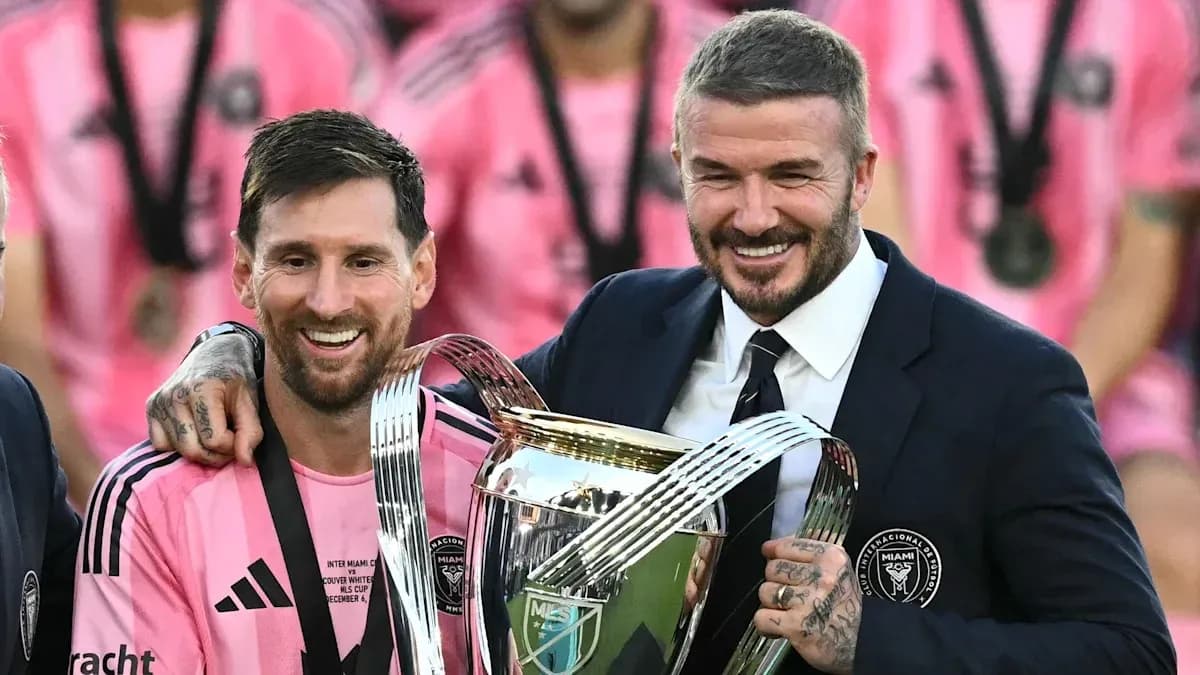
If there is one man who cuts through all the structural talk, it is Messi. His arrival at Inter Miami has changed the league’s global profile overnight. He is the gravitational pull.
But the celebrity orbit around MLS runs deeper than one genius in pink.
More than two dozen entertainers and athletes now hold stakes in MLS clubs. Will Ferrell and Magic Johnson at LAFC. Reese Witherspoon in Nashville SC. Matthew McConaughey in Austin FC. The league has become a playground for Hollywood and sporting royalty, and the valuations tell you why.
Drew Carey bought into Seattle Sounders in 2009, when the expansion fee sat at $30m. Today, the Sounders are valued at more than $900m. Beckham’s 2007 LA Galaxy deal famously included an option to buy an expansion franchise for $25m. He exercised it and created Inter Miami CF, now estimated to be worth north of a billion dollars.
This is no longer a quirky side project. It’s serious business, with serious upside.
The fight with Friday nights
Yet for all the World Cup buzz and Messi mania, MLS still fights the weight of American sporting culture.
Brian Udovich watches it from the touchline. His 12-year-old son Croil plays in an MLS Next Level league in Southern California, right in the heartland of youth football. Udovich has seen too many talented teenagers drift away – not to Europe, but to Friday night lights.
High school American football still owns the big stage. Names on the scoreboard. Marching bands. Cheerleaders. Packed bleachers under the floodlights. It’s theatre, and it comes with a sense of community and status that soccer, played on Saturday mornings in front of parents in folding chairs, struggles to match.
“It just means so much more to other cultures than us,” Udovich says of football in its global form. In the US, the battle for hearts and habits is still ongoing.
Michael Bradley, now head coach of New York Red Bulls, knows that cultural gap well. The US doesn’t have a century of football folklore to lean on. No grainy black-and-white memories, no grandfathers telling tales of World Cups past. For years, that lack of history fed a nagging doubt: maybe the sport would never truly stick.
“We don’t have the long, storied football history that other countries do,” Bradley told the BBC. “I think for a long time that led to an inferiority complex that maybe football would never really survive in the United States.”
This World Cup has shifted that mood. The crowds, the TV numbers, the kids ignoring the big screen to play their own game – they all point in the same direction. Bradley feels it too.
Now, he says, far more fans in the US feel proud of their football identity. The insecurity has faded. The question is no longer whether the sport will survive.
“I think we can all unequivocally say in 2026, football is not going anywhere.”
The real test starts now: can MLS turn that certainty into a league that no longer needs to say, “Thanks world, we’ll take it from here,” because it already belongs in the world’s top tier?