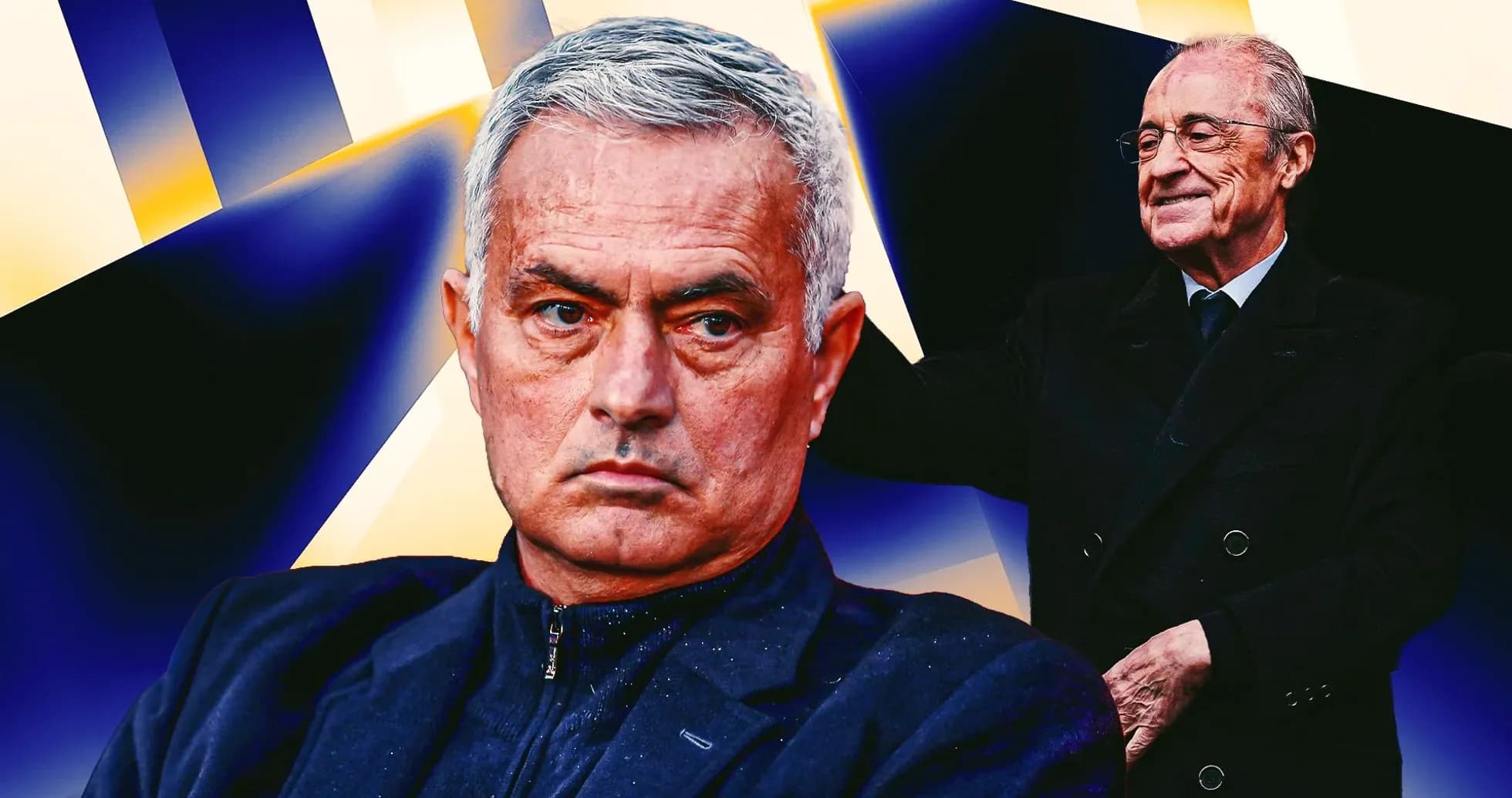
Mourinho's Return: A Step Back for Real Madrid?
Florentino Pérez is staring at a familiar scene and drawing familiar conclusions. Two seasons without a major trophy. Barcelona resurgent, driven by a brilliant, left‑footed genius. A restless Bernabéu demanding a response.
In Pérez’s mind, this is 2010 all over again. And when he looks for a solution, his gaze drifts back to the same name: José Mourinho.
The problem is that the Mourinho of 2024 is not the Mourinho of 2010. Not even close.
The myth of the Midas touch
Once, Mourinho walked into clubs and left with leagues and European Cups. Porto, Chelsea, Inter: everywhere he went, silverware followed and chaos felt like a price worth paying.
That aura has gone. The controversies remain, the trophies do not.
He has not won a league title for 11 years. His last piece of silverware came in the 2022 Europa Conference League, a competition that underlined how far he had drifted from the game’s sharpest edge. This is a two-time Champions League winner now operating a tier below the elite.
Pérez will argue that this is precisely why he needs him. Not for his tactical playbook, but for his personality. For the aura. For the ability to walk into a dressing room full of Kylian Mbappé, Vinícius Jr and assorted superstars and make them listen.
At Real Madrid, that has always mattered. Sergio Ramos put it bluntly once: “At Real, managing the dressing room is more important than the coach’s tactical knowledge.”
On that front, Mourinho still sells himself as the ultimate authority figure. The man who commands, confronts, provokes. The man who builds a bunker and dares the world to knock it down.
But Madrid’s recent history tells a very different story about what actually works at the Bernabéu.
A club that moved on without him
Look at the last two coaches to win the Champions League with Madrid: Carlo Ancelotti and Zinedine Zidane. Both were calming presences. Both understood the club’s egos and tensions, but chose to soothe rather than inflame.
Mourinho is their opposite. He is aggressive, confrontational, relentless. That intensity once energised Madrid; in the end, it tore them apart.
He likes to claim – unprompted and often – that he is one of the few coaches in the club’s history to leave on his own terms. Pérez has always backed that version of events. “Nobody’s been sacked, it’s a mutual agreement,” the president insisted in 2013. “We’ve decided to bring our relationship to an end.”
The reality was far uglier. Less than a year after signing a contract extension to 2016, Mourinho’s position had become untenable.
The turning point came in January 2013, when Pérez took the extraordinary step of calling a press conference to deny a MARCA story that senior players – including Iker Casillas and Ramos – had threatened to walk unless Mourinho was removed. The president pushed back, but the damage was already done.
By the time the coach’s departure was confirmed four months later, he had lost the dressing room. Completely.
When the siege turns inward
The same methods that had worked so brilliantly at Porto, Chelsea and Inter blew up in his face in Madrid.
Mourinho’s beloved “siege mentality” is designed to bind a squad together against a hostile outside world. For a while, it did. Then the hostility seeped inside the club’s own walls.
The climate of distrust and disrespect that he had carefully cultivated around Madrid eventually reached the players themselves. They stopped seeing the coach as their shield and started seeing him as part of the problem.
Casillas never publicly exploded, even after being relegated to the bench in 2012‑13. Others did. Pepe went on record criticising the way Mourinho treated the goalkeeper. The response from the coach was telling: he suggested Pepe was simply bitter because a teenage Raphaël Varane had taken his place.
Ramos, meanwhile, reportedly mocked Mourinho’s footballing ability behind the scenes. When Ancelotti arrived in June 2013, the defender delivered a razor‑sharp line: “You can tell he was a top player.”
Ramos also refused to indulge the narrative, pushed by both Mourinho and Pérez, that the Portuguese had laid the foundations for Madrid’s subsequent Champions League dominance. Mourinho has claimed that Pérez begged him to stay in 2013: “Don’t leave now. You’ve done the hard part and the good part is yet to come.”
Ramos wanted no part of that myth-making. Asked if Mourinho deserved any credit for the four Champions League titles between 2014 and 2018, he replied: “I don’t think he had anything to do with it. On the contrary, in fact…”
That might go too far. Mourinho did raise standards and he did help Madrid punch through a psychological barrier in Europe. But what transformed the club was the arrival of a unifying figure like Ancelotti, who calmed the storm rather than feeding it.
Which is why the idea of bringing Mourinho back now, of all times, feels like the exact opposite of what Madrid need.
A club in upheaval reaches for the past
This has already been a season of turmoil. Xabi Alonso arrived as the long-term project, the visionary entrusted with modernising Madrid’s football. Six months later he was gone, ruthlessly replaced by rookie coach Álvaro Arbeloa.
The message was clear: Pérez’s patience with projects is thin. His faith in strong personalities is undimmed.
Mbappé has already flirted with the idea of Mourinho, liking an Instagram post that pushed the Portuguese as Madrid’s next coach. That carries weight. Mbappé is the new face of the club, the star around whom everything will orbit.
But what plays well on social media does not necessarily play well in the dressing room.
Vinícius Jr, for one, has little reason to welcome Mourinho. Earlier this season, in a Champions League play-off between Madrid and Mourinho’s Benfica in Lisbon, racist abuse aimed at Vinícius forced the suspension of play. Mourinho’s comments afterwards effectively accused the Brazilian of provoking the situation, of inciting the shameful scenes.
Now imagine Mourinho walking into Valdebebas as his coach.
The doubts do not stop there. Reports in Spain suggest that not everyone on the Madrid board supports the idea of a Mourinho return. Yet Pérez still rules the Bernabéu. His conviction that this squad needs a leader more than a tactician has only been strengthened by the failed Alonso experiment.
So Mourinho remains at the top of his wish-list.
And that, more than anything, exposes where Madrid are right now.
Football has moved on. Has Pérez?
Watch Paris Saint-Germain against Bayern Munich at Parc des Princes. Look at the tempo, the positional fluidity, the aggressive pressing, the courage to build from the back under pressure. That is the modern Champions League.
It is not Mourinho’s football. Not anymore.
He can still organise a team. He can still suffocate a game. He can still turn a two-legged tie into a street fight. But the sport’s elite have pushed beyond that, tactically and physically. The best sides now blend structure with freedom, control with chaos, analytics with instinct.
Mourinho stands on the outside of that evolution, still selling the same product he was a decade ago.
Pérez, though, appears frozen in time, clinging to the idea that the answer to Madrid’s problems lies in reviving an old warlord rather than embracing a new era. Rehiring Mourinho in 2015 would have been a terrible gamble.
Doing it now would be worse.
Because this time, it would not just be a step back. It would be a confession that the most powerful club in world football has run out of ideas.