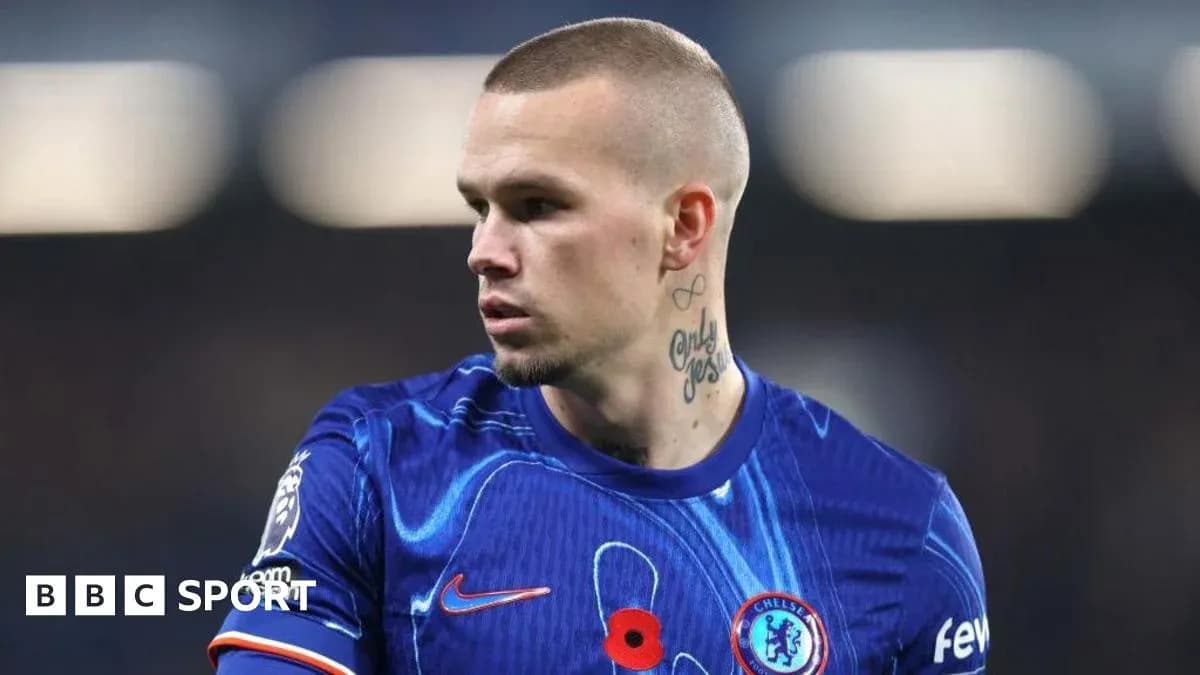
Mykhailo Mudryk Cleared to Return to Football After Doping Case
Mykhailo Mudryk’s long wait is over. After 20 months in limbo, the Chelsea winger has been cleared to return to competitive football “with immediate effect”, bringing one of the most opaque and complex doping cases in recent English football history to a sudden close.
From four-year exile to instant return
Mudryk, 25, had not kicked a ball in a competitive match since November 2024. An out-of-competition test while on international duty with Ukraine in October 2024 flagged an “adverse finding” for meldonium, a banned cardiovascular medication that can boost stamina and respiratory capacity.
The Football Association charged him in June 2025. In January this year, an independent commission handed down the harshest sanction available: a four-year suspension. If that ban had stood, he would not have been eligible to play again until around December 2028. For a player whose Chelsea career had barely begun, it looked like an ending.
Mudryk appealed to the Court of Arbitration for Sport. Behind closed doors, the case turned on science, timing and a shifting regulatory landscape.
On Friday, the FA confirmed that the anti-doping disciplinary process has now been resolved. Mudryk accepted that he broke anti-doping rules, but agreed a suspension equal to the time he has already spent out of the game. The appeal has been settled with the agreement of WADA, and the winger is free to play.
The FA also disclosed, for the first time, key details that help explain the dramatic reversal. The meldonium detected in his sample was present in “a low concentration”. Since that test was taken, WADA has updated its technical document on meldonium. Those changes do not apply retrospectively, yet the FA noted that if Mudryk’s sample were tested today, “the concentration of meldonium in the sample would not have been reported” and no adverse finding would have been recorded.
The rules did not change for him. The context did.
“The most difficult period” – and a second chance
Mudryk described the saga as “the most difficult period” of his career and said he was “grateful” to be able to return. He has consistently maintained that he never knowingly or intentionally took a banned substance, a stance he reiterated as the case closed.
Chelsea, who had stayed largely silent in public while the process unfolded, moved quickly to welcome him back. The club said it is looking forward to helping Mudryk “return to full fitness, back into the squad and back onto the pitch” and confirmed he will join their pre-season tour.
They stressed that they had “always supported Misha throughout this process while fully respecting the integrity of the anti-doping system and the legal process” and highlighted that, under current guidelines, “no anti-doping rule violation would have resulted” from his sample.
For a club that invested £61m to bring him from Shakhtar Donetsk in 2022 on a long-term contract running to 2031, this resolution carries obvious sporting and financial significance. His deal formed part of Chelsea’s much-discussed amortisation strategy, spreading the cost of major transfers over extended contracts. A four-year ban would have left a high-earning asset unable to contribute on the pitch during his prime years.
Instead, the story reopens.
Training in the shadows
While the legal machinery turned, Mudryk’s football life moved to the margins. Under the terms of his provisional suspension, he was barred from Chelsea’s training ground and could not work with club staff. The only public glimpse of him alongside first-team players came at Chelsea’s Conference League final celebrations in May 2025.
Everything else happened away from the cameras and far from Cobham.
Determined not to let his physical condition slide, Mudryk paid for private coaches and hired goalkeepers for individual sessions. He used a pitch at non-league Uxbridge FC in west London, working through finishing drills and attacking patterns that were later seen in clips from his training camp in Austria. The videos showed a player still quick, still sharp, still desperate to stay relevant.
Those around him, though, never pretended this was a substitute for elite competition. No private session can replicate the rhythm of training every day with top players, the intensity of being judged every weekend, or the tactical demands of Premier League football. Sources close to Mudryk describe an “extremely difficult period”, one in which the club offered support from a distance while respecting the strict boundaries of his suspension.
He survived it. Now he has to prove he can emerge stronger.
Chelsea’s dilemma – reintegrate, loan or sell?
Chelsea have made one thing clear: they will provide a pathway back into professional football. What that path looks like is far less certain.
Reintegration into the first-team squad is one option. A player with Mudryk’s raw pace and directness still fits the profile of what Chelsea thought they were buying in that high-profile 2023 transfer tussle. Pre-season offers a relatively low-risk environment to gauge his sharpness, confidence and tactical understanding after nearly two years without competitive action.
A loan move is firmly on the table. Strasbourg, part of the same ownership group, presents an obvious route if Chelsea want him to rebuild in a slightly less intense environment while remaining within their ecosystem. A spell elsewhere in one of Europe’s top leagues would test whether he can still bend games at speed and restore his market value.
A permanent transfer cannot be ruled out either. For all the support and carefully worded statements, Chelsea’s squad is crowded in attacking areas, and the club remains under pressure to balance the books. If a credible offer arrives and the player feels he needs a clean break, the club will have a decision to make.
For now, they have their winger back. That alone marks a significant shift from the bleak outlook of January.
A career back from the brink
Strip away the legal language, the technical documents and the amortisation talk, and the story is simple: a 25-year-old footballer has been dragged to the edge of his career and pulled back just in time.
Mudryk’s reputation will carry the imprint of this case for some time. Doping allegations do not vanish overnight, even when governing bodies acknowledge that, under today’s rules, his test would not have triggered a case at all. He has accepted a rule breach, served his punishment in full, and now steps into a landscape where perception may prove as tough an opponent as any Premier League full-back.
What he still has is time. Time on his contract. Time in his legs. Time to show whether the flashes of electricity that persuaded Chelsea to fight so hard for his signature in 2023 were a glimpse of something lasting rather than a brief surge.
His story at Stamford Bridge always felt unfinished. Now, with the ban lifted and the door reopened, the real question returns to the pitch: after everything that has happened, what kind of player will Mykhailo Mudryk be when the whistle blows again?