Newcastle United's Transition: From Howe to Jaissle
An era ended at Newcastle United without the usual fanfare, without a lap of honour or a choreographed farewell. It slipped away somewhere above the clouds on a flight back from Bristol.
Eddie Howe sat on that plane, watching back a 4-1 defeat in a pre-season friendly at Ashton Gate. A dead rubber to most, but not to the man who had ended Newcastle’s long wait for silverware. Even in the final hours of his reign, he was still rewinding, pausing, searching for answers.
By the next morning, the answer was public. A drained Howe had stepped down.
He had told the club’s hierarchy of his wish to leave a couple of weeks earlier, then agreed to stay until a successor was found. On the surface, continuity. Underneath, the tectonic plates were already shifting.
A new model, born from bruises
Newcastle’s last domestic campaign left scars. So did the previous summer’s transfer window. Financial missteps, Uefa sanctions, and the cold reality of a restrictive settlement forced a rethink.
The club has pivoted. Younger players, largely from the continent. A beefed-up data operation. A deliberate trading model, not just buying but planning to sell, all with one eye on the rulebook.
The pain has been immediate and raw.
- Sandro Tonali to Tottenham Hotspur.
- Anthony Gordon to Barcelona.
Both moves reluctantly accepted as the price of reinvestment. But the looming departure of captain Bruno Guimaraes to Arsenal cuts deeper. That was never part of the script.
Newcastle have also watched prime targets slip away. Spain winger Victor Munoz chose Liverpool. Switzerland midfielder Johan Manzambi went to Aston Villa. In a different financial climate, those might have been black-and-white signings.
Instead, the rebuild looks different. Five signings so far: goalkeepers Lukas Hornicek and Ewen Jaouen, midfielders Aladji Bamba and Sean Steur, and forward Bazoumana Toure. Intriguing pieces, not yet a complete picture.
Sporting director Ross Wilson is under no illusions.
“We have to build a model here that can compete, can win,” he said. “But also one that works for us and doesn't lead us to have to sell players we don't want to sell and lead to Uefa sanctions.”
The margin for error has shrunk. The stakes have not.
Enter Jaissle: intensity and a stopwatch
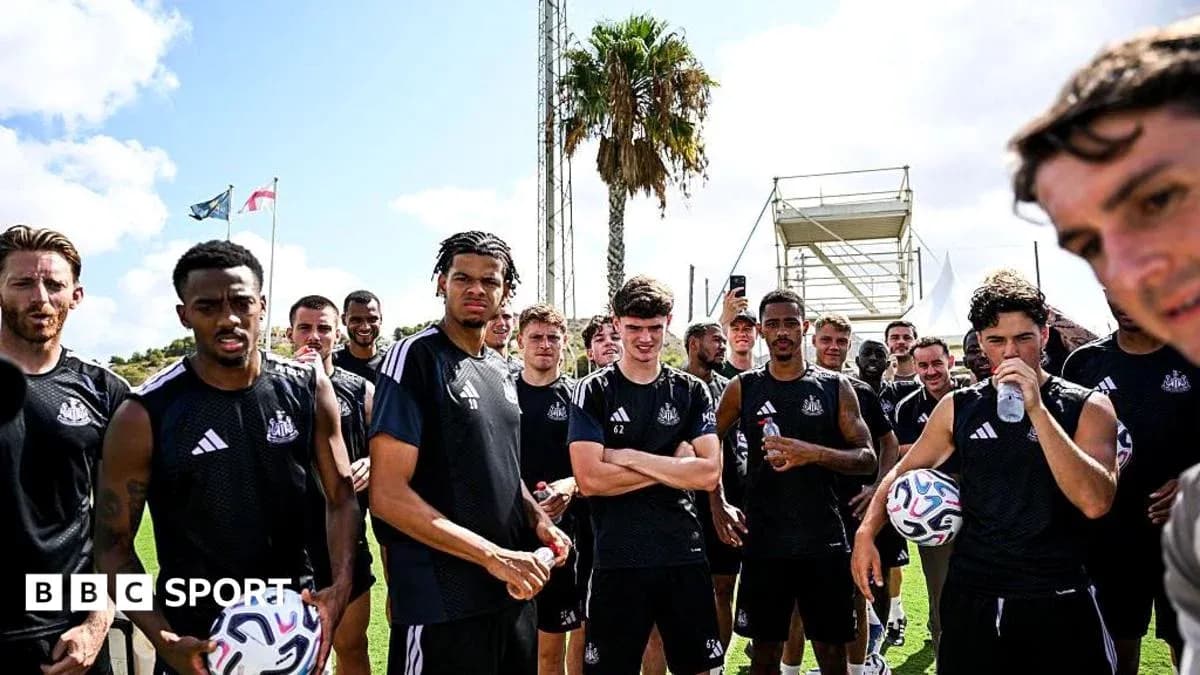
Into this landscape walks Matthias Jaissle, 38 years old, straight from Al-Ahli and dropped into Newcastle’s pre-season camp in Spain with the Premier League opener against Liverpool already racing towards him.
Performance director James Bunce called it “speed dating” because every moment counts. That description has proved accurate.
Training under a new manager always sharpens. Players run harder, tackle stronger, talk more. Under Jaissle, the dial has gone beyond that. Double sessions described as “off the charts”. Recovery runs repeated until legs turned to lead. Effort, for him, is non-negotiable.
He wants players to train the way they play. High tempo, front foot, no hiding.
There is method behind the ferocity. At Red Bull Salzburg, where he won back-to-back league titles and reached the Champions League last 16, his side led the Austrian league for high turnovers per game (9.8) and possession won in the final third (5.6). They hunted the ball and then hurt teams with it.
At Al-Ahli, the numbers stayed fierce. His team averaged 8.2 high turnovers a match and won 47.6 duels per game, yet he also adapted, layering a stronger defensive base as he guided them to successive Asian Champions League titles.
This is the balance Newcastle crave: vertical, aggressive football, anchored by clean sheets rather than chaos. No surprise Jaissle has already hammered home the importance of shutouts. One particular session left players drained from the sheer volume of recovery runs.
On Thursday, he eased off. Stopwatch around his neck, he took one look at the heavy legs and adjusted. That detail matters. He may rage across the training pitch, even physically moving his own coaches to show the intensity he demands, but there is calculation in the chaos.
In front of the cameras, he is calm, measured. On the grass, he is relentless.
Old club, new voices
Jaissle has not arrived alone. Assistants Alexander Hauser, Engin Yanova and Florens Koch have followed him, along with coach analysts Maximilian Fischer and Steffen Konrad, plus goalkeeping coach Alexander Bade.
Yet this is not a full reset. In his first address, Jaissle made it clear that those already at the club must “raise the standards” too. Continuity and disruption, side by side.
There are overlaps with Howe. The club saw them in the data and in the interviews; Jaissle saw them in his own research. High energy, proactive football, a belief in coaching young players up rather than buying ready-made stars.
But the shock to the system is real. The Liverpool game on 23 August is not creeping up on Newcastle; it is hurtling towards them. Andoni Iraola has had longer with his squad at Anfield. On Tyneside, the staff are working into the early hours, poring over analysis, trying to compress a pre-season’s worth of preparation into days.
Saturday’s friendly against Valencia at the Mestalla is not just another warm-up. It is the first glimpse of what Jaissle’s Newcastle might look like when the whistle blows for real.
Hornicek and the hard edge
Some players are barely through the door. Lukas Hornicek, the new Czech Republic goalkeeper, arrived less than a week ago after his £25.7m move from Braga. Already, he is being drilled on the physical reality of Premier League set-plays.
Crowded six-yard boxes. Towering centre-backs crashing in. Contact, everywhere.
Is he ready?
“For sure,” Hornicek said.
He will need to be. So will the rest of this young, reshaped squad.
Newcastle are trying to build a team that can outrun, outfight and outthink opponents while staying on the right side of Uefa’s rulebook. The era of easy money and indulgent mistakes is over. The margin now is in coaching, in development, in getting the next decision right.
The Howe years ended quietly, on a plane with a laptop and a 4-1 defeat. The Jaissle years begin with double sessions, heavy legs and a stopwatch ticking down to Liverpool.
What kind of Newcastle emerges from that countdown will define far more than just an opening day.