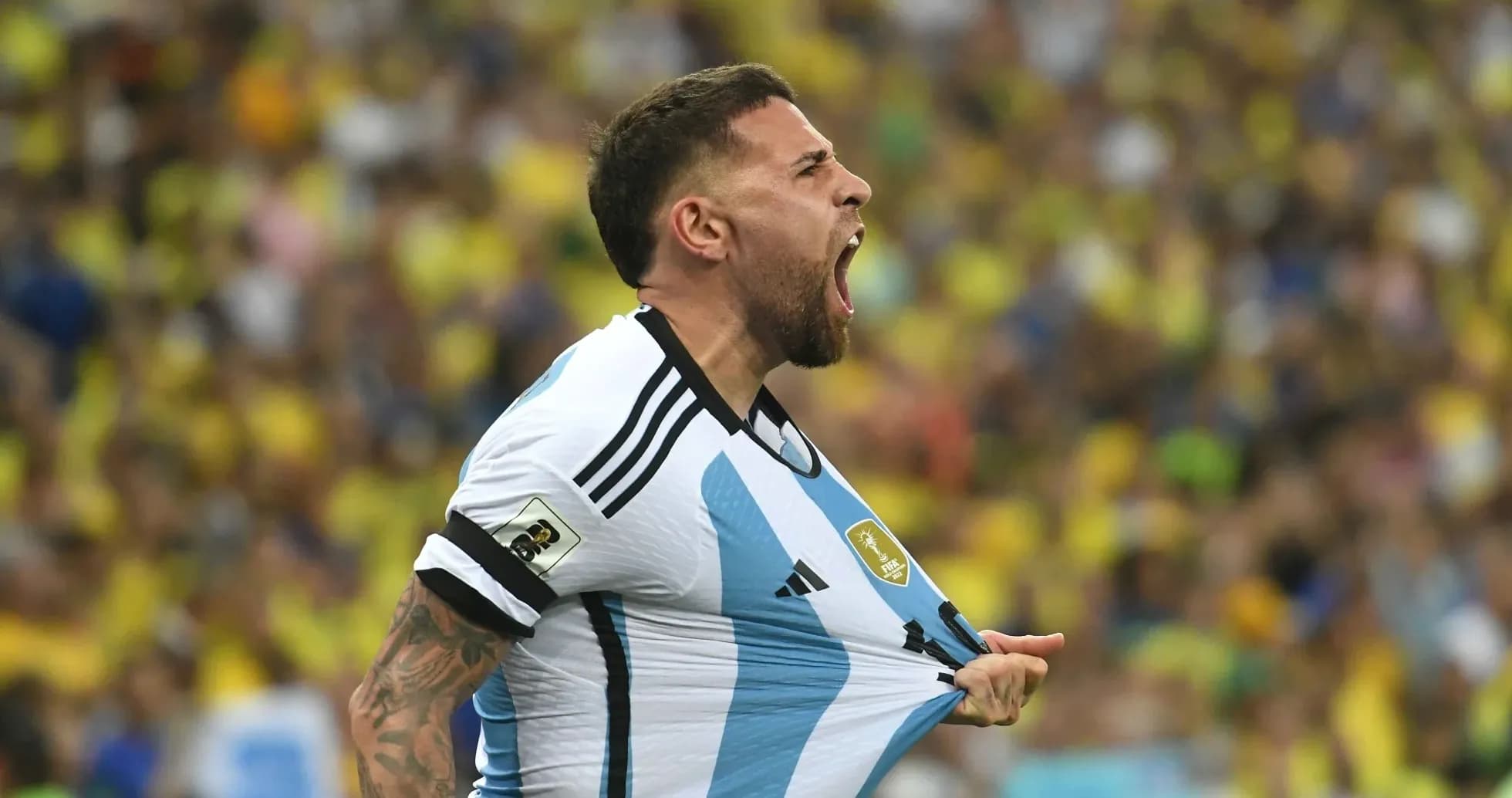
Nicolás Otamendi Announces Retirement from Argentina National Team
Nicolás Otamendi has never been one for half-measures. Not in a tackle, not in an aerial duel, and certainly not in his goodbye.
On Wednesday, the 38-year-old defender announced that the 2026 World Cup final would be his last act in an Argentina shirt, closing a chapter that began in 2008 and helped shape one of the most competitive eras in Albiceleste history.
He chose Instagram, not a press conference, to deliver what he called “the most difficult words I’ve ever had to” write. The message read like a letter to a country that had watched him grow from a rugged kid at Vélez Sarsfield to a world champion and vice-captain.
“Wearing the Argentina shirt was a childhood dream and the greatest privilege I had in football,” Otamendi wrote. “I defended it with all my heart, with pride, and with a sense of responsibility, knowing what it means to millions of Argentines.”
A farewell marked by regret and peace
The ending was not the one he wanted. Argentina’s defeat in the 2026 World Cup final clearly stung, and he did not hide from it. He admitted his regret over the loss, yet insisted he walks away “with the peace of mind that comes from giving it all.”
That line sums up Otamendi. No frills, no excuses. Just the certainty that every duel was contested, every inch fought for.
He thanked the fans who whistled and worshipped in equal measure over the years, and his family, who rode out the turbulence of international football alongside him. Then he turned his message toward those who will follow.
He urged the next generation of Albiceleste players to “never stop believing,” a phrase that could have been lifted from any of his performances in the shirt: flawed at times, but never short on conviction.
“Thank you, Argentina,” he concluded. “Thank you for letting me fulfill my dream of becoming a world champion and wearing the most beautiful jersey in the world.”
An outpouring from the dressing room
The reaction was instant. His post filled with messages from former teammates, each one a snapshot of what Otamendi meant inside the dressing room.
Alexis Mac Allister called him “an exemplar of fight, resilience and love for the shirt,” a neat summary of a defender who never pretended to be anything other than a warrior. Germán Pezzella described him as “a guide for us all,” underlining his role as a reference point for Argentina’s defensive line.
Paulo Dybala, Marcos Senesi, Mariano Andujar and Gianluca Prestianni added their own words of thanks, a chorus of appreciation from three different generations of Albiceleste footballers.
One message stood apart. Rodrigo De Paul, another emotional heartbeat of this Argentina cycle, dedicated an Instagram story to the vice-captain.
“From the day I got to the national team, you opened the door to your room, and since then we’ve held the same rituals,” he wrote. “My thanks to you, my brother, are eternal. You were an example to follow and one of the leaders of the beautiful story this team built. Thanks for everything, I’ll miss you.”
It was a glimpse into the private rituals behind the public trophies, and into the leadership Otamendi brought when the cameras were off.
From cornerstone to elder statesman
The news hit hard, but it did not shock anyone around the national team. Time had already started to move him from the front line to the background.
In Qatar 2022, Lionel Scaloni leaned heavily on Otamendi as a trusted starter, pairing him with Cristian “Cuti” Romero at the heart of a world champion defence. Four years later, his role shifted. Lisandro Martínez stepped in as Romero’s main partner, and Otamendi became the experienced backup, the voice on the bench and in training rather than the first name on the teamsheet.
For a player who built his reputation on competing for everything, accepting that transition might have been one of his hardest battles. He handled it in silence, with the same seriousness that defined his prime.
The making of a defensive symbol
Otamendi’s path to this point began in 2008, when he emerged at Vélez Sarsfield as a no-nonsense centre-back in the Argentine Primera División. From there, he moved through Europe, including spells at clubs such as Manchester City and Benfica, taking his brand of defending to some of the game’s most demanding stages.
He never fit the modern stereotype of the elegant ball-playing defender. Instead, he imposed himself with rugged, uncompromising, abrasive defending. He relished contact. He sought out the duel.
What set him apart, though, was how he turned perceived limitations into weapons. At 1.83m, he is a big presence by Argentine standards but often undersized in the international arena. It rarely mattered. His timing, aggression and sheer will made him a force in the air.
One image captured that better than any statistic: Otamendi rising above 1.98m Harry Souttar in the round of 16 against Australia at the 2022 World Cup. A smaller man, on paper, towering in the only place that counts. That snapshot became a symbol of his career – defying the matchup, winning the fight.
A place among Argentina’s greats
Otamendi leaves the national team with something that cannot be measured only in caps or medals. He leaves a template.
- Determination.
- Fierceness.
- Relentless competitiveness.
These are the traits he carried into every camp, every qualifier in Bolivia, every friendly in Asia, every knockout night on the biggest stage.
Those who come next will be measured, consciously or not, against the standard he helped set. When Argentina debates its greatest defenders, the conversation will still start with names like Daniel Passarella, Oscar Ruggeri and Roberto Ayala.
Now, it has to include Nicolás Otamendi.
The shirt will move on. The line will be reshaped. But for a long time, whenever an Argentine centre-back throws himself into an aerial duel against a taller forward and comes out on top, the echo of Otamendi’s legacy will be hard to miss.