Norway vs Brazil: World Cup Quarter-Final Clash
Norway stand on the brink of something they have never done before. One game, one giant in their way, and a World Cup quarter-final dangling just out of reach.
Brazil await under the lights at New York/New Jersey Stadium, the Selecao rolling in as group winners, Norway arriving as the awkward, uninvited guest nobody really fancied seeing in the last-16. Both had to sweat to get here, both left it late in the round of 32 — Brazil squeezing past Ivory Coast, Norway edging Japan. Now there is no margin for delay.
The prize is clear: a quarter-final against either co-hosts Mexico or England. The route is brutal, the opportunity enormous.
A goalkeeper without a club, with everything to play for
At the back of it all stands Orjan Nyland, Norway’s No1 and, curiously, a free agent. Recently released by Sevilla at the end of his contract, he walks into this World Cup knockout tie without a club but with a heavy responsibility.
Nyland, once of Aston Villa, Norwich, Bournemouth and Reading, has seen enough of English football’s grind to know what pressure feels like. This, though, is different. Brazil, knockout football, no safety net. Every cross, every parry, every decision will be a pitch-side audition for his next move and a nation’s hopes rolled into one pair of gloves.
A patched-up defence with Premier League steel
Norway’s back line arrives bruised but defiant.
Marcus Holmgren Pedersen started this tournament as the understudy at right-back. An injury higher up the pecking order changed that in a heartbeat. He has responded with aggression and ambition, even chipping in with a crucial goal in the 3-2 thriller against Senegal. Against Brazil, his flank will be a battlefield, not a touchline.
Alongside him, Kristoffer Ajer brings Premier League muscle. The Brentford centre-half is tall, composed, and will likely find himself locked in a personal duel with his club team-mate Igor Thiago. Friendships pause when the whistle goes; Ajer’s job is simple: win his box, or the night unravels.
The big question mark hangs over Julian Ryerson. The Borussia Dortmund full-back has missed Norway’s last two games and is the major injury doubt. When fit, he is the prototype modern full-back — relentless engine, sharp in the tackle, keen to surge forward — and his form has attracted interest from Liverpool. If he makes it, Norway gain thrust and balance. If he doesn’t, they lose one of their most complete players.
Torbjorn Heggem offers valuable flexibility across the back line. Now at Bologna after a stint with West Brom, he can plug gaps, shift positions mid-game, and quietly hold the structure together while others chase glory.
On the left, David Moller Wolfe has parked the pain of relegation with Wolves and turned up in national colours with purpose. The drop at club level has not dragged him down; if anything, it has sharpened him. His duel with Brazil’s wide men will be unforgiving, but his form in helping Norway reach the last-16 suggests he will not shy away.
Odegaard, the conductor on the biggest stage
In midfield, everything bends towards one man.
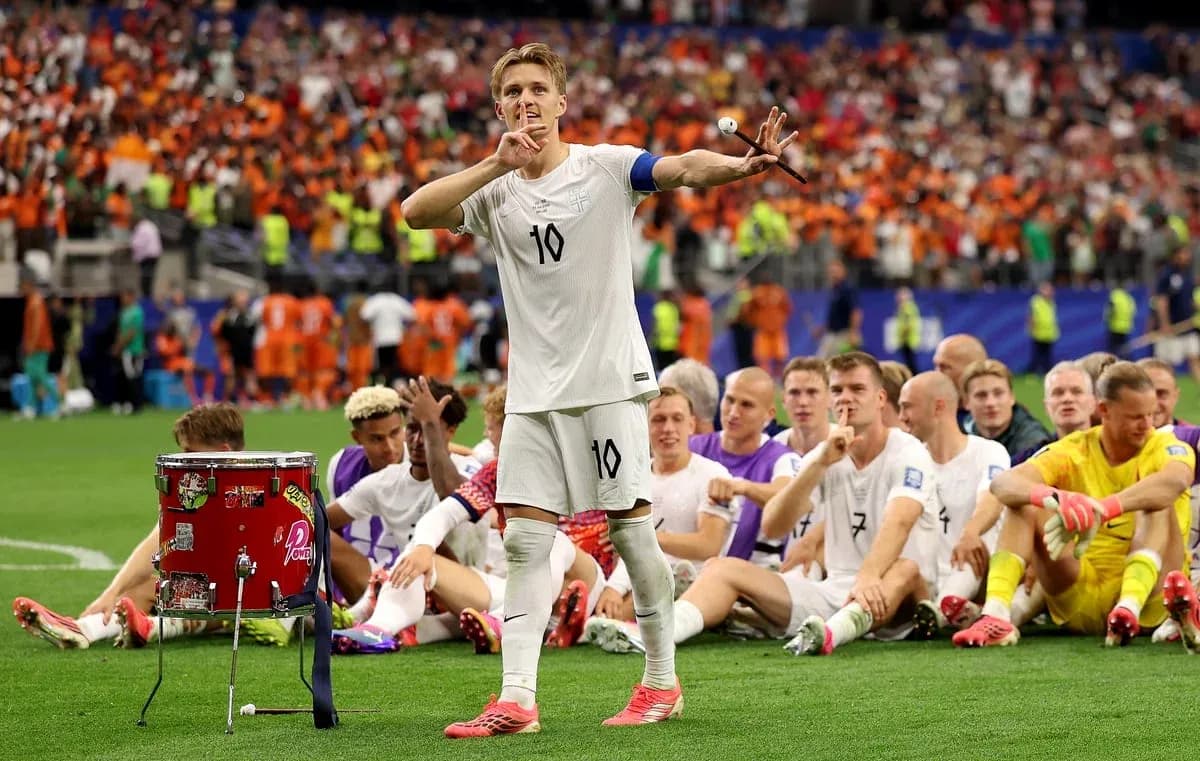
Martin Odegaard, Arsenal’s Premier League title-winning captain, walks into this tie as Norway’s creative heartbeat. His club season was disrupted by injury, but in North America he has looked utterly at ease, dictating tempo, finding pockets of space, and dragging his side up the pitch with that familiar glide and vision.
The numbers tell their own story: an assist in each of his three appearances at this World Cup. Different games, same outcome — Odegaard finds a way to unlock something. Against Brazil’s athletic, technically gifted midfield, he will need to be sharper still, threading passes through the smallest gaps, buying time where none seems to exist.
Next to him, Sander Berge brings the brawn and the stride. Norway’s midfield powerhouse will be asked to cover ground, snap into duels, and give Odegaard the platform to play. His task is brutal: try to impose himself on one of the most talent-rich midfields on the planet. If he loses that battle, Norway will spend the night chasing shadows.
Patrick Berg, a central figure in the Bodo/Glimt side that has rattled Europe over the past two seasons, adds intelligence and control. He knows how to handle games that tilt wildly, how to recycle possession when the pace becomes frantic, how to calm a team that suddenly finds itself under siege. Those European nights have hardened him; this is the next step up.
Firepower: from redemption stories to a global superstar
Up front, Norway carry a blend of redemption arcs and raw, frightening talent.
Alexander Sorloth is no longer the misfit who struggled at Crystal Palace. He rebuilt himself at Trabzonspor, then at Villarreal, and now at Atletico Madrid, where his scoring rate sits just shy of a goal every other game. He can operate through the middle or peel off to the right, offering flexibility and a constant aerial threat. His presence gives Norway a second punch if defences pour everything into stopping the obvious headline act.
That headline act, of course, is Erling Haaland.
Manchester City’s record-breaking No9 arrives with the weight of expectation that comes with being widely regarded as the world’s most devastating striker — even if Harry Kane might contest that crown. Haaland needs little introduction and even less space. One cross, one loose ball, one moment of chaos in the box, and he can turn a tight, tactical contest into a scoreline that lives forever.
If Brazil leave him unattended, they flirt with disaster. If they double up, they open lanes for others. Haaland changes not just games, but entire defensive gameplans.
Around them, the next wave waits its turn.
Antonio Nusa, now at RB Leipzig, carries the tag of “one of Europe’s more exciting young talents” and has done little to dampen the hype. A failed medical stopped him joining Brentford in 2024, Tottenham have watched closely, and his ability to run at defenders, twist away from challenges and create something out of nothing gives Norway a different kind of edge. If this tie opens up, Nusa’s directness could be lethal.
Oscar Bobb, another graduate of Manchester City’s production line, chose a January move to Fulham in search of regular football. He is an exciting winger when the mood takes him, slippery in one-on-one situations, capable of injecting pace into a game that has gone flat. This tournament offers him the “proper look” he has been waiting for; Brazil is as big a stage as any.
Behind Haaland, Jorgen Strand Larsen waits, patient but dangerous. His role as understudy to Norway’s superstar means minutes are limited, yet six goals in 29 games underline that he is no mere training-ground extra. If called upon, he brings honest running, smart movement and a nose for goal.
And then there is the late January mover from Wolves to Crystal Palace, now established as one of the better strikers in the Premier League. His presence in this squad adds another layer of top-flight experience to a forward unit already bristling with options, another reminder that Norway’s attacking depth is no longer a soft spot.
A nation on the edge of history
Norway have waited nearly 30 years to return to this stage. They slipped back into the World Cup with modest fanfare, took runners-up spot in Group I behind France, and quietly pushed their way into the last-16.
Now they stand in front of Brazil, under the glare of knockout football, with the chance to rewrite their own history. The names are ready: Nyland’s gloves, Odegaard’s vision, Haaland’s ruthlessness.
If this generation are ever going to crash the world’s top table, this is the kind of night they have to own.