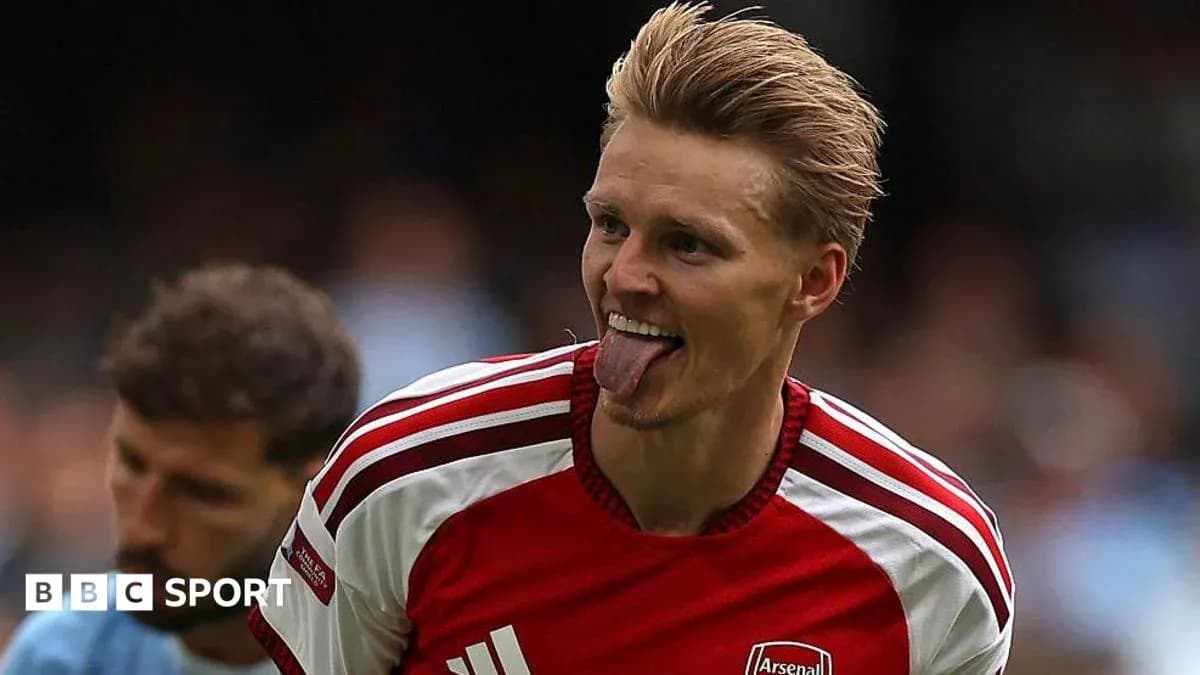
Martin Odegaard Shines in Community Shield Victory
Martin Odegaard walked off in Cardiff with the Community Shield trophy in one hand and the man-of-the-match award in the other, but what really lingered was the feeling that Arsenal’s conductor is back in full voice.
This 3-0 dismantling of Manchester City was about more than a curtain-raiser. It was about a player who spent most of last season watching, hurting, and wondering when his body would let him be himself again.
Odegaard back at the heart of it
Arsenal may have ended their 22-year wait for a Premier League title last season, but their captain lived it more as a survivor than a star. Knee and shoulder problems stalked him for months. He started only 16 league games. One goal. Seven assists. His leanest return since joining permanently from Real Madrid in 2021-22.
For a player of his influence, those numbers jarred. So did the sight of him on the sidelines while others drove the title charge. Even his captaincy became a talking point for former players.
On Sunday, those debates faded fast.
Odegaard didn’t just knit Arsenal together; he set the tempo, tightened the screw, and then, late on, delivered the moment that will live in the highlights. A feint, a flash, a finish. His dummy sent Gianluigi Donnarumma sprawling, the City goalkeeper left on the turf as the Norwegian rolled in Arsenal’s third. It was the kind of cold-blooded composure that had been missing from his game last year, not because he had forgotten it, but because his body wouldn’t let him show it.
He was everywhere. Of all the Arsenal players on the pitch, he completed the most passes (55 out of 58), the most dribbles (3 out of 3), and won possession more than anyone else in red and white, doing so nine times. Not just pretty touches between the lines, but graft, pressing, and control.
Sometimes a friendly feels like a friendly. This didn’t.
A midfield built to dominate
Mikel Arteta has not stood still since lifting that long-awaited league title. He has gone straight for more control, more bite, more variety in midfield. £75m signing Bruno Guimaraes has arrived to add steel and swagger, and even in just 45 minutes here he looked at home in the Arsenal engine room.
Mikel Merino, one of the many jostling for minutes in that area, has already called Arsenal’s midfield options “probably the best in football”. On this evidence, it is hard to push back.
Look at the list. Odegaard. Guimaraes. Myles Lewis-Skelly. Martin Zubimendi. Declan Rice. Eberechi Eze. Merino. Different profiles, same message: Arsenal want to suffocate games through the middle.
In that crowded room, the captain could have felt threatened. Instead, he looks energised. The competition seems to have sharpened him, not shrunk him.
Odegaard and Guimaraes clicked quickly in their first start together, rotating positions, pulling City’s midfield out of shape, and giving Arsenal a platform to attack with freedom. It felt natural, almost too natural for a first outing.
“Sometimes you are just in the flow. You need to find that on the pitch,” Odegaard said afterwards. “All of us were flowing pretty good out there. I will just try to keep that up and keep going.”
The flow is back. So is his authority.
From frustration to fuel
Last season’s struggle still sits close to the surface for him. He described it as “really a big struggle with a lot of difficult moments”, the kind of year that can gnaw away at a player of his calibre. Missing “so many games because of injury” was, in his words, “really frustrating”. Weird injuries. Bad luck. Stop-start rhythm.
But the end of that campaign changed the tone. Fit again, he helped Arsenal over the line to the title, then carried that form into a standout World Cup with Norway, starting five of their six matches and producing four assists.
“It was good for me to end the season with a title, here, and then a good World Cup. Then I had my break and I feel good, ready to go again,” he said. “What I have just worked on is to use that as motivation for this year and to come back stronger. And to use all of those experiences in a positive way.”
You can see that in the way he moves now. No hesitation in the challenges. No half-hearted sprints. Just a player who looks like he trusts his body again.
Arteta has sensed it too.
“Well, he missed five or six months for different things and it was extremely difficult for him to get any momentum,” the Arsenal manager said. “So I'm sure this year if we can maintain him fit, available with the players around him, we're going to see a very different Martin.
“And I sense from the first day that he joined [pre-season training] that he has something else on the belly that he wants to prove and show, because the team needs it as well.”
That edge, that need to prove something, changes the picture. Arsenal have added a £75m midfielder, bolstered their depth, and still, their biggest potential upgrade might be the man already wearing the armband.
Like a new signing?
The old cliché about an injured star returning “like a new signing” is usually overused. In Odegaard’s case, it feels uncomfortably accurate.
He was central when Arteta first began reshaping this Arsenal side, the elegant No 8 who connected defence to attack and set the standard off the ball. Last season, others had to fill that void. Now, with his fitness restored and his confidence sharpened by a strong finish to the campaign and a standout World Cup, he looks ready to reclaim that role.
The numbers from Cardiff tell one story. The eye test tells another. He demanded the ball, dictated where it went, and finished the game with the swagger of a player who knows this could be his season.
Arsenal already know how to win without a fully firing Odegaard. The more pressing question for the rest of the league is this: what happens if they now have him at his peak, driving what Merino calls “probably the best” midfield in the game?