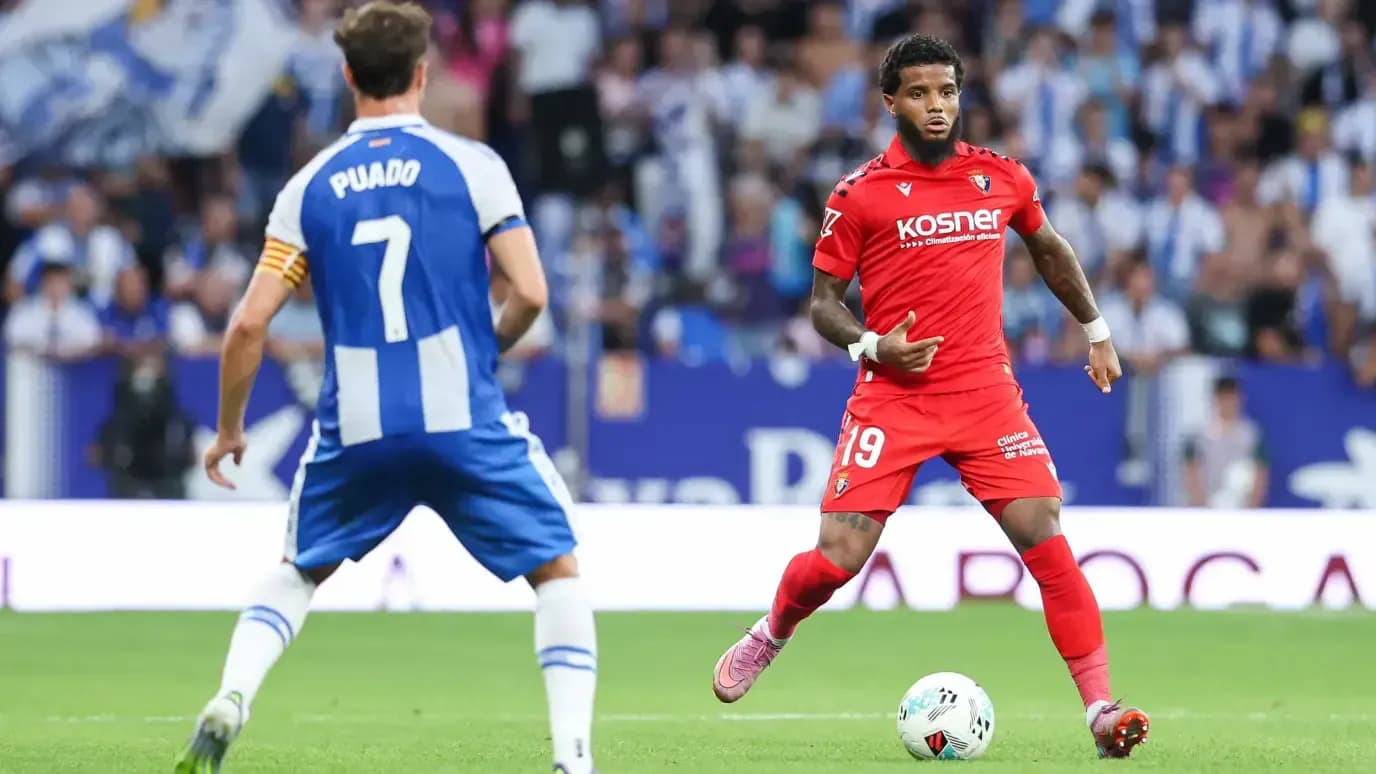
Osasuna vs Espanyol: Match Analysis and Tactical Insights
Osasuna 1–2 Espanyol at Estadio El Sadar leaves both sides locked on 42 points with one round to play, but the visitors climb above their hosts on head-to-head and goal difference in the congested mid-table pack, nudging Osasuna a little closer to the fringes of the relegation scrap while giving Espanyol breathing space above them.
Espanyol imposed themselves early in the duels and set the tone with the first card on 11 minutes, when Pol Lozano was booked for a foul in midfield, a sign of the visitors’ willingness to disrupt Osasuna’s rhythm. That physical edge paid off on 27 minutes: Carlos Romero surged forward from left-back and finished a move with an unassisted strike, his solo effort putting Espanyol 1–0 up and silencing El Sadar.
Osasuna responded after the interval with more direct pressure and were rewarded in the 49th minute. From a set-phase in Espanyol’s box, Enzo Boyomo stayed alive to the second ball and squared for Victor Muñoz, who swept home from close range to make it 1–1, the midfielder’s goal created by Boyomo’s awareness. The parity lasted only four minutes. In the 53rd minute, Espanyol broke quickly down the right, Tyrhys Dolan driving into space before cutting the ball across for Kike García, who finished clinically from inside the area to restore the visitors’ lead at 2–1.
With the game tilting away from them, Espanyol made the first change on 55 minutes as Charles Pickel replaced the booked Pol Lozano to add more defensive presence in midfield. Osasuna then launched a triple substitution in the 58th minute to chase the game: Raúl García came on for Aimar Oroz, Moi Gómez replaced Jon Moncayola, and Iker Muñoz came on for Lucas Torró, injecting fresh legs and more attacking profiles between the lines.
Espanyol adjusted their structure on 64 minutes with a double switch: Fernando Calero replaced Edu Expósito, sacrificing a forward for an extra defender, while Roberto Fernández Jaén came on for Kike García, maintaining a central outlet in attack. Osasuna answered in the 67th minute by refreshing the left flank, Javi Galán replacing Abel Bretones to offer more thrust from full-back.
As the hosts pushed higher, Espanyol sought fresh energy on the wings in the 76th minute: Antoniu Roca replaced Tyrhys Dolan, and Rubén Sánchez came on for Pere Milla, reinforcing the wide defensive work and counter-attacking threat. Osasuna used their final change in the 78th minute, Kike Barja replacing Valentin Rosier to turn the right side into a more attacking channel.
The tension rose in the closing stages. On 83 minutes, Iker Muñoz, one of Osasuna’s earlier substitutes, was booked as he tried to stop a transition, underlining the home side’s urgency and risk-taking. In the 90th minute Antoniu Roca collected a yellow card for tripping, a cynical intervention to break up play as Espanyol protected their narrow advantage. Despite late pressure, Espanyol’s compact block and game management saw them through to a 2–1 win.
Fixture Statistics & Tactical Audit
- xG (Expected Goals): Osasuna 1.61 vs Espanyol 0.79
- Possession: Osasuna 68% vs Espanyol 32%
- Shots on Target: Osasuna 9 vs Espanyol 3
- Goalkeeper Saves: Osasuna 1 vs Espanyol 6
- Blocked Shots: Osasuna 10 vs Espanyol 2
Osasuna dominated territory and volume, controlling the ball and building sustained pressure (68% possession, 24 total shots, 1.61 xG), but their finishing and shot quality did not fully match their territorial dominance, with many efforts blocked or from crowded areas (10 blocked shots). Espanyol were far more selective yet efficient, turning just 7 shots and 0.79 xG into two goals, reflecting sharp execution in transition and in their few high-quality moments. Marko Dmitrović’s workload underlined that pattern: his six saves mirrored Osasuna’s 9 shots on target minus the one goal conceded, while Sergio Herrera faced only three shots on target and was beaten twice. On the balance of xG, a draw would have been a fairer reflection, but Espanyol’s superior ruthlessness in the box and disciplined low block made their 2–1 win a classic example of clinical counter-attacking (0.79 xG, 2 goals; 32% possession).
Standings Update & Seasonal Impact
Osasuna began the day on 42 points with a goal difference of -4, having scored 43 and conceded 47. The 1–2 defeat adds one goal for and two against, moving them to 44 goals scored and 49 conceded, a new goal difference of -5, while their points total remains 42. With 37 matches now played, they stay in the lower mid-table cluster and, although not mathematically plunged into the relegation fight, they edge closer to the pack below and will likely need something on the final day to avoid a nervy finish.
Espanyol also started on 42 points, with 40 goals for and 53 against (goal difference -13). Their two goals in Pamplona take them to 42 scored, while conceding once moves their goals against to 54, improving their goal difference slightly to -12. The three points lift them to 45, giving them a modest cushion over Osasuna and the teams beneath them. That gap to the relegation zone widens just enough that, going into the final round, Espanyol can look upwards towards securing a safer mid-table slot rather than glancing anxiously over their shoulders.
Lineups & Personnel
Osasuna Actual XI
- GK: Sergio Herrera
- DF: Abel Bretones, Enzo Boyomo, Alejandro Catena, Valentin Rosier
- MF: Lucas Torró, Jon Moncayola, Rubén García, Aimar Oroz, Victor Muñoz
- FW: Ante Budimir
Espanyol Actual XI
- GK: Marko Dmitrović
- DF: Carlos Romero, Leandro Cabrera, Clemens Riedel, Omar El Hilali
- MF: Pere Milla, Pol Lozano, Urko González, Tyrhys Dolan
- FW: Edu Expósito, Kike García
Expert's Post-Match Verdict
Alessio Lisci’s Osasuna controlled the structure of the game with their 4-2-3-1, using the double pivot to recycle possession and pin Espanyol deep (68% possession, 515 passes at 86% accuracy), but they lacked penetration between the lines and the final incisive pass, leading to a high volume of low-yield shots (24 attempts, 1.61 xG, 10 blocked). The introduction of Raúl García, Moi Gómez and Iker Muñoz did increase central occupation and pressure, yet the attacking patterns remained predictable, funnelling too many efforts into crowded central zones where Espanyol could block and clear.
Manolo Gonzalez set Espanyol up in a compact 4-4-2 that morphed into a 4-5-1 without the ball, prioritising verticality and quick transitions. Their plan hinged on maximising the few moments they had in advanced areas, which they executed with notable efficiency (7 shots, 0.79 xG, 2 goals). Early aggression, evidenced by Pol Lozano’s booking, and later defensive substitutions such as Fernando Calero and Charles Pickel helped lock down the central corridor, while the wide changes of Antoniu Roca and Rubén Sánchez preserved energy for late defensive work. It was not a dominant performance in terms of control, but it was a textbook away display: disciplined deep defending, a goalkeeper delivering six crucial saves, and forwards converting limited chances into a decisive result.