PAOK's Tactical Struggle Against Anderlecht in UEFA Europa League
PAOK’s 4-2-3-1 at Toumba Stadium was built to dominate territory and rhythm, and the numbers confirm it: 65% possession, 5 corner kicks to 1, and a 14-shot profile (3 on goal, 11 off target, plus 3 blocked) against an Anderlecht side that accepted a deep, reactive 4-3-3. Yet the single most important tactical event came in the first minute, when M. Cvetkovic, starting nominally on the left of the front three, struck with Anderlecht’s first attack after combining with E. Llansana. From that moment, the visitors were able to structure the game entirely around protecting a 0-1 lead.
Out of possession, PAOK’s 4-2-3-1 behaved more like a 4-4-1-1. With J. Pavlenka behind a back four of J. Kenny, P. Hatzidiakos, G. Michailidis and Jogo, the hosts pushed both full-backs high to pin Anderlecht’s wingers and full-backs. B. Santamaria and C. Zafeiris formed a double pivot tasked with both recycling possession and providing rest defence against transitions from D. Sikan and Cvetkovic. Ahead of them, G. Konstantelias operated between the lines, with A. Zivkovic and Taison as inverted wide playmakers and A. Mythou as the lone striker.
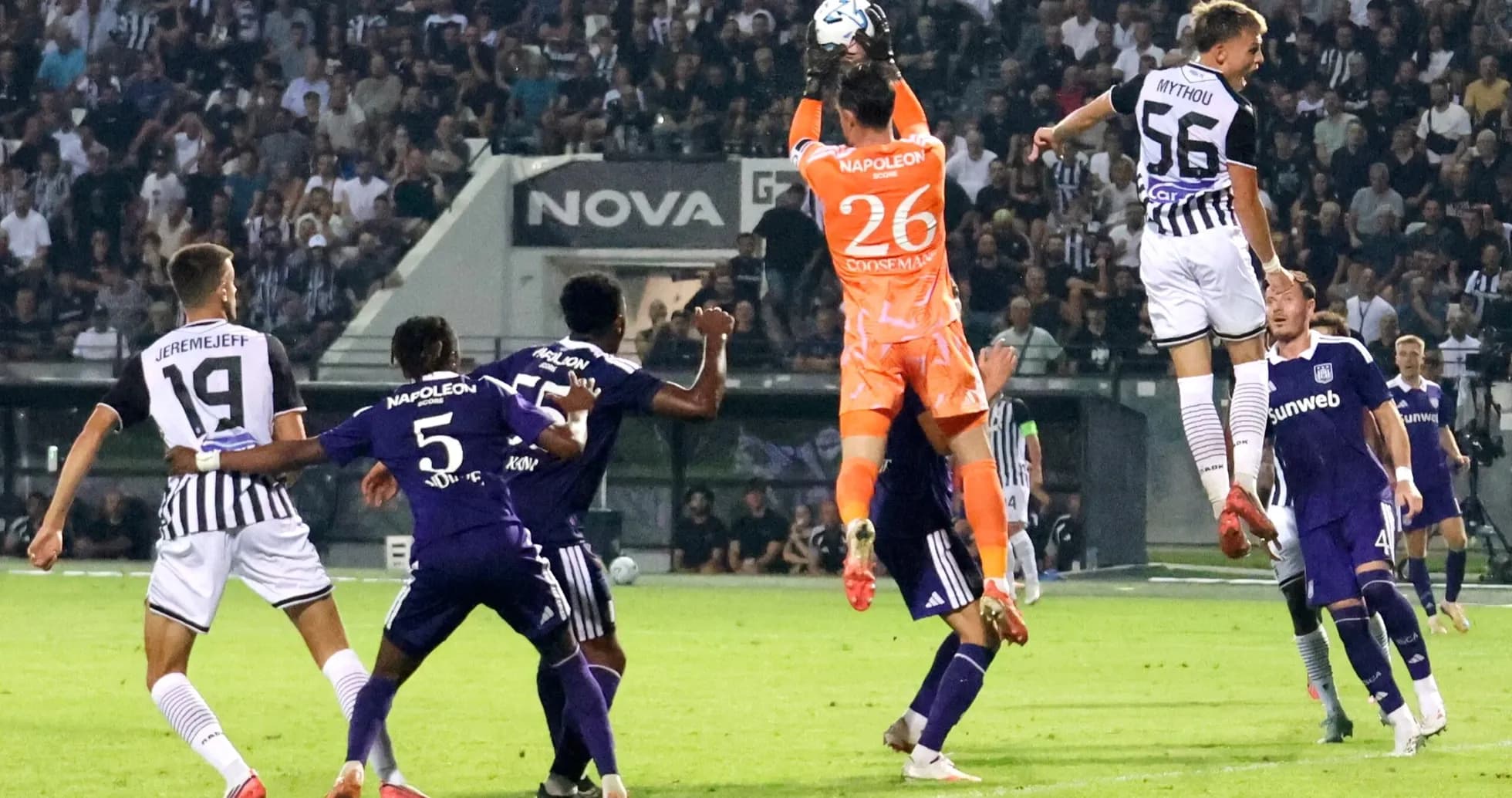
The structure gave PAOK control but not incision. The shot map implied by the stats is telling: 3 shots on goal from 17 efforts (including the 3 blocked) reflects a side able to reach shooting zones but often from suboptimal positions or under pressure. Anderlecht’s compact 4-3-3 block, with M. N’Diaye and G. Biancone narrow alongside L. Petrot, constantly collapsed on Mythou’s feet and forced PAOK’s attackers to shoot early or from range. The 23 fouls committed by Anderlecht underline how willing they were to disrupt rhythm, especially once the early lead was secured.
The turning point for PAOK’s defensive structure came at 46', when P. Hatzidiakos, already booked at 38', was replaced by A. Elustondo. The substitution was primarily about managing risk around the yellow card but also subtly shifted PAOK’s build-up. Elustondo, more comfortable carrying out of the back, allowed the hosts to push the defensive line slightly higher, compressing Anderlecht into their own third for long phases of the second half. However, with Anderlecht content to defend in a low to mid block, PAOK’s territorial dominance did not translate into clear-cut chances.
Substitutions and Tactical Adjustments
Alessio Lisci’s subsequent changes were aimed at increasing width and crossing volume. At 63', Jogo (left-back) made way for A. Baba, a more aggressive overlapping profile, while B. Santamaria was replaced by G. Taylor, effectively reshaping the left side to be more vertical. This was followed at 71' by A. Jeremejeff (IN) for Taison (OUT), turning the front line into more of a two-reference attack: Mythou and Jeremejeff provided dual targets for crosses and second balls, with Konstantelias dropping deeper to knit play. The final attacking substitution, at 83', saw D. Pelkas (IN) for Mythou (OUT), adding a more mobile, combination-oriented presence between lines as PAOK chased an equaliser.
Anderlecht’s response from the bench was entirely protective of their 0-1 advantage. At 57', O. Antman (IN) replaced J. Onia Seke, refreshing the right side’s defensive work rate. At 71', N. Saliba (IN) came on for L. Ambros in midfield, adding fresh legs in the central block, while T. Degreef (IN) replaced goalscorer M. Cvetkovic, reinforcing the defensive contribution on the flank. Each change reinforced the visitors’ ability to close central lanes and contest second balls, even as PAOK continued to dominate possession.
The disciplinary pattern fits this tactical story. Anderlecht’s 3 yellow cards to PAOK’s 2 align with a game in which the visitors repeatedly broke up play (23 fouls) to prevent PAOK’s combinations from accelerating through the middle. PAOK, with 15 fouls, were more often dealing with sporadic transitions and duels rather than sustained defending. Importantly, there were no red cards, so both coaches could execute their game plans without numerical distortions.
Statistically, Anderlecht’s offensive footprint was minimal but efficient: 2 shots on goal, 2 shots off goal, and no blocked efforts. That they converted one of only two efforts on target is the essence of their approach: strike early, then defend deep. The absence of recorded goalkeeper saves for either side in the data means we cannot quantify J. Pavlenka’s or C. Coosemans’ shot-stopping, but the overall shot-on-goal counts suggest Coosemans and the Anderlecht defensive unit faced more volume, while Pavlenka was largely a spectator after the opening minutes.
From a broader tactical lens, the match in the UEFA Europa League 3rd Qualifying Round became a study in game-state management. PAOK’s 65% possession and territorial control were structurally sound, but their 3 shots on goal from a high volume of attempts highlight a lack of penetration against a set block. Anderlecht’s 35% possession, 2 shots on goal and 1-0 scoreline reflect a side that maximised the value of the early goal and then leaned on compactness, fouls, and disciplined spacing to suffocate the contest.
In the end, the 0-1 scoreline at Toumba Stadium is tactically coherent with the data: PAOK controlled the ball and the field, Anderlecht controlled the scoreboard and the risk.