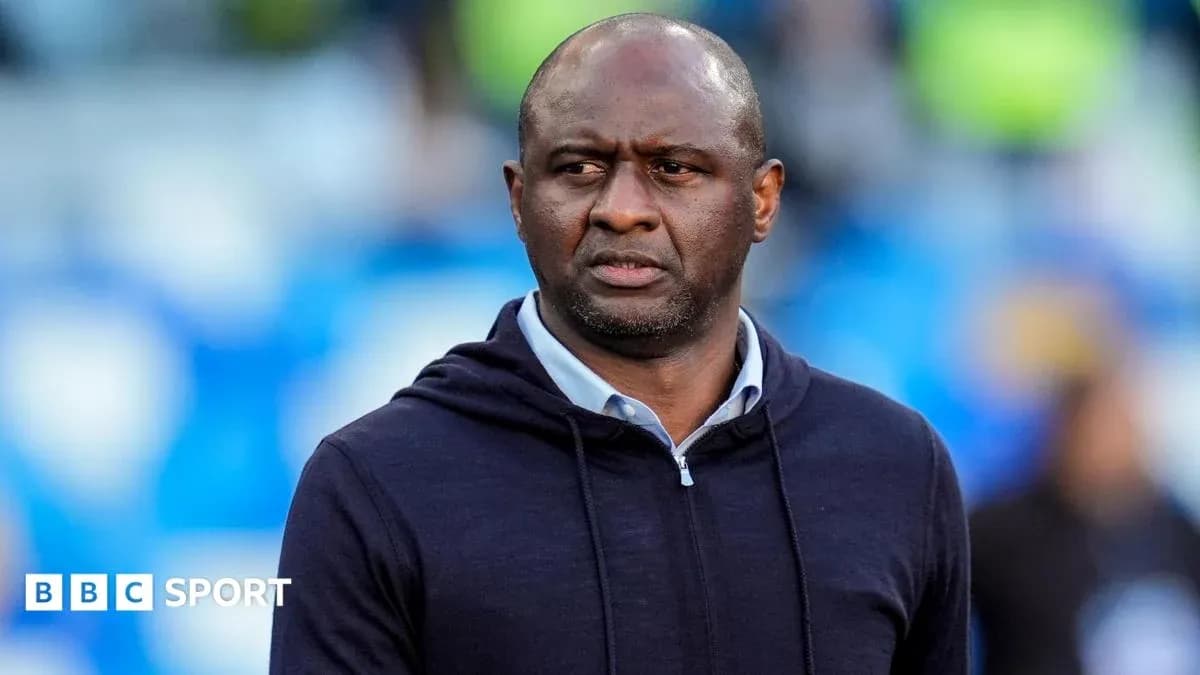
Patrick Vieira Unveiled as Senegal’s Next Coach Amid Uncertainty
Patrick Vieira has been unveiled as Senegal’s next head coach – and yet, somehow, he isn’t quite the coach of Senegal. Not yet.
His appointment has been announced, his name put to the job, his image already attached to the Teranga Lions. But there is no signed contract. No date for an official presentation. No clear path through the political and legal storm engulfing the country’s football leadership.
For a man who captained France and conquered Europe with Arsenal and Inter Milan, it is an oddly fragile start.
A coach named, but not in place
Senegal’s football federation (FSF) confirmed that Vieira, 50, had been unanimously approved to replace Pape Thiaw at a meeting on Monday. Patrick Kluivert was among the other candidates discussed, alongside Patrice Carteron and former Senegal internationals Habib Beye and Oumar Daf. In the end, the FSF settled on the World Cup winner born in Dakar, a symbolic choice as much as a sporting one.
Yet even as they announced him, they admitted the deal is not done.
The FSF says talks over the “administrative and contractual arrangements” are still ongoing. In other words: the fine print, the money, the guarantees. All of it remains on the table. And all of it is complicated by the federation’s own internal crisis.
A federation under fire
The FSF is fighting battles on multiple fronts. Its leadership has been contested for a year, and the case now sits with the Court of Arbitration for Sport (Cas) in Lausanne. A ruling is expected by Friday.
That decision could do more than embarrass the current hierarchy. It could question their very legitimacy – and with it, the legality of appointing Vieira at all.
The federation is already isolated. It does not enjoy the backing of the government, which funds the national team, and it has lost much of the public’s trust. Yet with competitive fixtures looming, the FSF moved anyway, pushing through Vieira’s appointment in the hope that time would not run out.
The calendar is merciless. Senegal open their 2027 Africa Cup of Nations qualifying campaign on 23 September away to Mozambique in Group J. Ethiopia follow days later. Someone has to pick the squad. Someone has to lead the team out.
Right now, that someone is supposed to be Patrick Vieira. But the ground beneath him is anything but firm.
Thiaw’s exit still unresolved
The man Vieira is replacing has not quietly stepped aside.
Pape Thiaw was sacked after Senegal’s dramatic last-32 elimination to Belgium at the Fifa World Cup. Crucially, that decision did not receive formal endorsement from the government, which pays the bills. Thiaw is now demanding several months of unpaid wages and a series of bonuses, with the total reportedly approaching $815,000 (£600,000).
Until that dispute is settled, the federation remains exposed financially and politically. It is trying to usher in a new era while still wrestling with the fallout from the last one.
The uncertainty does not end there. Cas is also due to decide on the ultimate destination of Senegal’s most recent Afcon title, won 1-0 after extra time against Morocco in January. Thiaw took his players off the pitch in stoppage time after a controversial penalty was awarded to the hosts, triggering a legal battle that has dragged on ever since.
The Teranga Lions were crowned champions of Africa for the first time in February 2022 at the delayed 2021 Afcon. They then claimed a second crown on the pitch earlier this year. Yet even that triumph hangs in the balance until Cas delivers its verdict.
This is the environment Vieira walks into: trophies under dispute, leadership under challenge, contracts under negotiation.
A legend’s mixed coaching record
On the pitch, Vieira’s name carries enormous weight. One of the greatest midfielders of his generation, he defined an era at Arsenal and lifted the World Cup and European Championship with France.
His managerial career has not matched that glittering playing résumé.
He has had spells in charge at New York City FC, Nice and Crystal Palace, showing flashes of promise but never quite building a sustained, elite-level body of work. Results have been uneven, and questions remain about his ability to construct and refresh a team over multiple cycles.
Yet Senegal is not a random stop on his coaching journey. It is home.
Vieira was born in Dakar and, although he chose to represent France, he never cut ties with his country of birth. Late in his playing days he poured significant investment and energy into the Diambars Institute, a project that would quietly reshape Senegalese football.
Diambars and the roots of a golden era
Diambars has grown into one of Africa’s leading academies. Its influence on Senegal’s recent success is impossible to ignore.
From its pitches have emerged Idrissa Gana Gueye, Bamba Dieng and Abdoulaye Seck, among others – players who have helped drive the national team’s rise since 2018. When Senegal finally climbed the African summit in 2022, and then backed it up with another title on the field in 2024, Diambars’ fingerprints were all over the squad.
Vieira’s connection to that institution gives his appointment a deeper resonance. He is not just a famous foreign-based star parachuted in for a job. He has already helped build part of the platform on which Senegal now stands.
That history will buy him some goodwill. It will not buy him time.
Rebuilding after a golden generation
The task in front of him is stark. Senegal are trying to move into a new phase after one of the most successful periods in their history.
A core group – Sadio Mane, Edouard Mendy, Kalidou Koulibaly, Gana Gueye – has carried the team to continental glory and back-to-back World Cups. Their influence is fading. Their successors must now step into a dressing room heavy with expectation and history.
There is talent coming through. Plenty of it. But those younger players will feel the weight of what came before them every time they pull on the shirt.
Vieira’s job, if and when the paperwork is finally signed, will be to manage that transition: to respect the legacy without becoming trapped by it, to refresh the squad without tearing up the identity that made Senegal so formidable.
He has already teased his interest. During a recent holiday in Senegal, covered with unusual intensity back home, the Frenchman dropped a series of hints that he was in line for the role. The whispers turned into open talk. The talk has now become an announcement.
Yet the real work has not started. Not officially. Not until the contracts are signed, Thiaw’s claims are resolved, and Cas has spoken on both the federation’s leadership and the Afcon title.
For now, Patrick Vieira is the coach of Senegal in name, if not in ink. The question is whether this fragile beginning can harden into a new era – or whether the chaos around him will swallow the project before it truly begins.