Pep Guardiola's Impact on Premier League Tactics
When Premier League managers are asked who shaped their ideas, one name keeps coming back like an echo: Pep Guardiola.
His time at Manchester City has never just been about one club stacking up trophies. It has been about a league being bent, reshaped and reimagined around a single, restless mind. From goalkeepers to full-backs to the very rhythm of possession, English football has spent a decade reacting to one man.
The goalkeeper revolution – and the twist in the tale
Guardiola’s first big call at City set the tone. Joe Hart, a title-winning, terrace favourite, was out. Claudio Bravo, and then Ederson, were in.
It wasn’t a tweak. It was a rupture. Guardiola didn’t just want a goalkeeper who could kick; he wanted a playmaker in gloves. In a Premier League that still prized shot-stoppers who dominated their box and launched it long, he demanded someone who could split the first line of a press, thread passes into midfield, and start moves rather than simply survive them.
He was hammered for it at the start. Bravo struggled, the errors were loud, and the critics louder. But Guardiola did not blink. He doubled down with Ederson, a goalkeeper who could ping 60-yard passes onto a winger’s laces and still save one-on-ones.
Ten years on, the argument has flipped. It is now more contentious to suggest a top-flight side can thrive without a goalkeeper who is comfortable with the ball. The dominoes fell across the division.
At Manchester United, David de Gea gave way to Andre Onana. Arsenal moved from Aaron Ramsdale to David Raya. Chelsea cycled from Edouard Mendy to Kepa Arrizabalaga to Robert Sanchez. One by one, the old-school keepers were pushed aside for ball-players, with wildly different results but a shared inspiration.
Then, just as the trend looked permanent, Guardiola swerved again.
With high, man-to-man pressing from goal-kicks becoming more ferocious, the risk of building short rose sharply. Opponents crowded the first phase. Space opened up higher up the pitch instead. The very innovation he had normalised suddenly carried more danger.
So City, the club that had come to define the ball-playing goalkeeper, signed Gianluigi Donnarumma. A giant, penalty-box goalkeeper, far less polished with his feet than Ederson, but a specialist in one-against-one situations and big European nights.
It was a statement: the value of an elite shot-stopper in tight, high-stakes games had climbed again in Guardiola’s calculations.
City did not completely abandon their principles. Against aggressive pressing sides, they still built from the back in tight pockets, with Bernardo Silva and Rodri dropping to receive directly off Donnarumma, almost like five-a-side pivots. The patterns were familiar, the personnel and risk calculus different.
Rivals watched. Manchester United moved away from the pure playmaker profile, replacing Onana with Senne Lammens, a more traditional keeper. A decade after Hart was moved on, the league had come full circle, only this time with the scars and lessons of Guardiola’s experiment written into every decision.
The birth of the inverted full-back – and its many lives
City’s 100-point season in 2017-18 is remembered for relentlessness, for records, for suffocating dominance. Underneath it sat a tactical adjustment born not from a grand plan, but from necessity.
Injuries left Guardiola without a natural left-back. No obvious solution, no ready-made replacement. So he went back to the raw materials at hand.
He looked at his left-footers. Oleksandr Zinchenko. Fabian Delph. Midfielders by trade, technically neat, comfortable passing in tight spaces. Instead of forcing them to play as conventional overlapping full-backs, he turned the role inside out.
The left-back moved into central midfield alongside the holding player in possession. It gave City an extra man in the middle, more security when they lost the ball, and clearer lanes for the left-winger to stay wide and stretch the pitch. Opponents didn’t know whether to follow the full-back inside or hold their shape. The jigsaw locked perfectly into place.
The impact rippled out. When Mikel Arteta took Zinchenko to Arsenal, he lifted that idea straight into north London. Arsenal’s most fluid, expansive football has come with inverted full-backs stepping into midfield, turning a back four into a shape that often looks like a 2-3-5 with the ball.
Ange Postecoglou, another Guardiola admirer, used Pedro Porro and Destiny Udogie in similar fashion at Tottenham, tucking them inside next to the holding midfielder to control the centre and launch attacks.
Guardiola, though, didn’t stop at midfielders-turned-full-backs. When Zinchenko was injured in 2018-19, Aymeric Laporte, a left-footed centre-back, took the role on the flank. In the Treble-winning 2022-23 season, Manuel Akanji and Nathan Ake spent long stretches nominally at right-back and left-back either side of Ruben Dias and John Stones, with Stones stepping into midfield.
What looked unconventional at first became a new template: centre-backs used wide to fortify the back line, yet still part of a fluid, possession-heavy structure.
Newcastle’s Dan Burn, all 6ft 7in of him, now patrols the left-back zone, tucking in to form a back three with the ball and defending as a more orthodox full-back without it. That concept – a defender who is part full-back, part third centre-back – owes plenty to Guardiola’s willingness to experiment.
On the other side of the spectrum, he has also pushed full-backs into even more attacking roles. Joao Cancelo, and now Nico O’Reilly, have been moved centrally but higher up, arriving in the box, contributing directly to goals. The full-back as auxiliary No 10 is no longer outlandish.
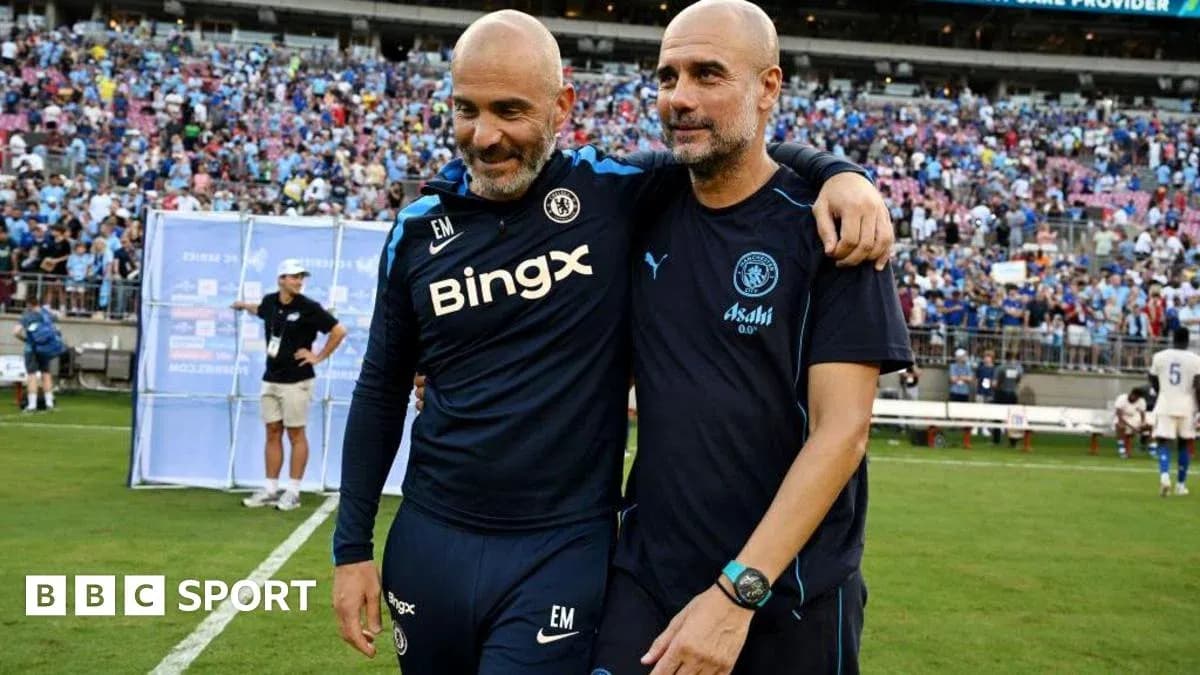
Arteta has echoed it with Jurrien Timber and Riccardo Calafiori at Arsenal. At Chelsea, Malo Gusto and Marc Cucurella have been used in similarly aggressive, interior positions under former Guardiola assistant Enzo Maresca. The job description for a full-back in the Premier League has changed, and it traces back to those early tweaks at City.
Possession as a weapon, not a statistic
Guardiola’s obsession with the ball predates his time in England. At Barcelona, after a rare night when he compromised his ideals against Inter Milan by playing Zlatan Ibrahimovic and going more direct, he left the stadium feeling he had betrayed himself. The lesson was harsh and lasting: if he was going to fail, he wanted to fail on his own terms.
At City, those terms have been crystal clear. Technical players everywhere. Midfielders masquerading as defenders. Full-backs stepping inside. Wingers either hugging the touchline or rolling infield depending on the plan, but always with a structure built to dominate possession.
The numbers back it up. In 2017-18, City averaged 71.9% of the ball across the league season. Since then, they have not dipped below 60%. Six Premier League titles in seven seasons turned that approach from curiosity into orthodoxy.
The league followed. Liverpool under Arne Slot, in his first season, lifted the title playing a brand of football closer to Guardiola’s controlled, positional game than Jurgen Klopp’s heavy-metal pressing. Arsenal under Arteta have paired an outstanding defensive record with long spells of calm, patient possession.
Brighton built an entire club model on coaches who want to impose themselves with the ball: Roberto De Zerbi, then Fabian Hürzeler, both committed to constructing attacks rather than merely reacting.
Others tried and fell. Scott Parker, Vincent Kompany, Russell Martin – all wedded to a possession-first philosophy, all undone by squads that could not quite carry the weight of their ideas. Their struggles underline the point: Guardiola’s influence runs far beyond his own dugout, even when the copycats cannot match the original.
From Ferguson’s England to Guardiola’s
Before Guardiola arrived, the Premier League’s identity was clear. High tempo. Direct attacks. Box-to-box chaos. Sir Alex Ferguson’s Manchester United embodied that era: fast wingers, quick transitions, relentless waves of pressure.
United under Michael Carrick have leaned back into those roots, a more traditional counter-attacking style that suits the club’s history. Yet the broader landscape has shifted.
One of Guardiola’s greatest achievements has been walking into a league stamped with Ferguson’s tactical DNA and quietly rewriting the code. The default for many of its best sides is no longer to trade punches in end-to-end battles, but to control space, slow the game, and suffocate opponents with the ball.
That does not mean Guardiola is rigid. The biggest misconception about him is that he simply drops a fixed style onto a league and waits for everyone else to copy. The reality is far more nuanced.
He holds to core principles – dominate possession, control transitions, use structure to free individuals – but he constantly tweaks the mechanisms. Traditional wingers or inverted ones. Full-backs inside or outside. False nine or orthodox striker. Ball-playing keeper or penalty-box specialist. Each shift responds to the players at his disposal and the problems the league throws at him.
He adapts, then he wins. When he wins, others imitate. By the time they have caught up with what worked, Guardiola and City are already somewhere else entirely.
That is the legacy he will leave behind: not just titles and records, but a Premier League that has spent a decade chasing his shadow, always arriving just as he disappears over the next tactical horizon.