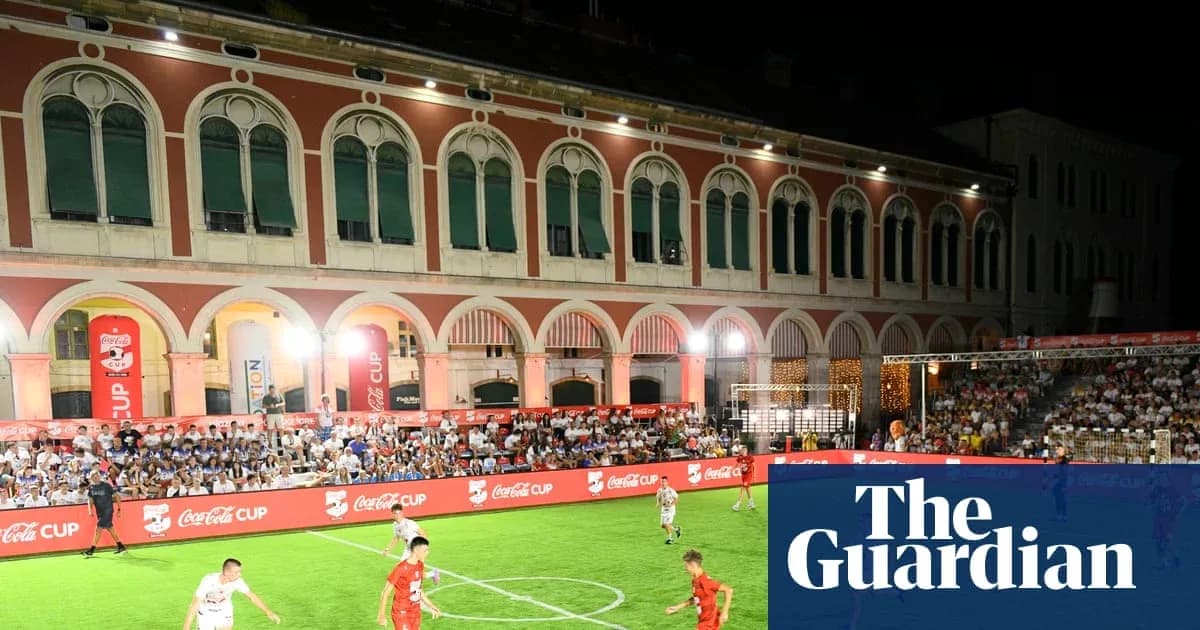
Plazma Youth Sport Games: A Celebration of Sport and Community
On a raised platform above the Adriatic, 20 children sit in a circle, heads bowed over chessboards. They are the best young players from across the Balkans, but they are not facing each other. All eyes track one man: Nigel Short, the grandmaster weaving his way awkwardly between chairs, making a single move on each board before shuffling on.
The kids are sharp. The twist is sharper. When they get stuck, they can turn to their “celebrity coaches” – Ana Ivanovic, Sean Dyche and, in the most surreal touch of all, rightwing tech billionaire Peter Thiel. It is a scene that feels half summer camp, half global summit.
Welcome to the Plazma Youth Sport Games.
The ‘Davos of sport’ on the Dalmatian coast
Split is hosting the 30th edition of the YSG, and the city has leaned into it. The Games have been dubbed “the Davos of sport” by some of their more illustrious visitors, and the label fits: each summer, big names from sport and politics descend on the Dalmatian coast to talk, to watch – and, crucially, to be seen.
Strip away the gloss, though, and the numbers tell a different story. This is the largest amateur sports event for children in Europe. Just under half a million youngsters from Croatia, Bosnia and Herzegovina, Serbia, Slovenia and North Macedonia entered qualifiers this year. Ten sports, from chess to 3v3 basketball, reach their finals in Split over one intense week.
The competition matters, but it is not the only point. Children are pushed towards teamwork, collaboration and the radical act of putting their phones away. The organisers insist Plazma is both a sports festival and a “social project”, a phrase that hangs over everything from the coaching clinics to the off‑court activities.
The message has landed. Over the years, a revolving cast of ambassadors has attached their names to the Games, from Zlatan Ibrahimovic to Alastair Campbell. People arrive curious and leave converted. Dyche, now a regular presence, calls it “a brilliant, brilliant initiative”, and he does not sound as if he is going through the motions.
One match in particular stuck with him: the girls’ mini-football final. “It was terrific, they were playing good football; getting properly stuck into each other, properly playing,” he said. “You could feel that they felt free and were being supported in that environment.”
Why this couldn’t be England
Dyche is adamant this kind of project would struggle to take root in the UK. His verdict is blunt.
“It seems to me that every time you try and get an initiative off in England, there’s a million rules and regulations that make it difficult,” he said. “I know how hard it can be to get funding too and times are tough for people.”
The irony is that the Plazma Games themselves were born from hardship. Founder Zdravko Maric launched them in the aftermath of the breakup of Yugoslavia and the Bosnian war. His aim was not grand peace-building, but something more immediate: to tackle the drug problems tearing through Croatia’s youth.
“It’s a lifetime project and we live with it every day,” says his brother, Slaven Maric, who has been involved since the start. “But when Zladko started it we didn’t have an idea that it would develop into this. It’s not about sport or the results, it’s about social life, it’s about being together. There were many issues with drug abuse [then], now it’s about bringing the kids to spend sometime together in real life.”
The next target is obvious: screens. Getting kids off their phones has already been flagged as a key theme for the 2026 edition. Esports companies have tried to muscle in, sensing a captive youth audience. Maric says those approaches have been politely but firmly turned down.
Split’s sporting DNA
Bringing the Games to Split did not just offer a scenic backdrop. It plugged into one of the richest sporting cultures per capita anywhere in Europe.
This is a city of around 160,000 people that has produced a roll call of champions. Goran Ivanisevic, Wimbledon winner. Bernard Vukas, once rated Croatia’s greatest footballer before Luka Modric rewrote the debate. Branko Cikatic, kickboxing legend. Toni Kukoc, NBA three‑peat champion. Stipe Bozic, the mountaineer who put the city’s name on the world’s highest peaks.
Walk the streets and the pride is carved into the stone. Split has its own Olympic “walk of fame”, a Hollywood-style strip honouring its 73 medal winners. It has its own beach sport, too: picigin, a kind of hand‑played hackysack in the shallows of the Adriatic, equal parts acrobatics and local folklore.
So when the YSG pitches up here, it feels less like a visiting circus and more like a natural extension. The city recognises itself in the Games’ ambition.
Slaven Bilic, another son of Split and a former Premier League player and manager, is now inevitably a YSG ambassador. His connection to the Maric family goes back decades, and his affection for the project is obvious.
“I’m not objective because I’ve known Zdravko for more than 30 years but it’s great that at a time when there’s a lot of negativity in the world that this can exist,” Bilic said. “Especially in this part of the world that is supposed to be unstable.”
Billionaires, brands and the next step
The question now hanging over the Adriatic is simple: what next?
Expansion is clearly on the table. North Macedonia took part for the first time this year, while Ukrainian teams arrived as invited guests. Talks have already been held with six other countries about joining in future editions.
Corporate muscle is growing as well. Coca‑Cola has come on board as a partner, alongside Topps and leading Croatian telecom firm Telemach. Behind them stands an even more powerful bloc: 11 billionaires are now associated with the Games, several of whom have put money into the project.
One of those investors is understood to be Thiel, the founder of PayPal and Palantir and a mentor to US vice-president JD Vance. In Split, he kept his distance. Asked by the Guardian why he had chosen to invest, Thiel declined to answer and moved along the riviera with his security detail, leaving others to speculate on his motives.
Aleksander Ceferin, the Uefa president, takes a broader view. Uefa provides funding to the YSG, and he sees them as a model for how elite sport should feed the grassroots. He was reluctant to be drawn into his ongoing battle with Fifa while in Split, but his praise carried an edge.
“I think that top sport, and the money that you get with top competition, should be used for the development of sport and this is the development of sport,” he said. The comparison with Gianni Infantino’s attempts to sell a stake in the World Cup to private investors almost made itself.
A finale with star power
The Games closed on Friday night with their own spin on Soccer Aid. One side: a YSG select team. The other: 11 all‑stars, a line‑up that would not look out of place at a legends’ gala.
Claude Makélélé patrolled midfield. Pavel Nedved glided into pockets of space. Ibrahimovic, inevitably, loomed over it all. On paper, it felt lopsided. On the pitch, it barely mattered.
The local youngsters had Dyche in their technical area, barking and cajoling, treating the occasion with the same seriousness he once brought to Premier League survival battles. The tackles flew in, the crowd roared, and the gap between superstar and amateur shrank for 90 minutes.
Building bridges. Forming memories. Getting properly stuck in.
For a tournament born in the wreckage of war and drugs, now fuelled by billionaires and global brands, there are flashier ways to mark a 30th birthday. But there are few better.