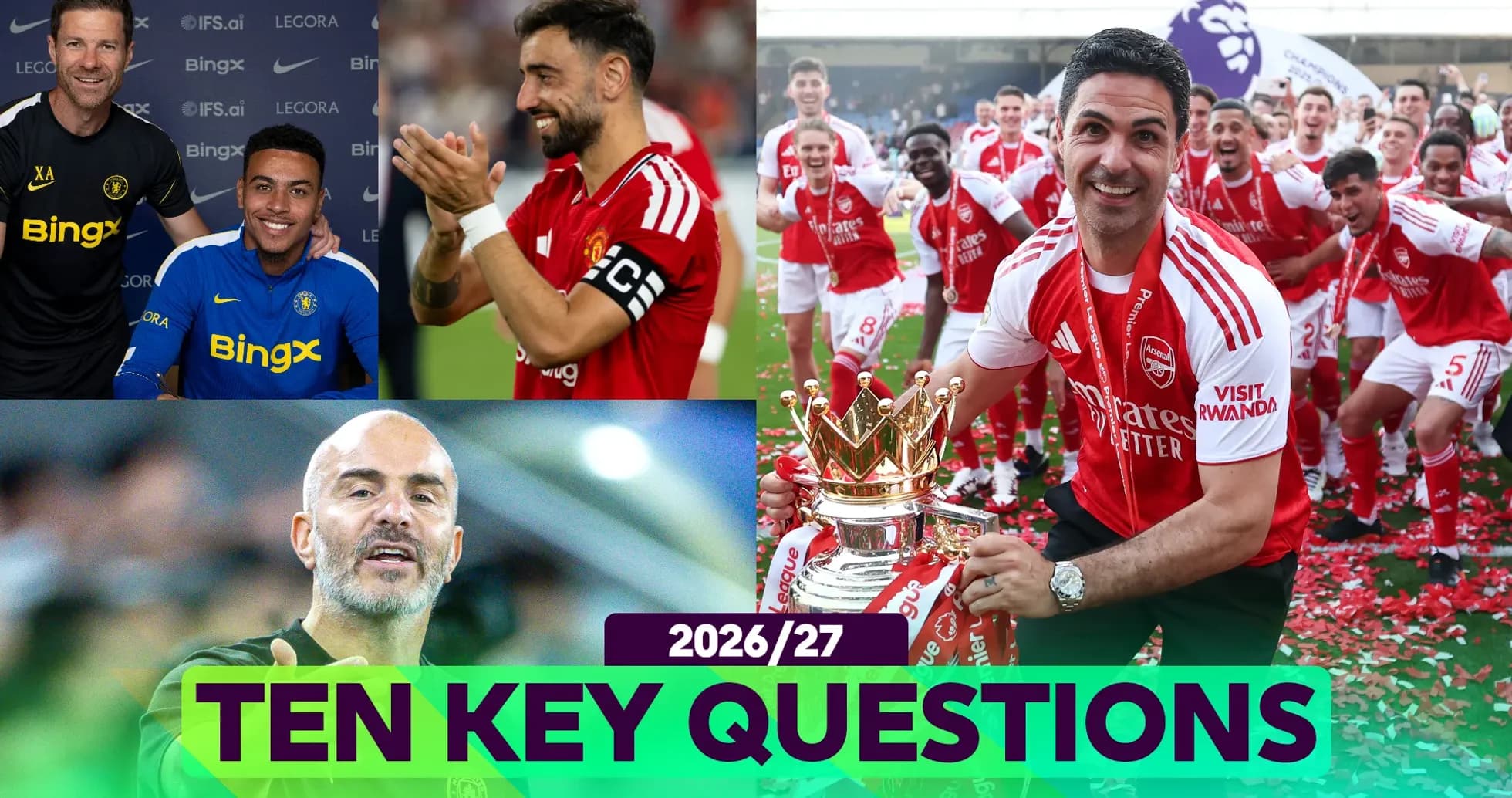
The Premier League Returns: Will Arsenal Defend Their Title?
The Premier League is back, and everything is changing – except, perhaps, the champions.
Arteta, the calm in the chaos
Across a division spinning into a new era, Arsenal stand still. That is precisely why they might move clear.
Five of the traditional "Big Six" are effectively rebooting. There will be a record nine new managers on opening weekend. Projects are being ripped up, philosophies rewritten, hierarchies reset.
In the middle of it all, Mikel Arteta has something nobody else does: a title-winning machine that already knows how to do it.
Only three managers have ever retained the Premier League: Pep Guardiola, Sir Alex Ferguson and Jose Mourinho. The league is too deep, the pressure too relentless, the margins too thin. Yet Arteta enters 2026/27 with a rare advantage. His Arsenal are settled in personnel, hardened by experience, and tactically mature after a five-year climb to the summit.
The "monkey" is off their back. The crown is finally theirs. Now comes the question that defines champions – can they keep it?
With Michael Carrick starting his first full season at Manchester United, Roberto De Zerbi doing the same at Tottenham, and Liverpool, Chelsea and Manchester City all under brand-new management, Arsenal suddenly look like the only established superpower.
Guardiola’s exit from City does more than end an era. It leaves Arteta as the only Premier League title-winning coach in the division. For a manager obsessed with marginal gains, that might be the biggest one of all.
City after Pep: continuity or collapse?
Manchester City have been here before in theory – transition, evolution, the next step – but never like this.
This is not a tweak. This is the end of the Guardiola dynasty.
Enzo Maresca walks into a job that has broken great managers elsewhere. Follow a legend, or be crushed by the comparison. At Liverpool, Arne Slot has already shown that continuity after Jurgen Klopp is possible. At Arsenal and United, Unai Emery and David Moyes discovered how suffocating it can be to live in the shadow of Wenger and Ferguson.
City have chosen their side. They have not searched for a contrast to Guardiola, but a continuation. Maresca is a Guardiola disciple, steeped in the same possession-heavy, structure-obsessed, position-first football that reshaped the club from top to bottom.
The idea is obvious: change the man, keep the model.
But even with a stylistic clone in the dugout, the dressing room is not the same. Bernardo Silva and John Stones have gone, taking with them leadership, rhythm and a chunk of City’s footballing brain. The eight-time champions now face a season that could go either way.
Does Maresca extend the dynasty? Or does the first real rupture of the Guardiola era – coach and core leaders gone – finally drag City back towards the pack?
Alonso at Chelsea: the next great Premier League coach?
If there is one appointment that crackles with intrigue, it is at Stamford Bridge.
Xabi Alonso arrives with the aura of a coming force. He turned Bayer Leverkusen into unbeaten champions in 2023/24, a feat that instantly propelled him onto every elite club’s shortlist. Now he lands in a Premier League that has just waved goodbye to Guardiola and Klopp.
The stage is clear for a new leading man.
Chelsea have been chaotic in recent years, but this time there is a clear structural advantage: no European football. Those blank midweeks once helped Antonio Conte blitz the league in 2016/17. The Italian is one of only six managers to win the Premier League in his first season – three of them, notably, at Chelsea: Conte, Jose Mourinho and Carlo Ancelotti.
Alonso has a chance to join that group.
He inherits a strong squad that has finally been balanced with experience. Danny Welbeck and Jordan Henderson are the first over-30 signings of the BlueCo era, a symbolic shift away from the scattergun youth-only strategy. It hints at a new seriousness, a new focus.
Give Alonso time on the training ground and a squad with fewer growing pains, and an explosive debut campaign is not just plausible. It feels almost inevitable that Chelsea will be relevant again.
The return of chaos football
Last season, some fans felt the league had tilted too far towards set-pieces and structure. The numbers back it up. Goals per game barely dipped – from 2.40 to 2.36 – but open-play Expected Goals told a different story.
Open-play xG per match peaked at 2.28 in 2023/24, then fell to 1.82 in 2025/26. The football felt tighter, more controlled, less wild.
That might be about to change.
The new wave of managers is, almost to a man, committed to aggression and risk. De Zerbi now has a full pre-season at Spurs to install his trademark high pressing and relentless attacking patterns, ideas he never fully embedded late last year. Andoni Iraola brings his "heavy-metal" style from Bournemouth to Liverpool, precisely the brand of chaos many at Anfield craved.
Alonso’s Leverkusen and Real Madrid sides scored heavily. Marco Rose, now at Bournemouth, comes from the RB Leipzig and Borussia Dortmund school of direct, vertical, high-tempo football. At Crystal Palace, Pierre Sage is another coach who lives for fast breaks and pressing triggers.
Put it all together and the league feels primed to swing back towards that 2023/24 style: end-to-end, breathless, and utterly unforgiving.
Is this the year United are back for real?
Manchester United have flirted with rebirth before. This time, the numbers give the optimism a harder edge.
Michael Carrick took over as caretaker on 14 January. Three days later, his first major act was a 2-0 win over Manchester City. From there, United caught fire.
Across his 17 league games in charge – almost half a season – United topped the Premier League form table:
Man Utd: 17 played, 12 wins, 3 draws, 2 defeats, 39 points.
Arsenal: 36 points.
Man City: 35.
Bournemouth: unbeaten, but with 21 points.
Liverpool: 25.
No complex tactical thesis is needed. If Carrick simply repeats that form over a full campaign, United win the title for the first time since 2013.
Football rarely obeys such straight lines. The pressure, the fixture list, the response from rivals – all of it will distort the picture. But United finally have empirical proof that, under this manager, they can operate at a title-winning pace.
For a club living off memories for more than a decade, that alone changes the mood.
The year of the comeback star?
New managers mean new hierarchies, and that spells opportunity.
Across the division, players who were sidelined, out of form or injured last season suddenly see daylight. It could become the year of the comeback.
Phil Foden and Cole Palmer both endured disappointing campaigns and missed out on England’s World Cup squad. They now have a point to prove. Marcus Rashford and Mason Mount face a fight just to secure their place in Carrick’s United plans.
Harvey Elliott, Omar Marmoush and Andy Robertson will all expect more minutes after struggling for game time. Yoane Wissa will hope a new manager can unlock his best form again.
Then there are those returning from injury. Levi Colwill at Chelsea and Alexander Isak at Newcastle feel like forgotten stars. This season, they have the chance to become central figures again rather than what-ifs on the treatment table.
Villa, Newcastle and the cost of upheaval
Twelve months ago, Aston Villa and Newcastle United were the continuity stories. Stable squads, clear identities, upward trajectories. They were tipped as Champions League contenders on that basis.
Not this time.
At Newcastle, the scale of change is startling. Eddie Howe has resigned. Matthias Jaissle steps in, tasked with rebuilding after the departure of arguably the club’s three most important players: Bruno Guimaraes, Anthony Gordon and Sandro Tonali.
In their place arrive Lukas Hornicek, Bazoumana Toure, Aladji Bamba, Sean Steur and Ewen Jaouen – all expensive, all highly rated, all unproven in this environment. It feels less like a tweak and more like a reset.
Villa’s shift is gentler but no less significant. Unai Emery remains, yet there is a sense of one cycle ending and another starting. Youri Tielemans, Morgan Rogers and Lucas Digne have gone. The club leans into a new core with Alejandro Garnacho, Johan Manzambi and Joao Gomes, each signing greeted with a genuine buzz.
Both clubs wanted to move from contenders to fixtures in the top four. This season will reveal whether such heavy surgery accelerates that journey – or stalls it.
Europe: dream or distraction?
Nine Premier League clubs played in Europe last season. For those not used to the Thursday-Sunday grind, the glow of continental nights came with a price.
Aston Villa handled it superbly, winning the Europa League and still finishing fourth. Crystal Palace were happy to trade a 15th-place league finish for a Conference League triumph that will live forever.
Others paid more dearly. Nottingham Forest, Spurs and Newcastle all slumped into the bottom half, their domestic form seemingly dragged down by the schedule.
This year, Brighton & Hove Albion make their first-ever Conference League appearance and only their second European campaign in history. They will look at Palace and see a roadmap. Palace themselves, now more experienced, should be better placed to juggle Europa League demands.
Bournemouth and Sunderland, both Europa League qualifiers, do not have that luxury. Their fans will already be wondering if the squad depth is there to cope.
There is a knock-on effect, too. Leeds United have strengthened and will fancy their chances of a top-nine finish, partly because so many rivals must now navigate midweek commitments. Brentford, who narrowly missed out on Europe last season, again have free midweeks to absorb Keith Andrews’ detailed work on the training ground.
The middle of the table is no longer a resting place. It is a launchpad.
Mid-table muscle and a deeper league
Leeds and Brentford are not alone in looking upwards.
Fulham have hired former Real Madrid coach Alvaro Arbeloa and handed him two signings from his old club. That alone is enough to stir belief in west London that he can build on Marco Silva’s work. Fulham finished just a point shy of Europe last season.
Nottingham Forest now have Oliver Glasner, the man who delivered both the Conference League and FA Cup to Crystal Palace. Even after selling Elliot Anderson to Manchester City, Forest will quietly target a repeat of their seventh-place finish from two years ago.
Everton, too, feel stronger. They should finally be settled in their new stadium and, crucially, they enjoy something rare this season: continuity in the dugout. David Moyes is back, and with Hayden Hackney, Christian Norgaard and Brennan Johnson on board, the squad looks clearly upgraded.
Put all of that together and the league tightens. There are fewer obvious weak links, fewer soft fixtures. Almost everyone has a plan, a coach with pedigree, and a squad that makes sense.
Promoted trio step into the storm
Coventry City, Ipswich Town and Hull City have watched Sunderland’s blueprint and followed it.
Sunderland’s aggressive spending last summer launched them not just to safety but into Europe, ending a two-year run of promoted clubs going straight back down. Coventry, Ipswich and Hull have responded with their own busy windows.
The twist? Most of their money has gone on established internationals from mainland Europe rather than Premier League journeymen. Ipswich have added Issa Diop and Sasa Lukic, Hull have brought in Matt Targett and Jack Butland, but the emphasis is clear: quality first, experience of this league second.
Predicting their fate is a fool’s game. Many expected Sunderland and Leeds to sink in 2025/26. They did the opposite.
Coventry arrive as dominant Championship winners, guided by an experienced manager in Frank Lampard. Ipswich have recent top-flight memories and a head coach in Gary O’Neil who has already kept both Bournemouth and Wolverhampton Wanderers up.
Hull face the steepest climb. Their Expected Points numbers last season were brutal: 23rd out of 24 in the Championship for xG for and against. On paper, they are favourites to finish bottom.
Yet this is their first Premier League campaign since 2017. For Hull, as for everyone, hope still outweighs fear.
A league on the brink of something
Everywhere you look, there is a story ready to ignite. A champion trying to become a dynasty. A giant trying to wake up. A superclub trying to survive life after a legend. A new generation of managers ready to reshape the style of the league.
The Premier League has never been short on noise. This year, it might finally match the volume with depth. The question is no longer whether it will be competitive.
It is who, in a season this strong and this unstable, dares to take control of it.