Premier League Insights: Winners, Losers, and Key Performers
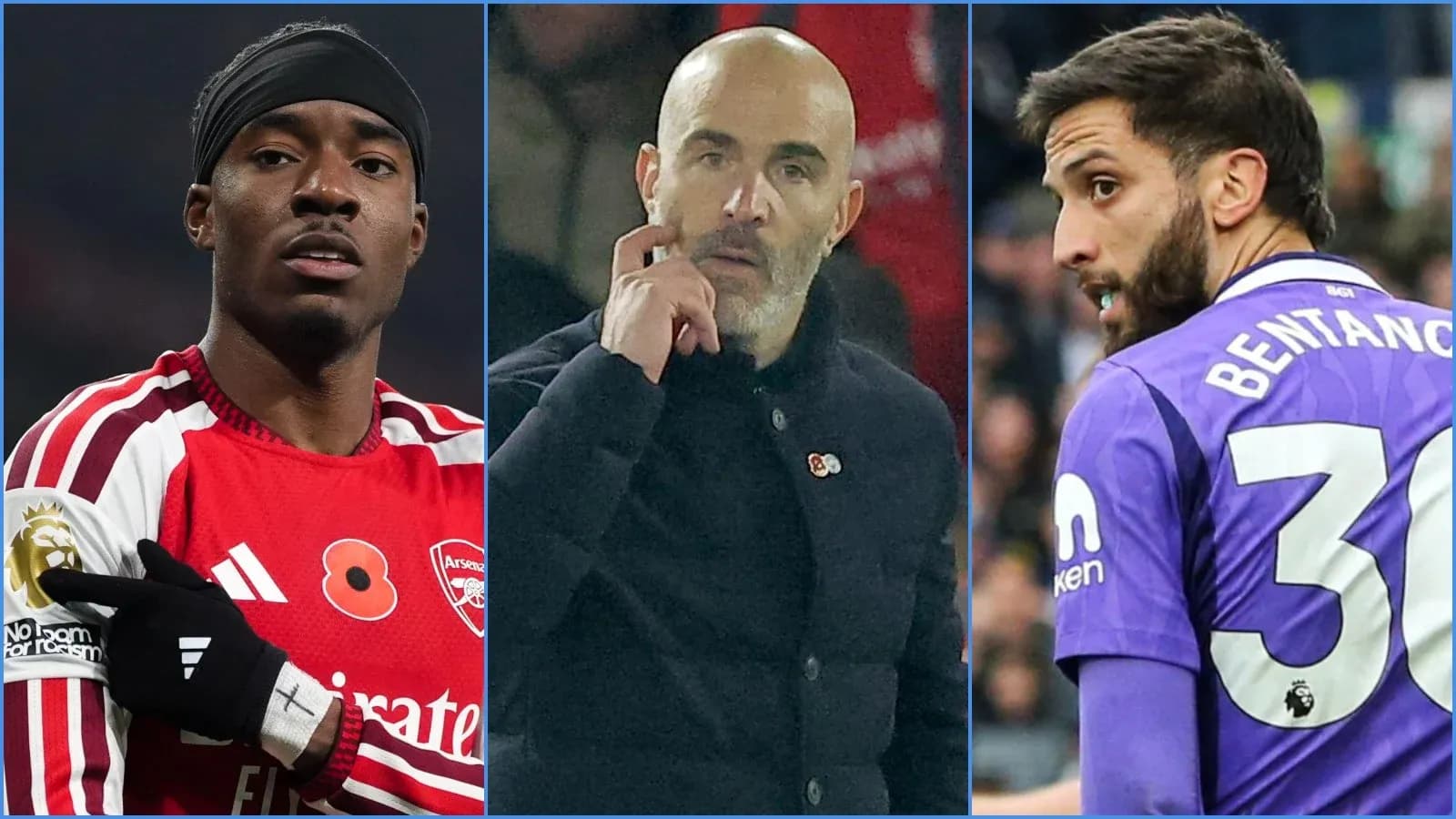
Noni Madueke, David Moyes and Rodrigo Muniz walked into the international break as winners. Unai Emery, Manchester’s power axis and a cursed Spurs midfielder trudged out as the collateral damage of a wild Premier League fortnight that refused to follow the script.
This is what the table doesn’t show you.
Brighton, Forest and the machine that scores first
Nottingham Forest first. Quietly, efficiently, they look like a side who know exactly where this season is going. On their way to the title, and playing like they believe it.
But Brighton are the ones turning routine wins into a kind of cold-blooded art form. Their last 10 Premier League victories have all been to nil. Twenty-five unanswered goals. If Brighton score first, the contest usually dies on impact.
Pascal Gross runs the game, Diego Gomez threatens from any range, and Luka Vuskovic is allowed to defend in straight lines with everything in front of him. Give that structure a lead and the second-best team in the country simply squeeze the life out of you.
Madueke: from snub to centrepiece
Noni Madueke has taken this stretch of the season and ripped his name into it.
Mikel Arteta called him “the best player in training in the last 10 days” when club football resumed in October and said he had “no option” but to start him. A month on, heading into another England break without him in the squad, the manager is talking about “a different Noni”.
The numbers back it up. Across a brutal run of nine games in 28 days, no one has been as influential for the champions. In the league alone, Madueke has been directly worth four extra points: the only goal against Nottingham Forest and the shot that forced the breakthrough against Hull.
Hull felt the full version. He led the match in shots (four) and duels won (eight). He had at least five more touches in the opposition box than anyone else. He completed six dribbles – as many as the rest of the pitch combined.
No player in the division is creating more chances per 90 minutes. Yes, it’s only a month-long sample. But this is the decisive, game-breaking wide forward Arsenal didn’t buy in the summer. And the overcomplicated finish that ruined a glorious late team move only underlines how much more there is to come.
His response to the last England snub was not a sulk but a plane ticket. He flew to Portugal, worked, and turned himself from undesirable to undeniable. Now he heads into another fortnight of self-imposed graft, driven by pure resentment towards Thomas Tuchel, and you fear for whichever full-back stands in his way next.
Moyes and the centre-forward factory
Say what you like about David Moyes – and people have, for the best part of 25 years – but give the man a centre-forward and he will build a platform around him.
Thierno Barry is just the latest in a long, improbable line. Marko Arnautovic, Michail Antonio, Jarrod Bowen at West Ham. Before them, Nikica Jelavic and Beto, who somehow both scored 16 Premier League goals under Moyes despite often looking like they’d been introduced to a football that morning.
Barry’s Coventry brace took him to 14 Premier League goals under the Scot, nudging past James Beattie and into the orbit of Jermain Defoe and Duncan Ferguson, both on 15 in Moyes’ personal scoring charts.
Moyes almost certainly believes Everton would have won the title in his first spell if he’d had Barry up front. And the uncomfortable thing for everyone who mocked him is that he probably isn’t wrong.
Muniz: a goal, a loss, and a promise
Rodrigo Muniz’s first Premier League goal since the opening day of last season came wrapped in something heavier than form and fitness.
“Last season was really difficult for me because, now I can say it, but I had the surgery,” he said after the draw with Newcastle. “My wife was pregnant last season and, unfortunately, we lost the baby, but God is good all the time and now she’s pregnant again. The goal was for my baby, and I hope this season will be different than last season.”
One finish, a year of pain, and a tribute rolled into a single moment. A lovely story. The hope now is that Manchester United don’t find a way to ruin it in the market.
Ahoka and the art of finding a gem
Jules Ahoka had played 98 minutes of senior professional football before this season. Ninety of those as a centre-half.
Sunderland paid £8.6m in August and threw him in. Five starts, a Europa League goal and then, against Chelsea, his real Premier League unveiling: on in the fourth minute for the captain, facing a £173m midfield.
He walked away with man of the match. Fourteen defensive contributions – tackles, interceptions, recoveries, clearances and headed clearances – as Sunderland kept a clean sheet and earned a win their manager badly needed.
It throws another harsh light on Manchester United’s scattergun midfield rebuild. While they spent big on a unit still being pulled apart and put back together, others quietly identified a teenager with barely a game to his name and dropped him into chaos without blinking.
Liverpool, Bournemouth and the away-day extremes
Liverpool sit 18th in the home table. Away from Anfield? They’re top and the only side still unbeaten on the road. The old fear that the stadium’s mystique might be anchoring them rather than lifting them has never felt sharper.
Bournemouth, meanwhile, have turned 2024 into a case study in succession planning. In this calendar year they’ve set a new club record for the longest unbeaten run and matched their best sequence of consecutive wins, all under different managers.
They’ve done it with structure and with opportunism. Evanilson has a knack for forcing individual errors and Bournemouth have scored at least twice as many goals from opposition mistakes as any other side. The only regret is timing: they ran into Manchester City before Marco Rose pieced it all together and won’t see them again until April.
Winners with caveats, losers with hope
Senne Lammens had a moment to forget that will not be celebrated in the Goalkeeper’s Union.
Crystal Palace continue to posture and delay while everyone can see where this ends. Roy Hodgson, again. The sooner the pretense drops, the quicker they can get on with it.
Unai Emery, in one sense, wins. Manchester United will now leave him alone, which is the best thing that could happen to both him and Aston Villa. But his record at Old Trafford is staggering. Ten trips with four different clubs against five different United managers. He has led nine times – 0-1 on four occasions, 1-2 twice, 0-2 twice and 2-4 once – and never won. That isn’t a quirk; it’s a curse.
Manchester City’s travelling circus has lost its charm. Dressing up as inflatable bananas and heading 80-odd miles is less amusing when the new-manager bounce has fizzled out and the siege mentality has thinned. On the pitch, they look like strangers, which tracks for a squad thrown together for a new coach. Off it, the knowledge of systemic cheating charges strips away the comfort blanket. It’s one thing to win while the world glares at you. It’s quite another to play badly.
United: living on borrowed stoppage time
For two minutes and 46 seconds, Manchester United sat bottom of the Premier League table. In November. During their tenth game.
Fergie Time still exists, just in warped form. Late goals turned their last two matches from defeat into a comeback win and a scarcely believable 4-4 draw. The clock keeps striking, but the context has changed.
This will almost certainly be their longest continuous spell in the relegation zone since at least October 1986, when it became obvious Ron Atkinson had reached the end. That moment has long since arrived with Michael Carrick, yet the club clings to the idea that another flurry of stoppage-time escapes signals a corner turned, not another dead end in a maze that has chewed up far better managers over the last decade.
Fun, if you’re neutral. Less so if you’re paying for a season ticket.
Bentancur’s bizarre Spurs hex
Rodrigo Bentancur has become the strangest subplot in a Spurs season already full of them.
The broader failure belonged to Roberto De Zerbi. That much should be clear. But Bentancur’s numbers are astonishing. Spurs have not scored a single goal with him on the pitch this season. They have conceded eight.
The timeline reads like a dark comedy:
- He starts against Aston Villa, leaves in the 84th minute at 3-0 down, and Spurs promptly score twice.
- He gets sent off at 1-0 down against Manchester United and somehow ignites a comeback.
- He serves a three-game suspension. Spurs win all three, conceding once.
- He returns from the bench against Leeds at 0-0, plays well, then sets up the winning goal – for Leeds.
Coincidence? Cruel luck? Some ancient curse that only activates when he crosses the white line? Whatever the cause, Spurs are consistently worse when he plays, and De Zerbi’s faith is starting to look like an indulgence he can’t afford.
Leeds’ reluctant enforcer and Brentford’s red mist
Leeds earned an excellent, fully deserved, brutally hard-fought win over Spurs. It eased some tension but didn’t erase a familiar frustration: Tarik Muharemovic.
The complaints are loud. He’s too slow, not physical enough, not suited to the league, and – for good measure – apparently a poor tipper. Yet this supposed clogger leads the entire division in clearances and headed clearances, both by a distance. Leeds will grumble and roll their eyes, then quietly keep picking him. Someone has to do the ugly work.
Brentford’s problems are of a different sort. Three red cards already this season, two of them for violent conduct in the last three games. Igor Thiago’s dismissal drew more sympathy than Yehor Yarmoliuk’s, but both were rooted in a naivety Brentford should have grown out of by now.
Not since their first Premier League campaign have they racked up this many reds. If they don’t learn quickly, that tally will rise and so will the cost in points.
Hull’s narrow pain and Brighton’s looming shadow
Hull’s last Premier League stay was defined by heavy defeats. Only four of their 22 losses came by a single goal. This time, the margins are tight. Three defeats so far, all by either 1-0 or 2-1, during a nine-game winless run.
It’s no comfort to Sergej Jakirovic when the points column stays empty, but the narrow scorelines speak to organisation, energy and resilience. Hull are competing. They are refusing the batterings many predicted in pre-season.
They get Brighton after the international break. That will test just how thin those margins can stretch.
Newcastle’s missing goals and Chelsea’s fading promise
Newcastle’s squad contains 255 Premier League goals. On paper, that sounds healthy. In reality, it hides a glaring problem.
Only two current players have ever reached double figures in a single top-flight season: Harvey Barnes, who did it for a relegated Leicester side in 2022/23, and Yoane Wissa, whose final two seasons at Brentford have already proved painfully expensive for Newcastle’s budget.
Joelinton is third on the internal all-time list with 24 league goals in six seasons. Jacob Murphy sits one behind him on 23 in his ninth campaign. Fifth? Fabian Schar.
Across their last 36 Premier League games, only Will Osula (seven) has scored more than Anthony Gordon and Bruno Guimaraes (both six). Neither is a natural finisher. A big chunk of goals walked out of the door in the summer and Newcastle didn’t replace them, despite spending well over £250m.
At Chelsea, Levi Colwill’s season is veering into cautionary territory. His reputation swelled during his absence through injury and amid Enzo Maresca’s public defence of him last year. Now, he finds himself being twisted and tormented by Brian Brobbey and others.
These displays won’t stop the Barcelona links, but they do show how quickly a supposed solution to Chelsea’s defensive problems can become part of the issue. In 20 years’ time, you can already picture him on a podcast, explaining through tears that Brobbey was the toughest opponent he ever faced.
Ipswich and the long wait for a clean sheet
Ipswich have gone 29 Premier League games without a clean sheet. That is not a blip; it’s a defining trait.
The last team they shut out in the top flight had Christopher Nkunku up front with Joao Felix playing off him. That feels like a different era. Different problems, too.
Now the question is simple and unforgiving: who finally becomes the team that lets them breathe again – and how long can they survive if nobody does?