Ramla Ali Becomes World Champion After Unbelievable Journey
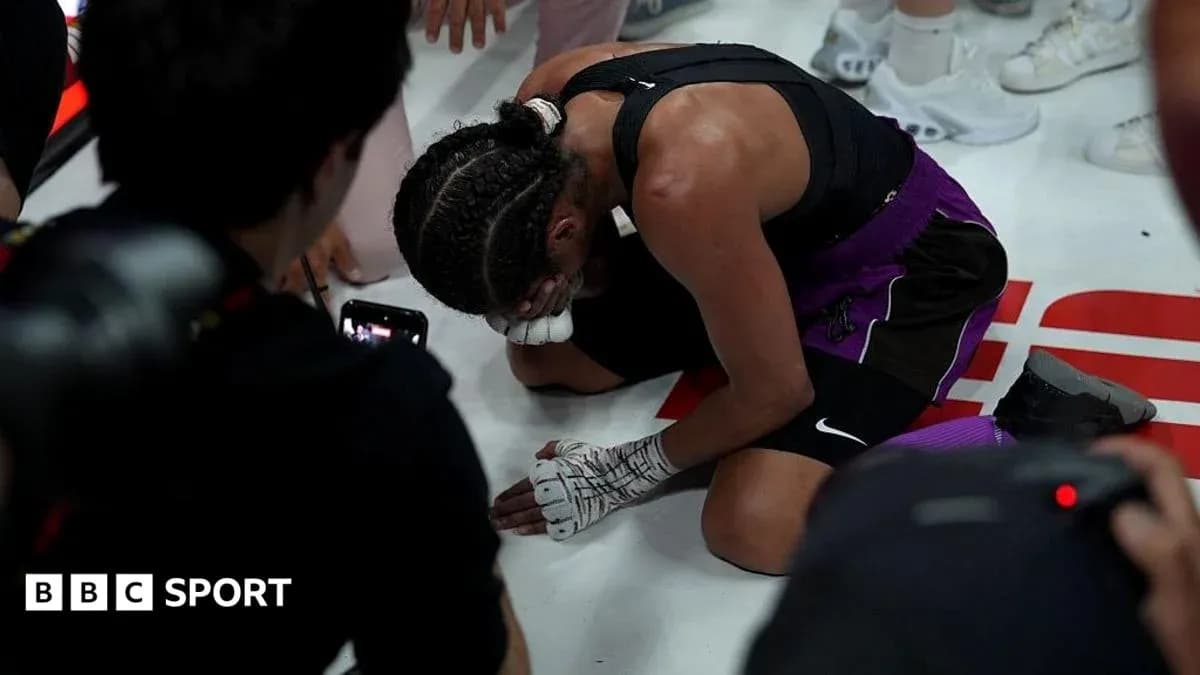
Ramla Ali sinks to her knees, tears pouring down her face in the middle of a Texas ring. At 36, after a life that has already contained more chapters than most careers, she finally has what she has chased for years: a world title. Two of them.
In Arlington, Ali edged previously unbeaten American Mikiah Kreps on a split decision to become WBO and IBF super-bantamweight champion, a result that crowns one of the most improbable journeys in modern boxing.
The scorecards – 97-92, 96-93 and 98-91 – told one story. The faces of the fighters told another. Ali collapsed in emotion, dedicating the win to her late father. Kreps stared in disbelief, convinced the night, and the belts, should have been hers.
From refugee to world champion
Ali’s path to this moment began long before the opening bell in Texas. She fled war-torn Somalia as a baby, settled in London as a refugee and fought her way into history as the first Somali boxer to compete at an Olympic Games at Tokyo 2020. She became the first Muslim woman to win an English title as an amateur. She became an activist, an author, a model, a visible symbol of possibility for young women around the world.
But the boxing dream, the one she talked about when she turned professional in late 2020 – becoming a world champion – looked like it had been smashed to pieces last year. She was knocked out in her ninth fight and then outclassed in her first world-title attempt by Yamileth Mercado two years ago. The doubters circled. Was this all a step too far? Did she really belong at this level?
On Saturday night, in the heat of a brutal, breathless fight, she answered them.
A knockdown, a backlash and a war of wills
The pivotal moment appeared to arrive in the third round. Kreps, 30, marched forward as she had from the start, only to walk straight into a flush left hook. The shot jolted her, sent her glove brushing the canvas as she tried to steady herself. The referee ruled a knockdown. Kreps protested. The replays were merciless. The call was right.
Ali had banked a 10-8 round. She had momentum. She had the crowd’s noise behind her.
But the fight did not turn into a procession. It turned into a test.
Kreps came roaring back, upping the tempo, pinning Ali under constant pressure. The American outlanded her with 115 punches to 78, including 91 power shots to Ali’s 70. One judge saw it as a rout the other way, scoring it 98-91 to Kreps.
As the rounds ticked by, Ali looked like a fighter living on fumes. Between rounds, she told her corner she was exhausted, that she couldn’t go on. Each time, her coach gave her the same answer: think of your dad. Do it for him.
So she dragged herself off the stool. Again. And again.
She boxed on instinct and will, trying to tame Kreps’ work rate, trying to steal the cleaner moments that might sway the judges. It became less about tactics and more about resolve. About how much punishment you can take and still find a way to land enough of your own.
When the final bell rang, both believed they had done enough. Only one would leave with the belts.
A win heavy with meaning
The announcement turned the arena into a split-screen of emotion. Ali, hearing her name, crumpled, sobbing, the months of grief and doubt spilling out on to the canvas. She spoke of her father, who died in May, and of a promise fulfilled. She spoke of Somalia, of the kids watching who might now believe they belong in places they were never meant to reach.
Kreps, beaten for the first time as a professional, was left to process a defeat that the punch stats suggested should have gone her way. For her, this was devastation. For Ali, it was vindication.
This was not the slick, flawless coronation of a dominant champion. It was messy, close, arguable. It was also utterly fitting. Nothing in Ali’s life has come easily. Why would the night that finally made her a world champion be any different?
What comes next
On the undercard, Australia’s Skye Nicolson retained her WBC belt with a unanimous decision over Japan’s Miyo Yoshida, keeping alive the prospect of a fascinating unification clash. Nicolson, like Ali, is signed to Jake Paul’s Most Valuable Promotions. The storyline almost writes itself.
But that can wait.
For now, Ali stands as WBO and IBF super-bantamweight champion, the refugee who became an Olympian, the model and activist who refused to walk away when her chin and ambition were questioned, the woman whose own biopic has just been released and already needs a new final act.
She was told to stop. She was told it was over after Mercado, after the knockout, after the critics sharpened their knives and wondered aloud why she was still doing this.
On a night in Texas, with the world titles strapped around her waist, Ramla Ali gave them her answer.