Rangers Face Pressure Amid Poor Performance and Financial Concerns
The warning landed like a punch.
“Be very careful – as much as we're loyal, if this rot continues, the atmosphere in the crowd will lead to people not turning up and buying what you're selling us.”
One shareholder, one microphone, about 800 Rangers investors listening. The line drew loud applause at the recent meeting, but it was really aimed at the new American-led regime now running Ibrox. A message, delivered politely but with a clear edge: do not mistake loyalty for blind faith.
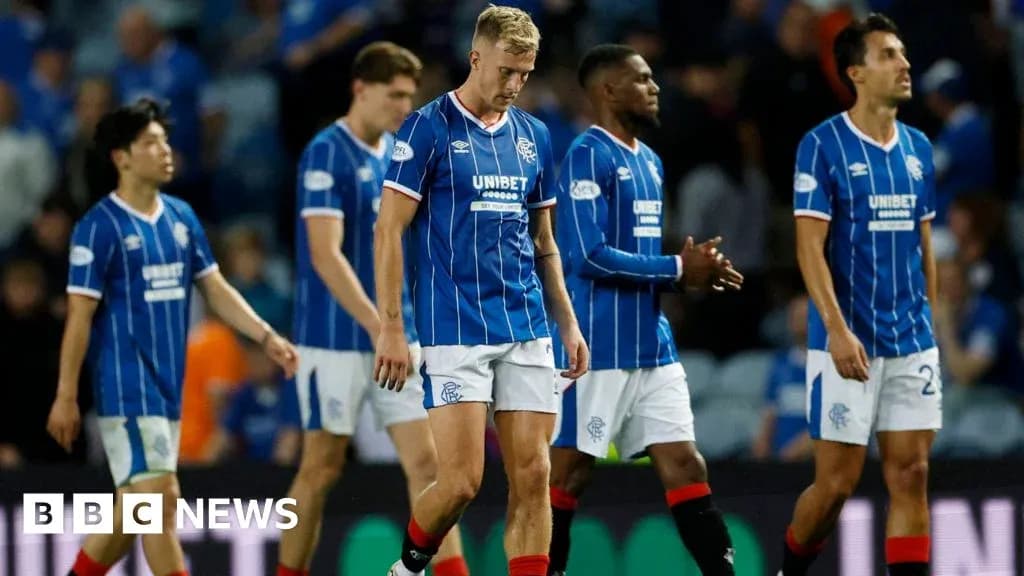
Four days later, the same fans watched Rangers stumble out of the Europa League. A 1-1 draw at home to Jagiellonia Bialystok, a result that confirmed elimination and summed up a miserable start under Derek McInnes.
Four games. Two draws. Two defeats. No momentum. No comfort.
McInnes, the former Hearts manager, is left trying to fix a team that looks fragile on the pitch. Above him, the board faces a different kind of pressure. They cannot afford to ignore that shareholder’s warning, because the numbers are blunt: if supporters stop buying into the project, the business model starts to creak.
Rangers need loyalty now more than ever. The performances are not selling themselves.
A fragile financial equation
Strip away the emotion and the problem is simple. When the product fails, the club has to work twice as hard to keep customers – in this case, fans – onside. In Scottish football’s tight financial landscape, that loyalty underpins everything.
For clubs at Rangers’ level, serious money comes from two places: Europe and player sales.
Over the past five years, excluding matchday income, Rangers have pulled in around £18m from European competition. In their last set of accounts, that was roughly 19% of total turnover. A fifth of the club’s revenue, built on continental nights.
To get close to that figure this season from the Europa Conference League, they would have to do something dramatic: win the tournament.
Kieran Maguire from the Price of Football website laid out the stark comparison. “For every pound you make in the Europa Conference League, you can make £2 in the Europa League and £7 in the Champions League,” he said.
The gap is brutal. Conference League participation also means fewer home games – three instead of four in the Europa League – so matchday takings dip as well. The only real upside is the theoretical chance to go deeper into the competition.
First, though, Rangers have to get there. They must beat Czech side Jablonec over two legs just to reach the league stage and even start thinking about a run.
Even if they do, the numbers are likely to be down. The club could still be staring at an £8m shortfall from European income compared with recent seasons. An English Premier League side could absorb that kind of hit. A financially robust club in another league might ride it out. For Rangers, it bites.
Player trading puzzle
One obvious way to plug the gap is the transfer market. That, historically, has been a weak point.
Reports suggest Rangers recently rejected an offer of around £22m for striker Youssef Chermiti. The decision looks even heavier now, with the forward suffering a serious injury that could keep him out for the rest of the season. A fee of that size would have eased the strain created by the Europa League exit. It didn’t happen. There is no quick fix there now.
Behind Chermiti, Nico Raskin is widely seen as the club’s next major saleable asset. The Belgian midfielder is currently valued at about £14.5m by Transfermarkt. Even if a buyer came in at that level, Rangers would immediately face another problem: replacing him without weakening the team further.
The board has already gone back to the market in a different way. A recent share issue raised £16m in fresh capital, with directors still seeking more investment. That money was sold to investors on a promise – it would go into strengthening the team.
Yet recruitment is one of the biggest concerns around Ibrox. More than 20 players have arrived in the past 12 months, but the squad looks disjointed and underperforming. Supporters see churn, not clear progression.
At the same time, the club has outlined plans to refurbish Ibrox and upgrade the training ground. All of that costs serious money.
The new consortium, many of whose members remain unnamed, put in an initial £20m when they took control a year ago. With revenues under pressure and the team struggling, it looks increasingly likely they will have to reach into their pockets again before the year is out.
Whether they are willing to do that, and on what terms, is a looming question.
Breaking points and empty seats
Before any fresh cash arrives, Rangers have another job: persuading their own supporters that this is still heading somewhere worthwhile.
Inside the club, the line is consistent. Poor recent results, they say, have not altered their long-term financial outlook or their ambition to win regularly and do it sustainably. The strategy, they insist, remains intact.
But that shareholder’s warning hangs over everything. The owners have already admitted to mistakes. Apologies, though, only carry weight if they are followed by visible change.
Chris Jack of the Rangers Review summed up the mood when he spoke to BBC Scotland News. “You cannot knock the loyalty and support the Rangers fans have given the club over many, many years, but every individual fan or fan base has a breaking point,” he said.
“They're going to have a point where they say ‘actually, I don't fancy it this afternoon and it's time for the club, the players and the manager to give me something.’”
For years, anger has been the dominant emotion around Ibrox when things have gone wrong. Now, in some corners, that anger is cooling into something more dangerous for any football club: apathy.
Apathy does not shout. It does not protest. It simply stays at home.
And for Rangers’ new regime, trying to rebuild a team, a balance sheet and a bond with the stands, that is the one cost they can least afford to pay.