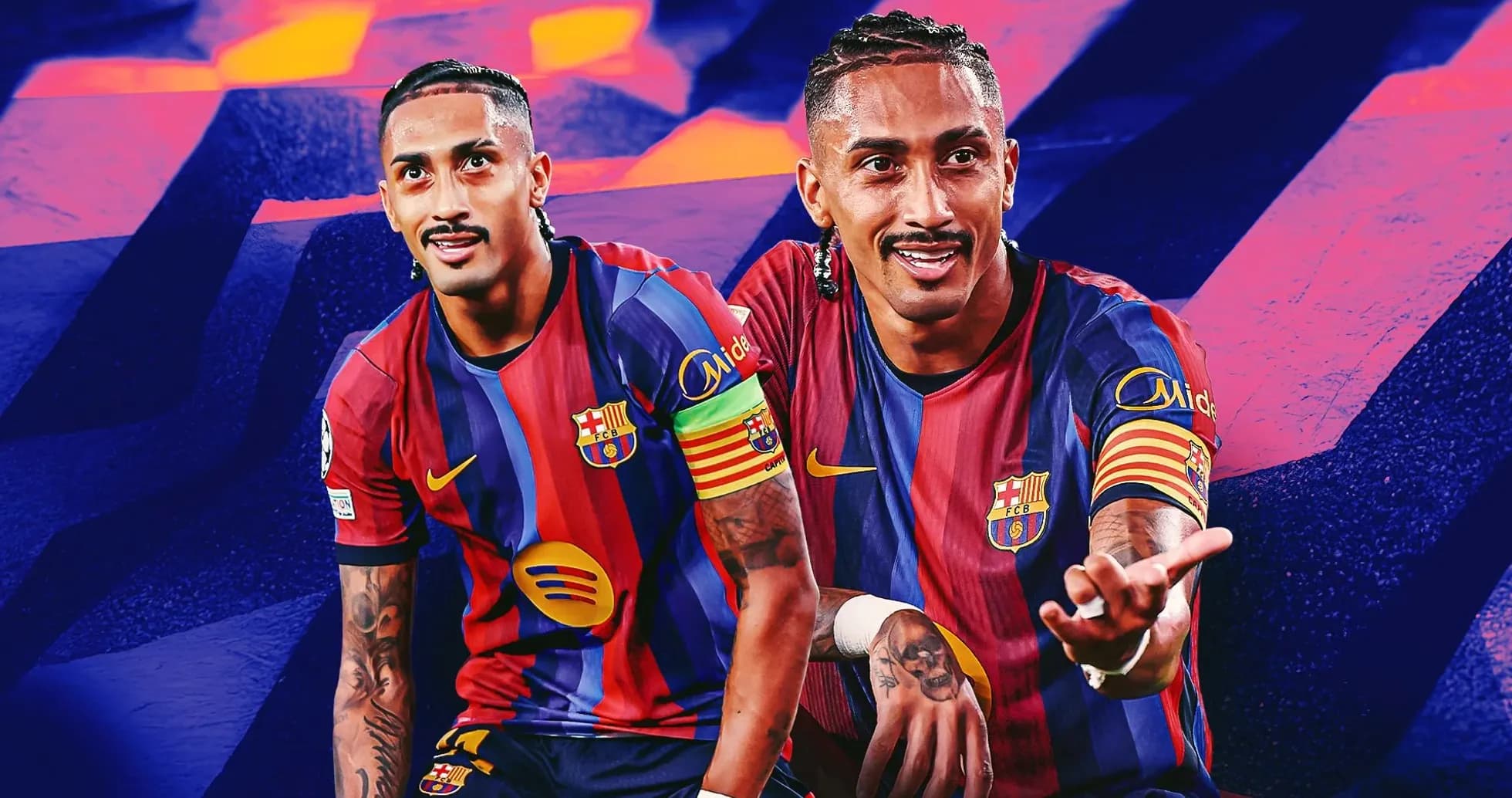
Raphinha's Transformation: From Injury Prone to Barcelona's New No.9
A year ago, Raphinha’s season was defined by ice packs and treatment tables. Now it’s defined by goals.
Under Hansi Flick, the Brazilian has been dragged out of the treatment room and dropped straight into the centre of Barcelona’s attack. Not as a stopgap. As the reference point. As the captain. As the man.
He has responded with the kind of form that makes a Ballon d’Or snub feel almost absurd.
From sidelined star to central obsession
Raphinha’s 2024-25 campaign was Ballon d’Or material: 60 goal contributions, a winger shredding defences from the left. Then his body betrayed him. Persistent hamstring injuries cost him 125 days, wrecked his rhythm and eventually ruined his World Cup. His numbers were sliced in half to 29 goal contributions last term.
The punishment went beyond the pitch. This year’s Ballon d’Or shortlist did not even include his name.
Flick didn’t hide his anger. “He (Raphinha) is far too good not to be on that list, but we can’t change it,” the Barca coach said, speaking with the certainty of a man who has just watched his striker tear apart another defence. Flick’s solution to the injustice? Hand Raphinha the keys to the centre of the pitch and build the team around him.
The result has been devastating.
A brace that announced a new monster
The clearest statement came in the Champions League opener against Feyenoord. Barca won 5-1. Raphinha walked off with the Player of the Match award. The scoreline felt almost secondary to the performance of their new No.9.
His first goal was pure theatre. He took a slightly wayward pass from Lamine Yamal, rolled past one defender, surged into the box, shaped to shoot, then produced a dummy so audacious it left two Feyenoord defenders collapsing to the turf. Only then did he pass the ball into the net with cold precision.
The second was straight from the centre-forward manual. Raphinha initially checked towards the ball when Dani Olmo picked it up in the centre-circle, then exploded in the opposite direction, losing his marker in a heartbeat. Olmo threaded the pass, Raphinha met it in stride and drilled a shot across the helpless goalkeeper.
It was the performance of a man playing with the swagger of the best in the world. Flick said as much: “Rapha has played fantastic. He’s on another level – he’s unbelievable.”
The numbers agree.
Numbers that echo club legends
Raphinha has already hit 11 goals this season. No Barcelona player in the last 60 years has started a campaign this fast. Not even Lionel Messi.
Messi reached 10 goals in his first seven appearances of 2012-13 and hit nine at the same stage in two other seasons. Ronaldo matched nine in 1996-97. Raphinha has gone past them.
He is doing it while reinventing what a Barca No.9 looks like. Robert Lewandowski was a classic target, supreme with his back to goal. Ferran Torres stretched teams with sharp runs in behind. Raphinha is something else entirely.
The 29-year-old drifts. He lives between the lines, darting into spaces that don’t exist until he creates them. His pace and close control drag defenders out of shape, his link play knits Barca’s fluid front line together. When Yamal and Anthony Gordon receive the ball wide, it is often because Raphinha’s movement has carved open the pitch for them.
And when the space is there for him? He doesn’t hesitate.
Hat-trick hero and pressing machine
Racing Santander discovered that the hard way. Barca smashed them 7-2 in La Liga, and Raphinha helped himself to a hat-trick.
Two of those goals came from the penalty spot, but the one in between captured his new identity. Again, Olmo was the architect. Again, Raphinha’s brain did the damage. He ghosted into the gap between Racing’s centre-backs, waited, then pounced the second the pass arrived. One touch to set, a half-volley guided into the corner. No fuss. No doubt.
On the ball, he makes the game look simple. Off it, he turns it into a grind for everyone else. Barca’s press starts with him, and he hunts relentlessly, forcing errors because he refuses to stop running at full tilt.
This is the intensity Flick demands. It’s also why the coach will quietly be relieved that a move for Julian Alvarez never materialised. With Raphinha leading the line like this, Barcelona can spend their money elsewhere in the next windows.
Walking in the shadow of R9
Barcelona’s relationship with Brazilian brilliance is long and glittering: Romario, Rivaldo, Ronaldinho, Neymar. But one season still stands apart – Ronaldo’s lone year in 1996-97.
Ronaldo arrived from PSV for a world-record fee of $19.5m at just 20 years old and detonated La Liga. He scored 47 goals in 49 games, won the Copa del Rey, the UEFA Cup Winners’ Cup and the Supercopa de España, and tore through defences with terrifying strength, raw speed and ruthless finishing.
He claimed the Pichichi with 34 league goals, took the European Golden Shoe and topped the 1997 Ballon d’Or vote. The highlights from that season remain stitched into Barca folklore: the solo run against SD Compostela, the hat-trick that turned a 4-3 Copa del Rey quarter-final against Atletico Madrid into a classic.
“He is the most spectacular player I’ve ever seen,” said Sir Bobby Robson at the time. Laurent Blanc summed up the experience of facing him: “He was like a freight train coming at you with a ball at his feet.”
Ronaldo – R9 – was a fixed spearhead, a pure reference point. Raphinha roams more, but the instincts are familiar. The directness. The refusal to waste time on the ball. The ability to slice through a team in seconds with a mix of flair and fearlessness.
If he keeps this level, the comparison will not just be about style. It will be about output. And trophies.
The captain who almost walked away
That this version of Raphinha exists at all owes much to Flick. Without the German, he might not even be at Camp Nou.
His first two seasons at Barca were underwhelming. Under Xavi, he never fully nailed down a starting spot, never truly became indispensable. A move away in 2024 felt likely.
Flick saw something else. He saw a player with untapped potential, a leader waiting to be challenged. When Marc-André ter Stegen left on loan to Ajax in the summer, Flick didn’t hesitate. He handed the captain’s armband to Raphinha – the first Brazilian ever to wear it permanently in Catalunya.
The response has been emphatic. His passion, work rate and team-first mentality have set the standard for a young squad. He doesn’t just talk about responsibility; he takes games by the scruff of the neck and drags them where he wants.
Raphinha himself refuses to indulge in self-congratulation. After the Racing demolition, he cut through any hype: “I will never say I am performing well; I always strive to improve everything I can. I am happy with the goals, and with the win, and that is the most important thing, but we have to keep improving.”
He stressed how “comfortable” he feels through the middle and credited Flick for changing how he thinks and sees himself. “He is the coach who changed the way I think and how I see myself,” Raphinha said. “I am extremely grateful.”
A frontline humming – and carefully managed
Raphinha is the face of Barca’s attacking resurgence, but he is not alone. Flick’s forward line is loaded.
Gordon, Karim Adeyemi and Gabriel Jesus have all settled quickly after arriving in the summer. An 18-year-old Egyptian striker, Hamza Abdelkarim, has stepped up from Barca B to offer yet another profile in the box.
“Raphinha, Gabby and Hamza are three different profiles, but there are other ways we could play,” Flick has explained. “Anthony and Karim can also play in this position (as striker). Or Dani Olmo. Dani has showed us in last two years he can play there – the same with Fermin [Lopez]. We have a lot of options.”
Those options matter for one reason above all: Raphinha’s body. Barca cannot afford a repeat of last season’s injury woes. Flick has been ruthless with his substitutions, withdrawing his captain early against Feyenoord, Athletic Club and Racing to preserve his legs.
The same care is being applied to Yamal. The teenager has become even more dangerous playing closer to Raphinha. Their understanding is instinctive. The moment a centre-back shifts his body towards Yamal, the youngster slips the ball inside, trusting that Raphinha is already darting into the blind-side channel.
Yamal seems content to let Raphinha be the headline act. The dressing room is stacked with star power, but egos are kept in check. The collective edge is sharp, the mood is focused. It feels like a group building towards something substantial.
Towards the Hall of Fame?
Barcelona’s history is full of Brazilian artists, but only a few reach the inner circle, the true Hall of Fame. Ronaldo sits there. Ronaldinho sits there. Others hover just beneath.
Raphinha is not there yet. He knows it. He acts like it. But with the armband on his arm, the goals flying in and a team built to his strengths, he is charging down that corridor.
If this is how his story as a central striker begins, how frightening might the next chapters be?