Real Betis vs Real Madrid: Tactical Analysis of La Liga Draw
Real Betis and Real Madrid shared a 1-1 draw at Estadio La Cartuja de Sevilla in a La Liga Regular Season - 32 fixture that felt like a tactical arm-wrestle more than an exchange of punches. Real Madrid led from the 17th minute through Vinicius Junior and controlled key transition moments, but Betis’ structural tweaks and bench depth gradually tilted the pitch. Héctor Bellerín’s 90' equaliser, assisted by Giovani Lo Celso, crystallised a second half in which Betis’ 4-2-3-1 evolved into a far more aggressive, possession-dominant shape. With xG almost level (1.08 vs 1.19) and possession split 52%-48%, the draw reflected the underlying balance, but the routes both sides took to that parity were markedly different.
Vinicius Junior opened the scoring at 17', finishing a Real Madrid attack that exploited the front-two dynamics of Kylian Mbappé and Vinicius against a stretched Betis back four. From there, the match’s rhythm was punctuated by Betis’ attempts to re-balance their defensive line and Real Madrid’s efforts to manage space rather than the ball.
The first major structural change came at 32', when Marc Bartra (OUT) made way for Diego Llorente (IN). This was not just like-for-like: Llorente’s more conservative positioning allowed Natan to be more aggressive in stepping into midfield, an early signal that Betis were willing to compress the central corridor to disrupt Jude Bellingham and Federico Valverde.
Discipline then briefly shaped the tempo. Sofyan Amrabat was booked at 38' for a foul, a direct consequence of Betis’ higher engagement line and his responsibility as the single most screening-oriented midfielder in front of the centre-backs. Two minutes later, at 40', Dean Huijsen received a yellow card for a foul, underlining how Real Madrid’s young centre-back pairing had to defend large spaces behind an advanced midfield line.
Halftime arrived with Real Madrid 1-0 up, reflecting their sharper early execution rather than overwhelming dominance. Statistically, they were more efficient: 8 shots on goal from 12 total attempts, with 10 of those inside the box, compared to Betis’ 4 on target from 19 total shots.
Betis’ tactical reset began immediately after the interval. At 46', Álvaro Fidalgo (OUT) was replaced by Marc Roca (IN), and Cedric Bakambu (OUT) was replaced by Cucho Hernández (IN). Functionally, this did two things: Roca’s entry gave Betis a deeper passer alongside or slightly behind Amrabat, improving first-phase circulation, while Cucho Hernández offered more vertical runs and channel occupation than Bakambu, stretching Real Madrid’s back line and opening lanes for Pablo Fornals and Abdessamad Ezzalzouli between the lines.
The next decisive adjustment came at 68', when Fornals (OUT) made way for Lo Celso (IN). Lo Celso’s left-footed playmaking from the half-space transformed Betis’ attacking structure. The 4-2-3-1 began to look like a 2-3-5 in settled possession: full-backs high, double pivot (Amrabat/Roca) stabilising rest defence, and a fluid front five interchanging behind Cucho.
Real Madrid’s response was to refresh legs and protect central zones. At 72', Trent Alexander-Arnold was booked for a foul, a symptom of the increasing defensive strain on the right side as Betis overloaded with Ezzalzouli and Bellerín. One minute later, at 73', Betis made a crucial midfield swap: Amrabat (OUT) was replaced by Isco (IN), further tilting the side towards creativity over pure ball-winning. Simultaneously, Real Madrid began their own reshaping: Dean Huijsen (OUT) for David Alaba (IN) at 73' introduced a calmer distributor at the back, while Thiago Pitarch (OUT) for Eduardo Camavinga (IN) at the same minute added press resistance and ball-carrying in midfield.
In attack, Real Madrid tried to regain vertical threat late on. At 81', Mbappé (OUT) was replaced by Gonzalo García (IN), and at 82', Brahim Díaz (OUT) made way for Manuel Ángel Morán (IN). Both changes aimed to refresh the front line’s intensity and pressing, but by then Betis’ territorial control was pronounced.
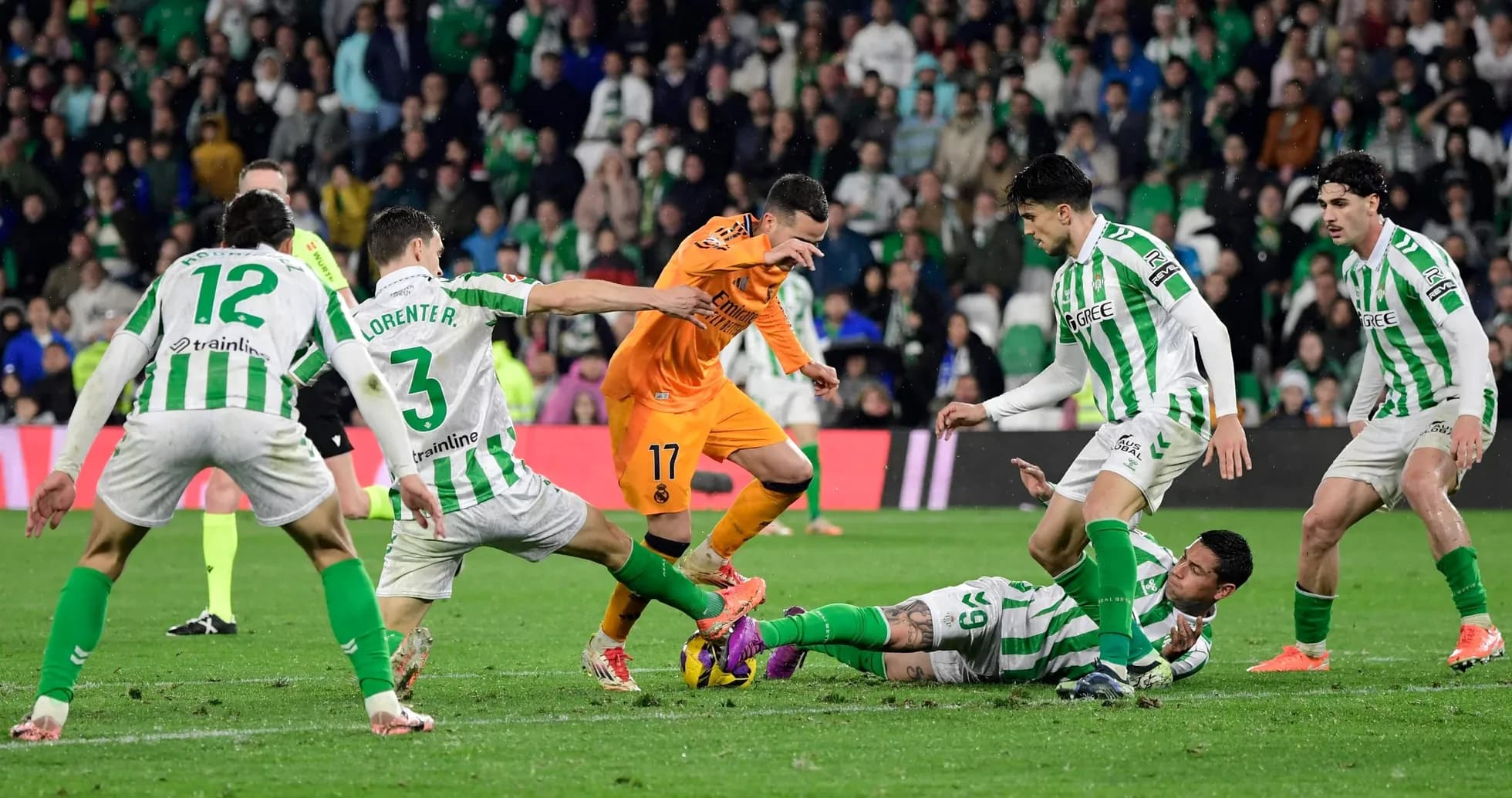
The payoff came at 90', when Bellerín scored for Betis, assisted by Lo Celso. The right-back’s advanced positioning was the culmination of Betis’ second-half structure: full-backs consistently high, supported by a technically secure midfield triangle (Roca, Isco, Lo Celso). The move also underlined how Real Madrid’s defensive block, increasingly deep and narrow, struggled to track late-arriving wide runners.
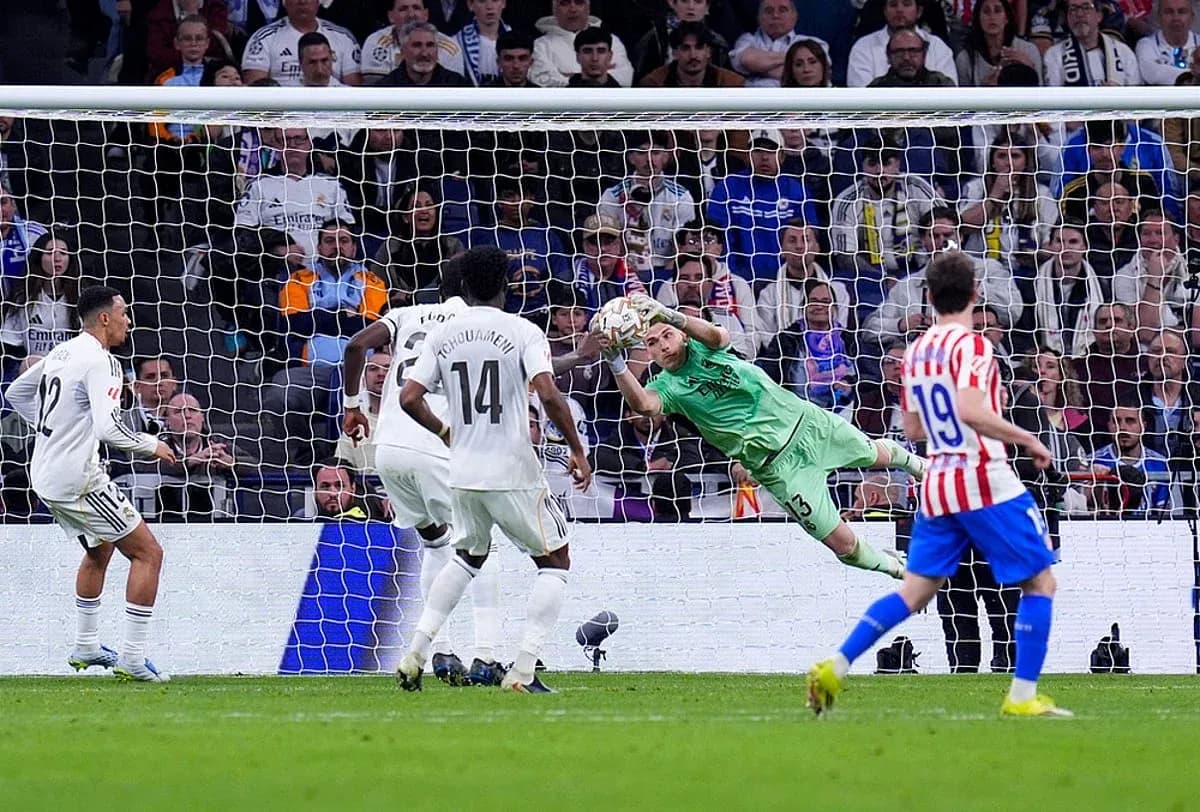
From a goalkeeping standpoint, the numbers tell a clear story of roles rather than heroics. Álvaro Valles made 7 saves, reflecting Real Madrid’s high shot quality (8 shots on target from 12 total, 10 inside the box) and their preference for incisive, selective attacks rather than volume. His “goals prevented” metric sat at 0, suggesting the shots he faced aligned closely with their expected difficulty and that he performed to statistical expectation rather than above it.
Andriy Lunin, by contrast, faced 4 shots on target from Betis’ 19 total attempts and made 3 saves, also with 0 goals prevented. Betis’ shot profile was more speculative, with 7 efforts from outside the box, and many of their attacks ending in blocked or off-target attempts (5 blocked, 10 off target). Lunin’s workload was lighter in volume but carried high leverage late on as Betis pushed numbers forward.
Tactically, Real Madrid’s 4-4-2 was built around verticality and efficiency. Bellingham and Valverde provided the central engine, Pitarch initially offering a more balanced wide-midfield presence opposite Brahim Díaz. The front two of Mbappé and Vinicius stretched Betis’ centre-backs horizontally, creating channels for late midfield arrivals. Defensively, their overall form was solid: only 10 fouls conceded and 2 yellow cards, suggesting a controlled aggression, while their defensive index—anchored by Rüdiger, Huijsen/Alaba, and Mendy—limited Betis to largely sub-optimal shooting positions until the final phase.
Betis’ 4-2-3-1, however, evolved more dramatically. Early on, the double pivot of Amrabat and Fidalgo struggled to progress cleanly under Real Madrid’s pressure. After the introduction of Roca, Lo Celso, and Isco, Betis’ overall form became that of a high-possession, territory-dominant side: 573 passes completed at 90% accuracy, 52% possession, and 7 corners to Madrid’s 6. Their defensive index, while not overly aggressive (10 fouls, 1 yellow card), relied heavily on structural compactness rather than duels, especially once Amrabat departed.
Statistically, the verdict is of near-perfect equilibrium. Real Madrid edged xG (1.19 to 1.08) and generated higher-quality chances with fewer shots, while Betis accumulated volume and territorial control, especially after the break. Card totals were modest and precise: Betis 1 yellow (Amrabat 38'), Real Madrid 2 yellows (Huijsen 40', Alexander-Arnold 72'). The 1-1 final score, with halftime at 0-1, mirrors a match in which Madrid’s early clinical edge was gradually eroded by Betis’ structural adjustments and bench impact, culminating in a deserved late equaliser that tactically felt inevitable long before Bellerín’s finish.