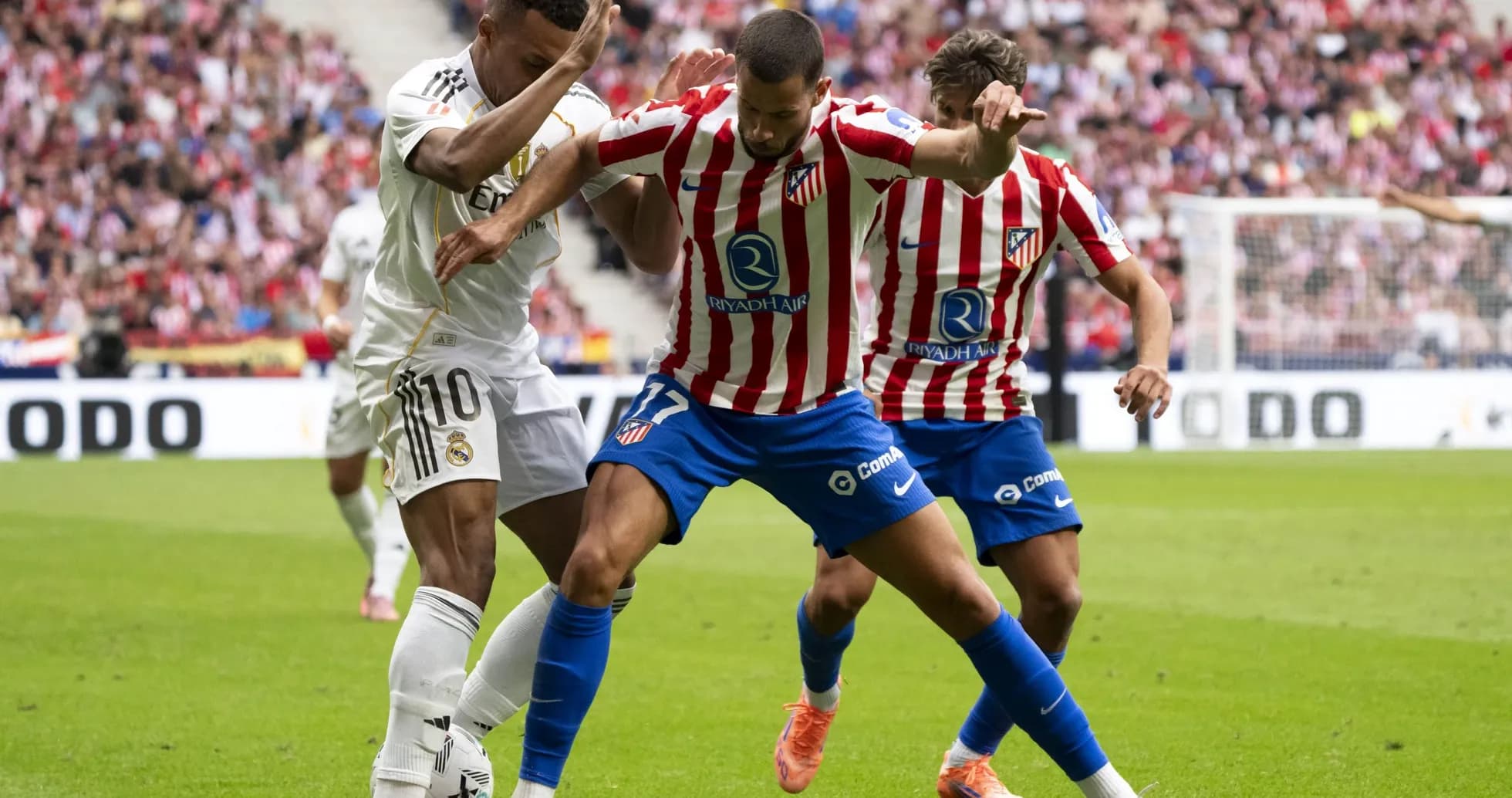
Real Madrid vs Atletico Madrid: Tactical Analysis of a 3-2 Victory
Real Madrid’s 3-2 win over Atletico Madrid at the Santiago Bernabéu was defined by structural flexibility, vertical aggression and superior use of wide spaces within a shared 4-4-2 framework. Both sides lined up in mirrored shapes, but the interpretation of that system diverged sharply as the game unfolded, especially around Real Madrid’s right side and Atletico’s left defensive lane.
Alvaro Arbeloa’s Real Madrid started in a clear 4-4-2: Andriy Lunin in goal; a back four of Dani Carvajal, Antonio Rüdiger, Dean Huijsen and Fran García; a midfield line of Federico Valverde, Thiago Pitarch, Aurélien Tchouameni and Arda Güler; with Brahim Díaz and Vinicius Junior up front. The shape, however, behaved more like a 4-3-1-2 or 3-2-5 in possession. Tchouameni anchored centrally, Valverde stepped high and wide to the right, and Güler drifted inside from the left, leaving Fran García to provide width on that flank. Brahim often dropped between the lines, turning the nominal front two into a fluid front three with Vinicius pulling into the left half-space.
Diego Simeone’s Atletico Madrid also deployed a 4-4-2, but with a more orthodox interpretation. Juan Musso was protected by a back four of Marcos Llorente, Robin Le Normand, Dávid Hancko and Matteo Ruggeri. In midfield, Giovanni Simeone and Johnny Cardoso occupied the right half and central-right lanes, Koke sat as the central organiser, and Ademola Lookman started from the left. Antoine Griezmann and Julián Álvarez formed the front two. Out of possession, Atletico’s block was compact and horizontally narrow, with Lookman initially tasked with tracking Carvajal and then jumping onto Tchouameni when the ball was central.
Atletico’s Early Threat
Atletico’s early threat came from directness and transition. Their opener at 33' – Lookman finishing from a G. Simeone assist – reflected a pattern: quick progression into the channels behind Real’s advanced full-backs. Real’s back line, especially with Fran García high on the left and Carvajal occasionally joining Valverde on the right, left pockets for Atletico’s front and wide players to exploit. With 7 shots on goal from 13 total attempts and an xG of 1.0, Atletico were selective rather than high-volume, looking to convert transitions rather than sustain long attacking phases.
Real Madrid’s Response
Real Madrid’s response after the break was driven by tempo and positional aggression. They finished with 52% possession, 17 total shots and a substantial 2.41 xG, evidence of consistent territorial control and chance creation. The penalty converted by Vinicius Junior at 52' came from sustained pressure and box occupation: both forwards pinning the centre-backs, Valverde arriving late, and Güler drifting into pockets that forced Atletico’s midfield line to collapse.
Valverde’s strike at 55' underlined his dual role as a right midfielder and extra central runner. With Tchouameni holding and Pitarch offering short support in the right half-space, Valverde could time his surges beyond Brahim and Vinicius. His goal was the product of Real overloading the right, then attacking the space at the top of the box. Up to that point, Atletico’s right side, with Llorente and G. Simeone, had struggled to contain both Valverde’s vertical runs and Carvajal’s overlaps.
Simeone's Tactical Changes
Simeone reacted aggressively on 57', reshaping his side with a triple substitution: at 57', A. Sorloth (IN) came on for A. Griezmann (OUT); at 57', N. Gonzalez (IN) came on for J. Cardoso (OUT); and at 57', N. Molina (IN) came on for A. Lookman (OUT). This altered the dynamic on Atletico’s right: Molina provided a more natural full-back profile higher up, while Sorloth and Álvarez formed a more direct, physically oriented front pair. The impact was immediate in transition, culminating in Molina’s 66' goal from a J. Álvarez assist, again exploiting Real’s advanced full-backs and the space left when their midfield pushed on.
Arbeloa’s Key Shift
Arbeloa’s own key structural shift came at 64'. At 64', K. Mbappe (IN) came on for T. Pitarch (OUT), and at 64', T. Alexander-Arnold (IN) came on for D. Carvajal (OUT). Mbappé’s introduction moved Real into a far more aggressive front line, with Mbappé, Vinicius and Brahim stretching Atletico’s back four horizontally. Alexander-Arnold, from right-back, acted almost as an auxiliary playmaker, stepping into midfield to dictate switches and diagonal deliveries. His influence was crystallised at 72', when Vinicius Junior’s second goal came from an Alexander-Arnold assist, a sequence that showcased Real’s ability to pin Atletico deep and find quality in the final pass.
Defensive Resilience
Defensive resilience was high on both sides: Real Madrid saw 1 of their shots blocked, while Atletico Madrid had 1 attempt stifled by the opposition. However, the defensive profiles diverged. Real, with 2 fouls and 1 yellow card before Valverde’s red, defended largely through structure and counter-pressing rather than repeated challenges. Atletico, committing 15 fouls and collecting 4 yellow cards, relied more on disrupting rhythm and protecting the central lane.
The red card to Valverde at 77' forced Real into a late-game reconfiguration. Reduced to ten men and protecting a 3-2 lead, they had to compress space centrally and sacrifice some of the high pressing that had pinned Atletico back. Arbeloa’s final substitution at 87' – at 87', A. Carreras (IN) came on for Vinicius Junior (OUT) – further signalled a tilt towards defensive stability on the left, shoring up the flank that Atletico had targeted earlier.
Goalkeeper Performances
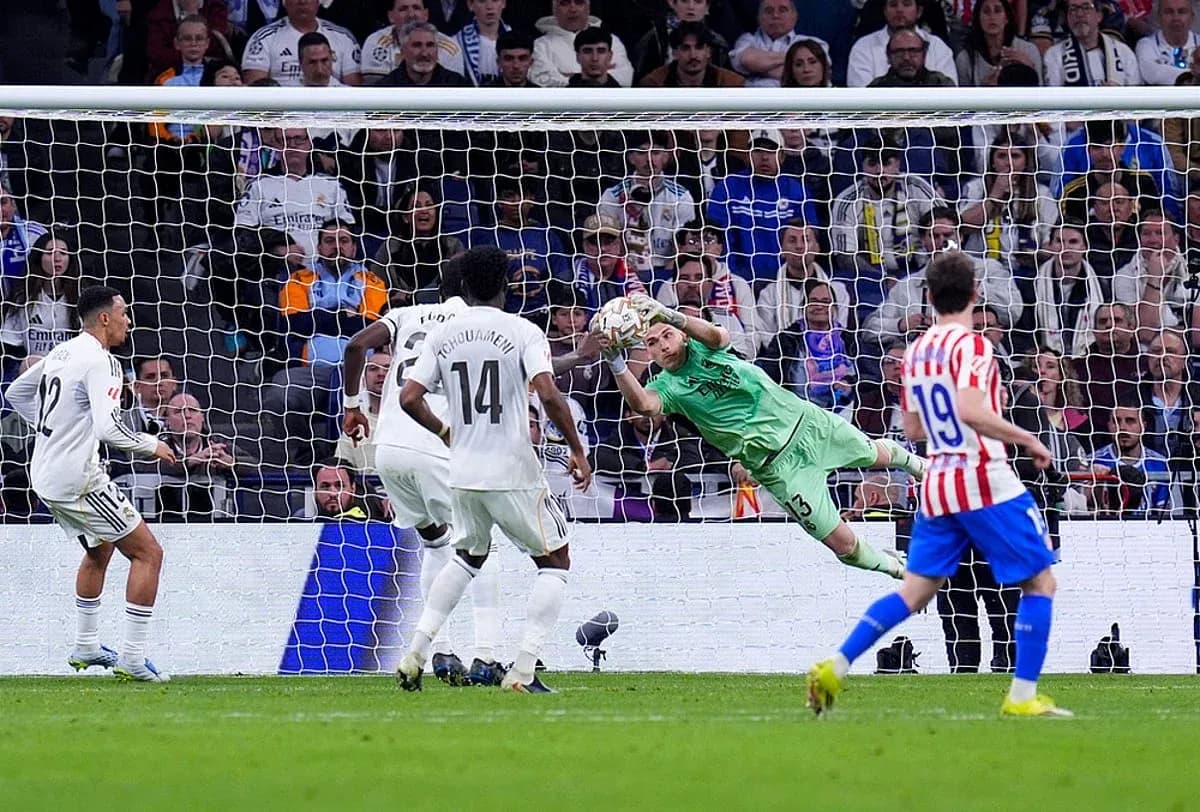
In goal, both keepers were active. Lunin made 5 saves, but with Real’s goals prevented at -1, the data suggests that the defensive unit as a whole allowed slightly higher-quality chances than the scoreline alone might imply. Musso also recorded 5 saves, yet Atletico’s goals prevented figure of -1 indicates their defensive structure similarly underperformed relative to the quality of chances conceded.
Ultimately, Real Madrid’s superior xG (2.41 vs 1.0), higher shot volume (17 vs 13) and marginal possession edge (52% vs 48%) underscore a performance built on sustained pressure, intelligent positional rotations and decisive use of substitutions. Atletico’s direct transitions and structural tweaks kept them competitive, but Real’s attacking flexibility – particularly after the introduction of Mbappé and Alexander-Arnold – tilted the tactical balance decisively in the hosts’ favour.