Roberto De Zerbi's Challenge at Tottenham: Overcoming Mental Fragility
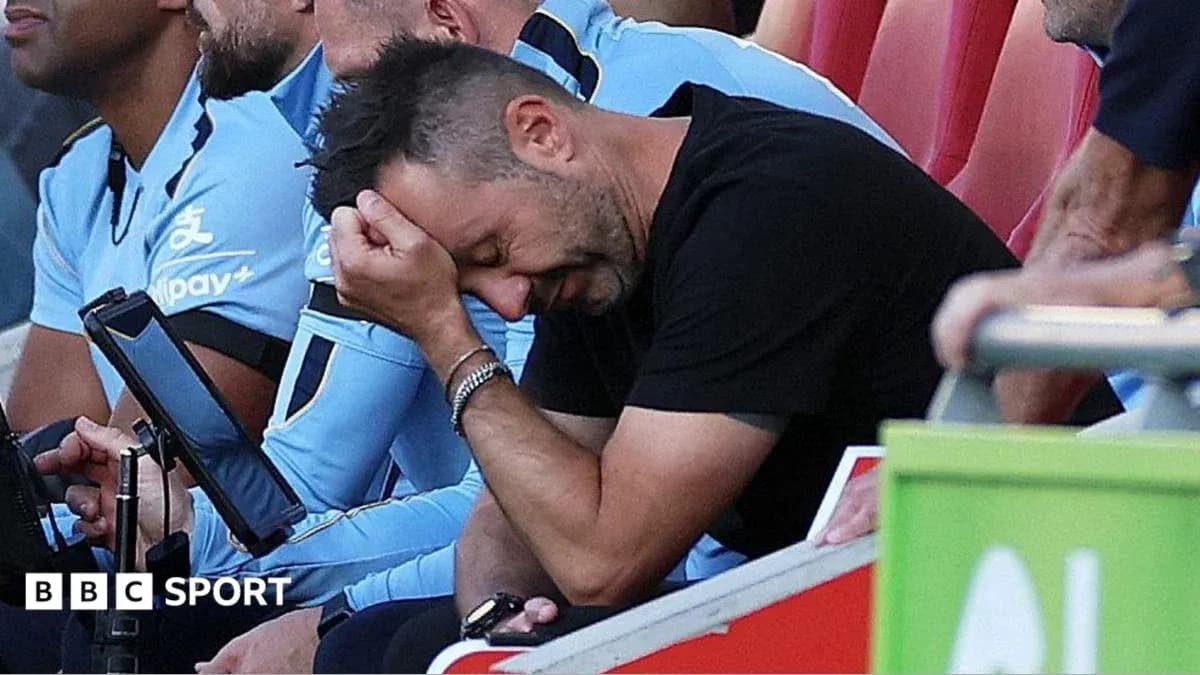
Roberto De Zerbi will soon have spent close to £400m reshaping Tottenham Hotspur, yet it took only 90 minutes in west London to show that money still cannot buy a backbone.
The Italian walked into Spurs last March talking as much about mentality as tactics. Seven games to save a season, seven games to keep them in the Premier League. He did it, just, with a final‑day escape against Everton. The reward was a vast transfer budget and a mandate to ensure that kind of anxiety never returns.
On this evidence, it might.
A new era, same old Spurs
This 3-0 defeat at Brentford was exactly the kind of nightmare De Zerbi and the club’s hierarchy believed they were paying to avoid. New recruitment team, new transfer strategy, new faces everywhere you looked. Yet the first time Brentford turned up the heat, Spurs folded in horribly familiar fashion.
They were not just beaten. They were bullied.
De Zerbi has spoken openly about the psychological scars of a squad that has finished 17th in back-to-back seasons. He thought he had started to address them. Instead, under the sunshine at The Gtech Community Stadium, the new Spurs looked alarmingly like the old version: brittle, hesitant, mentally fragile.
He tried to explain it away with conditioning. Too many players late back from the World Cup. Too many newcomers still short of sharpness. But that did not explain the basics that went missing – the lack of resistance in duels, the absence of organisation, the way Brentford won almost every important battle.
“Bad game,” he told BBC Sport’s Match of the Day. “We lost and suffered the difference in the duels. It was the key of this game. We didn't fight in the right way. Maybe credit to them because it's the best quality Brentford have.
“Our physical condition was not in the right level for all players because many came later after the World Cup and there were many new players in the squad and first XI. But we have to analyse this game better because we can't play this way in this type of game.”
From roar to resignation in 49 minutes
The afternoon began with noise and belief. In one corner of The Gtech, Spurs fans gave their new signings a raucous welcome, a travelling support determined to embrace the idea of a reset.
By the 49th minute, many of them were already on the way home.
Michael Kayode’s strike to make it 3-0 prompted a stream of supporters towards the exits, leaving the new recruits applauding rows of empty seats at full-time. The exodus summed up the mood: not anger, not yet, but a weary sense of déjà vu.
It could easily have been worse. Igor Thiago, usually so reliable from the spot, smacked a penalty against the post. A let-off in theory, but no consolation in reality. The contest had long since slipped away.
Rock legend Jon Bon Jovi watched on from the stands, and Spurs handed him enough material for a box set of bleak ballads. They started poorly and then disintegrated.
Big names, big fees, no impact
De Zerbi threw four of his new signings straight into the fray: Andrew Robertson, Marcos Senesi, Jan Paul van Hecke and Sandro Tonali. If they wanted a low bar for improvement, they found it here. None made a case for themselves, though they were hardly alone.
Tonali, the £100m marquee arrival from Newcastle United, endured the harshest afternoon. Brentford’s record signing Mamadou Sangare dominated the midfield, outmuscling and outplaying the Italian to such an extent that the fee became an easy punchline for the home crowd.
Tonali’s most notable contribution was a wild first-half effort that sailed high into the sky, greeted by gleeful taunts that Spurs had wasted their money.
Matheus Fernades, an £85m signing from West Ham United, came off the bench. Savinho and possibly Omar Marmoush will add more options when they are involved. That is not where the real problem lies. What De Zerbi lacked here was not depth, but heart.
From the opening minutes, Spurs’ “brave new world” looked haunted. One surge of Brentford pressure, and the visitors cracked. The Bees sensed it and swarmed, hunting down a side that looked unsure of itself and easy to unpick.
They were right.
Brentford ruthless, Spurs rattled
Brentford should have led before Keane Lewis-Potter finally broke through after 12 minutes. When Vitaly Janelt doubled the advantage before half-time, the game felt almost done. Spurs had no response, no spark, no hint of a comeback.
On the touchline, De Zerbi fumed and gestured, trying to inject urgency into a team that had already sunk into resignation. Heads dropped. Challenges were lost. Panic replaced structure. Any notion that this might be a slow burn of a project evaporated in a blur of red-and-white shirts streaming forward.
Conor Gallagher and Lucas Bergvall did not emerge for the second half, withdrawn at the break. They could fairly argue several others might have followed.
De Zerbi knows what comes next. He has to go back into the minds of these players and try to rebuild them from the inside out. That cannot be done with a chequebook.
A pattern Spurs cannot ignore
Plenty of ambitious sides have stumbled on opening day and gone on to recover. Context matters. But this did not feel like a one-off.
This felt like a continuation.
The pattern – frailty, resignation, the familiar slide into defeat – has hung over Spurs for years, through Ange Postecoglou’s tenure, which at least brought a Europa League title, through Thomas Frank’s stint and the fleeting, forgettable reign of Igor Tudor.
De Zerbi did not hide from the scale of the problem.
“I am surprised for the result and performance,” he said. “I knew we were not in the right condition. We can't find an excuse. I am sorry for the result and performance. We are starting a new project and we couldn't find the principle.
“Marcos Senesi, Jan Paul van Hecke and Sandro Tonali are not in the best physical condition. We knew that before the game. We have to improve on that and many other things like organisation and pressing.”
More signings are likely. More money will be spent. De Zerbi, though, refused to lean on that as a shield.
“I don't want the excuse that the first XI was not enough to compete and get a result. Brentford's spirit on the pitch was great, it has to be the right example for us.”
New faces can freshen a dressing room. They cannot, on their own, erase a culture where collapses like this feel almost routine.
If Spurs are to escape the cycle of drift and disappointment, De Zerbi’s real task is clear. He does not just have to rebuild a squad. He has to rip out a mentality that has taken root over seasons of underachievement – and he has to do it before this campaign starts to look like the last two all over again.