Rodri's Journey: From Injury to World Cup Glory
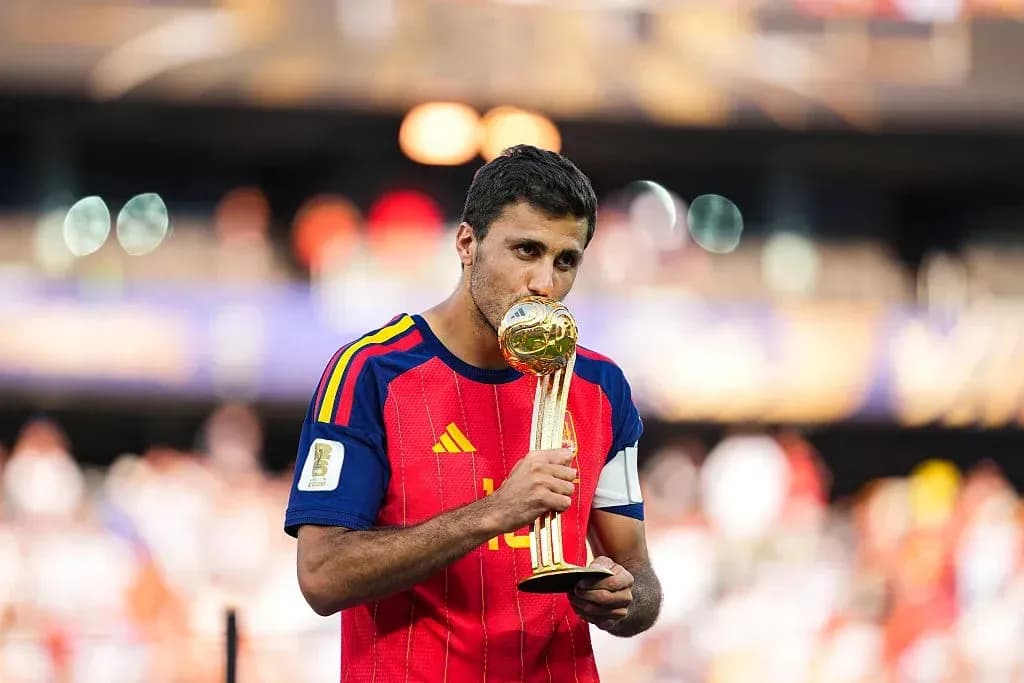
Rodri stood on the podium with the World Cup in his hands and the Golden Ball at his feet, but his mind was somewhere else entirely – back in a treatment room, back in September 2024, back when his right knee refused to cooperate and the future looked a lot smaller than it does today.
Spain had just edged Argentina 1-0 in extra time to reclaim the biggest prize in football, a final that demanded nerve, patience and a willingness to stare down one of the game’s great powers. At the heart of it all, as he has been so often for club and country, was Rodri.
Only this time, the story ran deeper than tactics and territory.
The midfielder’s season had been shredded by that serious knee injury and the setbacks that followed. Each time he tried to climb, the game pushed him back down. For many, missing months in a World Cup year is a brutal twist. For Rodri, it became the defining chapter.
So when the final whistle went and Spain’s players scattered across the pitch in disbelief, his reaction carried a different weight.
"We're a bit shocked right now, even myself," he told Fox Sports in the immediate aftermath. "I cannot express with words. I think now we're like in a cloud but, for me, it's been a very tough time."
The World Cup has a habit of anointing stars. Here, it crowned a survivor.
Rodri didn’t just lift the trophy; he left the tournament as its best player, the Golden Ball winner in a team built on control and courage. He anchored Spain through tight games, dictated tempo, and in the final against Argentina he again set the rhythm in a contest that always felt like it might be decided by a single moment.
Yet his mind kept circling back to those months out, to the long, lonely grind of rehab.
"I just want the new generations to see my example as an opportunity," he said. "When you go down, you can rise again. This is my philosophy for my entire life."
That line will travel. Young players, watching him spray passes on the biggest stage, will see the polished product. Rodri wants them to see the scars.
"Of course, sometimes things go well, things go wrong, but always the positiveness," he added.
The message wasn’t just for the kids. Before the final, inside the dressing room, he went straight at the fear that can suffocate teams on nights like this.
"I said to the lads before the game, 'we have to go for the game.' We need to face them, we have to look to their eyes. We want this game."
No talk of caution. No retreat. Spain stepped into the final as a team determined to play on their terms, even against Argentina’s aura. The 1-0 scoreline, sealed in extra time, told the story of a match on a knife-edge, but also of a side willing to be brave when fatigue and doubt began to bite.
"And then life gives you the World Cup or not," Rodri said, "but we were brave and I was brave in that moment I was down, so I want to thank all the people that helped me."
Then came the most revealing line of the night, one you rarely hear from a player in the glow of a trophy lift.
"But I want to thank myself, to be honest, in those moments."
It was raw. Honest. Stripped of cliché. Rodri wasn’t just saluting the physios, the staff, the support network around him. He was acknowledging the fight it took to keep going when no cameras were rolling, when the only audience was a clock on the gym wall.
On a night when Spain returned to the summit of world football and a midfielder claimed the Golden Ball, the story cut through the noise: a player broken by injury, rebuilt by stubbornness, and now holding the sport’s greatest prize as a living, breathing example of what it means to rise again.