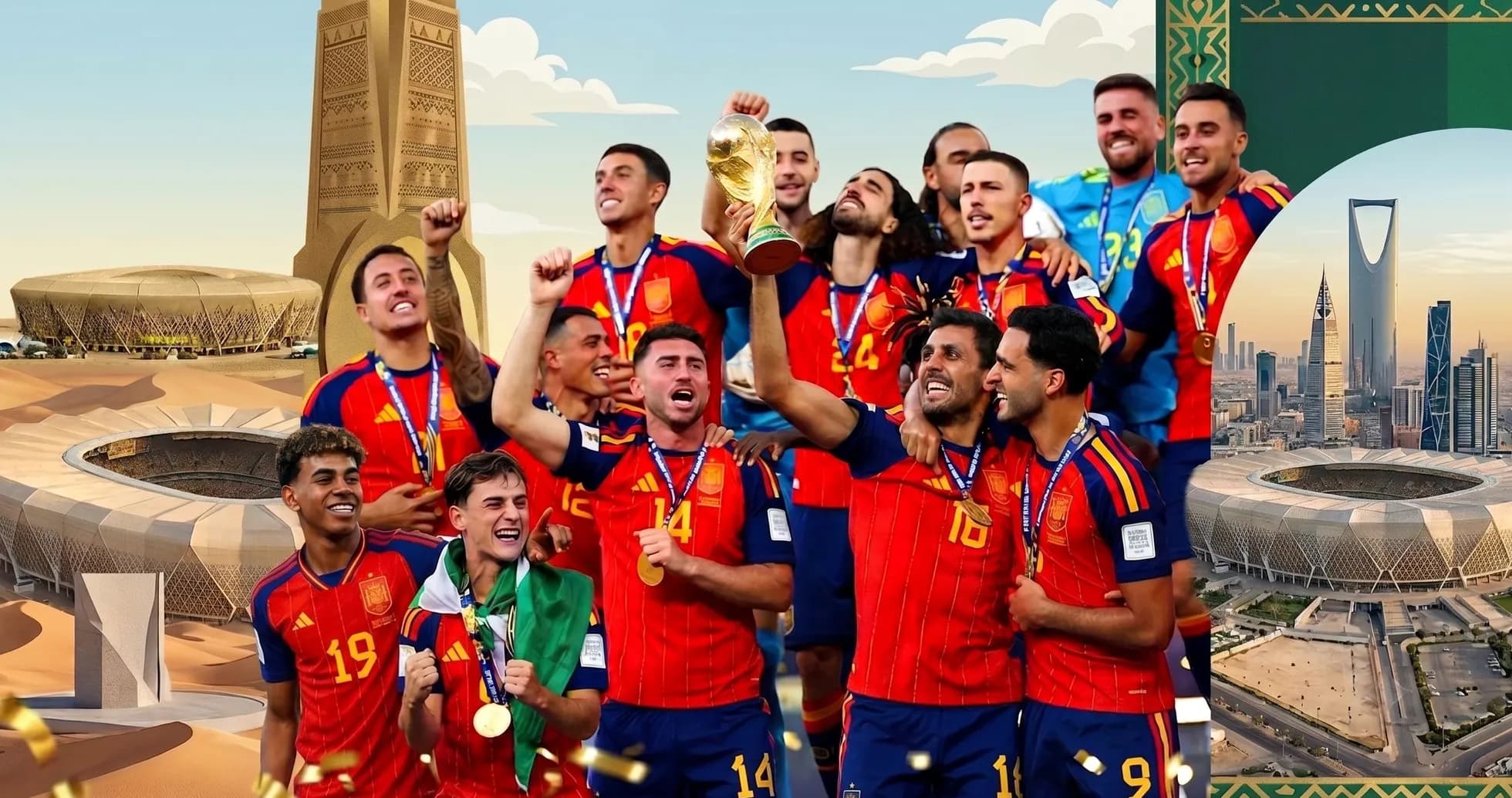
Saudi Roshn League's World Cup Absence and Future Aspirations
Two summers ago, the Saudi Roshn League watched the European Championship final with a sense of ownership. Spain lifted Euro 2024, and two of the league’s own – Nacho Fernandez of Al-Qadisiyah and Aymeric Laporte of Al-Nassr – stood on the podium in red.
Fast forward to 2026 and the picture could not be more different.
Spain are world champions again, this time on the biggest stage of all, beating Argentina with a single, coldly taken goal in a final defined by tactical control and defensive steel. The Roshn League, packed with Spanish talent, played no direct part. Not a single player from Saudi Arabia’s top flight made Luis de la Fuente’s squad.
For a competition that has spent heavily to sit at football’s top table, that absence stings.
Spain’s title, Saudi’s near misses
The irony is hard to miss. The Roshn League has rarely been more attractive to Spanish players, yet when De la Fuente named his group of world champions, the Saudi-based contingent watched from afar. The coach built a side that strangled games with possession, stayed compact without the ball, and trusted a young, fearless core. None of them came from Saudi clubs.
It could have been very different.
Several of Spain’s World Cup winners had been on Saudi radars in recent seasons. Some held talks. Some were heavily linked. None signed. Deals broke down on that elusive “final step” – the last call, the final clause, the moment when big transfers either crystallise or collapse. Had even one of those moves gone through, the Roshn League would now be able to point to a world champion in its ranks.
Instead, the league watched as familiar names shone for Spain from a distance.
Aymeric Laporte is the clearest example. Just a year after leaving Al-Nassr to return to Athletic Bilbao, he anchored Spain’s back line alongside Pau Cubarsi, forming a defensive wall that carried the Matadors to the title. Laporte’s time in Riyadh had ended on a sour note. Under Italian coach Stefano Pioli, he found himself sanctioned, training alone, then excluded from the final matches of the season. He later spoke openly about the “difficult” atmosphere at Al-Nassr, pointing to the constant churn in management and coaching staff.
From isolation in Saudi Arabia to the summit of world football with Spain in a single season. For the Roshn League, that’s a storyline loaded with what-ifs.
And Laporte was not alone. Spain’s squad in North America was full of players who had, at one point or another, attracted serious interest from Saudi clubs. None of those pursuits ended with a signature. The World Cup trophy now underlines what slipped through their fingers.
No champions, but plenty of presence
The absence of a world champion on a Saudi payroll does not mean the Roshn League was a bystander this summer. Far from it.
Forty-nine players from the competition travelled to the 2026 World Cup. That is a statement of relevance in itself, a sign that the league is feeding national teams across continents, even if Spain’s final 26 came from elsewhere.
Those call-ups also came with a significant financial upside.
According to French newspaper L’Equipe, FIFA’s club benefits programme paid 4,300 euros per day for each player involved in the tournament, from 1 June to 19 July 2026. The total pot: 305.3 million euros. For ambitious clubs balancing heavy investment with sustainability, those numbers matter.
No Saudi side tapped into that stream more than Al-Hilal. They sent 12 players to the World Cup, the highest tally of any club in the Kingdom. Their full-back Theo Hernandez stayed with France all the way to the third-place match, his run stretching the payment window and reinforcing his status as one of the league’s marquee names, even if Les Bleus fell short of bronze.
Just behind them, Al-Ahli and Al-Nassr each dispatched nine players. Al-Ahli had particular reason to celebrate. Striker Ivan Toney helped England secure a historic bronze medal, playing his part in a run that restored some pride after years of near misses. Every minute, every appearance, added both to his value and to the club’s World Cup dividend.
Al-Qadisiyah, meanwhile, found their own star turn in Julian Quinones. The Mexican forward lit up the group stage and beyond, scoring four goals and delivering a decisive assist in just five matches. His performances offered a reminder of what the Roshn League can provide: a platform for players to step onto the global stage and deliver under pressure.
Prestige still to come
So the ledger is mixed. No world champions in club colours. No Spanish hero to parade on the first matchday back. But 49 World Cup participants, deep runs from several, and a healthy slice of FIFA’s compensation pool.
For a league determined to be seen as more than a destination for late-career stars, the next step is obvious. It is no longer enough to host players who appear at World Cups. The target now is to keep the Laportes of this world, not watch them leave and lift trophies elsewhere.
The money is there. The visibility is growing. The question is whether the Roshn League can turn near misses and what-ifs into the kind of signings that, in 2030, walk up the steps with medals around their necks while still wearing Saudi club colours.