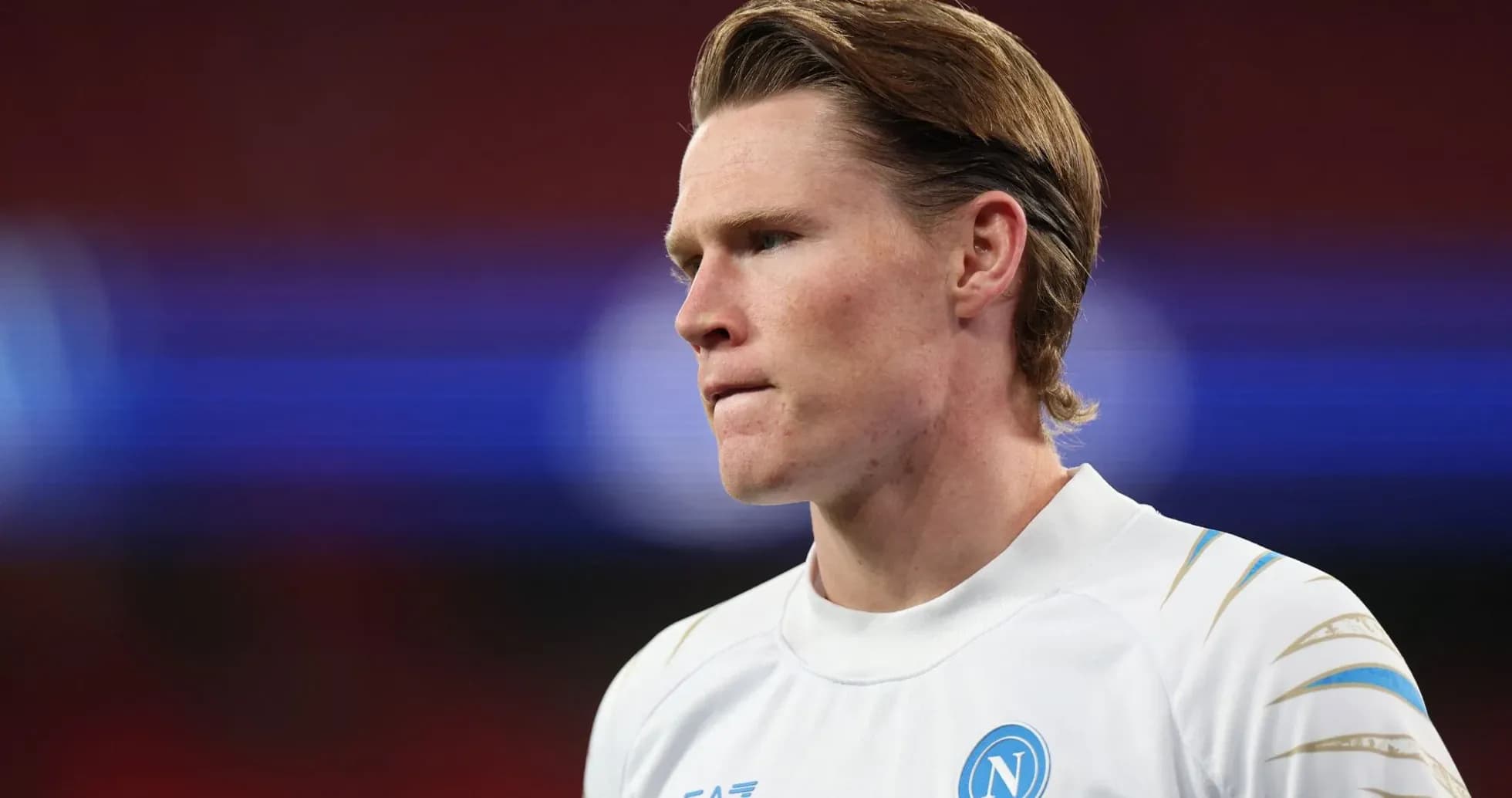
Scott McTominay's Transformation at Napoli: From Manchester United to Star Midfielder
Scott McTominay’s reinvention in Naples has turned him from a Manchester United nearly-man into one of Europe’s most dangerous attacking midfielders – and sparked a fresh debate over whether English football has really seen the last of him.
Sold for £26 million ($35m) after 255 senior appearances for United, McTominay walked away from Old Trafford with respect but without a guaranteed starting shirt. He had come through a famed academy, broken into the first team under Jose Mourinho and become a regular presence. Yet he was rarely the first name on the team sheet.
At United he did the dirty work. Often anchored as a deep-lying, holding midfielder, he screened the back four, broke up play, kept it simple. The role muted his attacking instincts and raised an awkward question: was he truly indispensable in that position for a club with United’s ambitions?
Naples has answered that for him.
From holding man to buccaneering No.10
At Stadio Diego Armando Maradona, the shackles have gone. McTominay has been pushed higher, trusted as a buccaneering No.10 rather than a safety-first shield. The transformation has been ruthless.
Twenty-seven goals in two seasons. A league title. Division MVP. A place in the Ballon d’Or conversation. The same player, but not the same footballer.
What looked like a solid sale for United now sits under a harsher light. A home-grown talent, reimagined elsewhere, driving a major European club and thriving on the biggest stage. No surprise, then, that criticism has followed United for letting him leave.
Talk of another move has circled for a couple of transfer windows. Big fees, big clubs, big questions. Yet reports suggest Napoli are ready to lock him down with fresh terms through to 2030. If that happens, prising him out of southern Italy will take serious money and serious persuasion.
“Somebody in England” will be watching
For former Scotland defender Colin Hendry, it is hard to believe English clubs are not already plotting.
Speaking to GOAL in association with Estafa.info, Hendry was asked if British football has seen the last of McTominay. His answer pointed straight back across the Channel.
“Seeing what he's done for Napoli a couple of years back, such a massive influence on them and what they achieved, then there's going to be somebody in England probably thinking, ‘you know what, we wouldn't mind bringing that here because he has got that winning mentality’,” Hendry said.
He stressed he was not accusing the Premier League’s elite of lacking edge, but underlined how rare that trait can be.
“And I'm not saying that the top six, top eight clubs don't have a winning mentality, but over the years, it’s not easy to find,” he added.
For Scotland, that mentality was supposed to drive a new era.
World Cup high, World Cup hurt
McTominay played a major role in firing Scotland to their first World Cup since 1998. His stunning overhead kick in a crucial qualifier against Denmark became an instant landmark moment, the kind of goal that turns belief into expectation.
The tournament itself told a different story.
On North American soil, Scotland stumbled to another group-stage exit. McTominay, like several of his team-mates, could not hit the same heights he had found in qualifying.
Hendry did not hide his frustration.
“I was disappointed with Scotland in the World Cup, if I'm being honest. Then again, I suppose a lot of people would say that we were disappointing in 1998,” he admitted.
The on-pitch let-down was softened only by what happened off it. The Tartan Army once again stole the show.
“The one shining light about the World Cup in 2026 was the Tartan Army. They've now got history in America that's totally untouched,” Hendry said. He spoke of fans he knows personally – the North East Tartan Army from Peterhead – already planning a return to the United States. “They're back out in Boston in October - they're going back, they've got the boat and everything organised, it’s remarkable.”
Fine margins and familiar regrets
The campaign never really recovered from a bruising start.
“I think everybody was completely disappointed after 1-0 against Haiti. The initial game really set us up - I mean, really, really set us up,” Hendry reflected.
Then came Morocco. Scotland conceded inside 70 seconds, a nightmare opening that, strangely, seemed to jolt them into life.
“And in a strange fashion as well, us going down 1-0 within 70 seconds against Morocco actually worked in our favour a little bit because they had their noses in front and we had to then react. The good thing is that they didn't score a second or a third goal, but we had to actually react to that and had a practically whole game to do that.”
There were flashpoints, too. Hendry was adamant Scotland should have had a spot-kick.
“Could we have had a penalty on John McGinn? I think so. I think generally if that's a free-kick outside the box, which it would have been given as a free-kick outside the box, it's obviously a penalty if it's in the box and it wasn't given.”
Those moments linger. So does the overall sense of a chance missed.
“But I think on the whole, we were disappointing,” Hendry said. “But then again, as I said, people going back to 1998, it was disappointing in the end because we ended up getting gubbed by Morocco in the final game, which was a disappointment as well.”
For McTominay, the contrast is stark. At club level he is a champion, an MVP, a symbol of Napoli’s resurgence. With his country, he carries the weight of hope and the scars of another early exit.
If English clubs do come calling again, the question will not be whether he can handle the stage. It will be whether anyone can persuade Napoli – and a player reborn in their colours – to leave this version of himself behind.