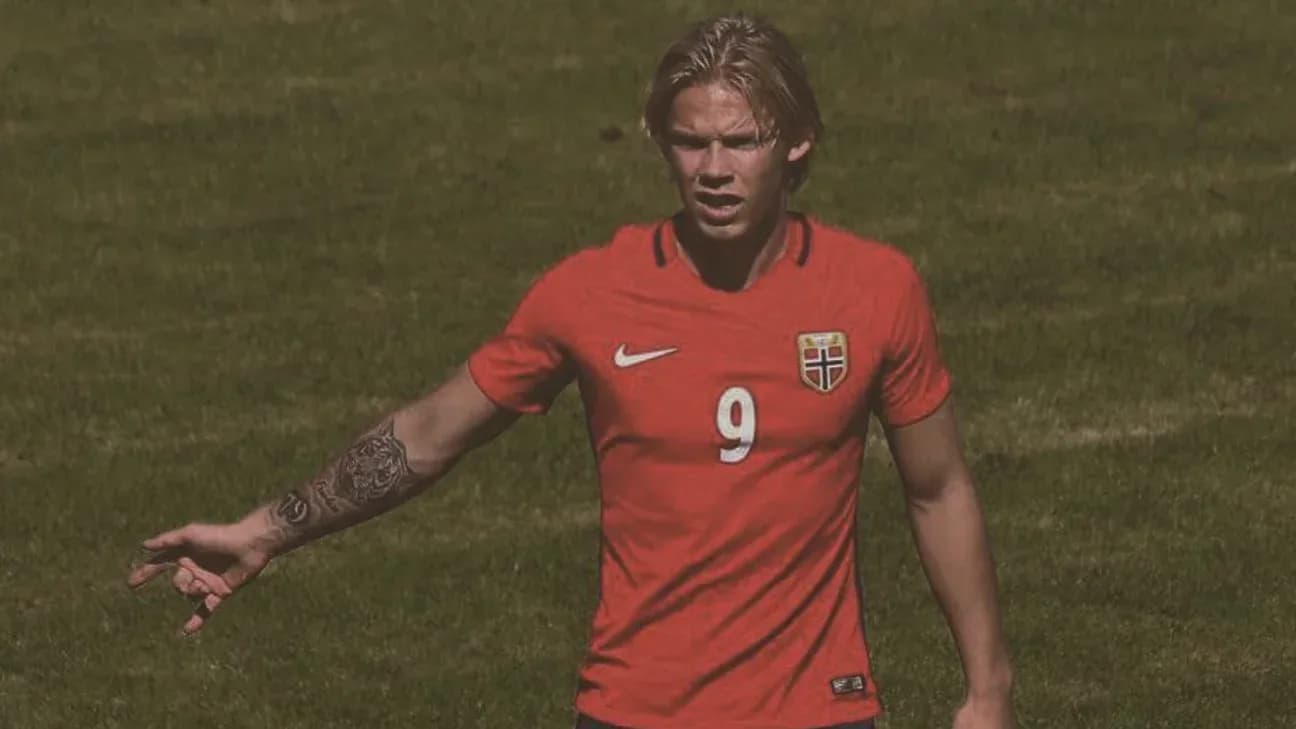
Sebastian Pedersen Joins Orlando Pirates: The Blonde Bomber's Impact
Erling Haaland’s “cousin” has landed in Soweto.
The family tree jokes on social media are fiction, but the connection between Erling Haaland and Orlando Pirates’ new striker Sebastian Pedersen is real enough where it matters: on the teamsheet.
Both came through Norway’s youth ranks as centre-forwards, both wore the same badge at U18 and U19 level, and both chased the same starting shirt. According to Transfermarkt, Pedersen shared five Norway youth squads with Haaland, three of those in UEFA Euro Under-19 qualifiers. The pattern in those games tells its own story: when one stepped on, the other usually stepped off. Direct rivals, never quite partners.
Pirates move for the “blonde bomber”
Now it is Pirates who hope to benefit from that schooling in an elite environment.
“Orlando Pirates Football Club is pleased to announce the signing of striker Sebastian Pedersen from Norwegian side Sogndal Fotball,” the club confirmed on Sunday. The 27-year-old has signed a two-year deal, with an option for a further season, and becomes the latest piece in Abdeslam Ouaddou’s rebuild ahead of what the club expects to be a demanding campaign.
Pedersen arrives with a reputation in Norway as a penalty-box predator rather than a battering ram. A one-touch finisher. The numbers back that up: 51 goals in his last 117 matches, and overall 59 goals and 9 assists from 166 club appearances.
He is a product of one of Norwegian football’s renowned “talent factories”, having represented his country from U15 through to U21. That pathway has shaped his game. He thrives on movement, timing and sharp service, not endless wrestling with centre-backs.
Crucially for Pirates, he offers more than just a central option. Pedersen can operate from the flanks, particularly off the left, covering two of the three attacking roles recently vacated by Relebohile Mofokeng. Early indications from within the club, though, point to him being used primarily through the middle, where the need is most acute.
Filling the Mabasa void
That need stems from Tshegofatso Mabasa’s departure. While Mabasa spent the second half of last season on loan at Stellenbosch, Pirates leaned on Evidence Makgopa and Yanela Mbuthuma to carry the load up front.
Makgopa’s hold-up play gives Pirates a reliable reference point. Mbuthuma presses and harries defenders relentlessly. Both contribute, both stretch defences, but the cold numbers are hard to ignore: Makgopa finished last season with six goals, Mbuthuma with five. For a team that still managed to win the Premiership, that return from their central strikers felt light.
Pedersen has been signed to change that equation. His career has largely unfolded in Norway’s second-tier OBOS-ligaen, where he has scored consistently. His record in the top-flight Eliteserien is more modest — one goal in 12 appearances, totalling 275 minutes — but Pirates are betting on his instincts translating to South African football, where the rhythm, space and style will differ from Scandinavia’s.
If he adapts quickly, the Buccaneers gain the penalty-box presence they have been “crying out for”. If he doesn’t, the goals burden remains spread uncomfortably thin.
The other Marcus Pedersen
The surname has already caused confusion.
Norway’s 2026 World Cup squad included Torino right-back Marcus Holmgren Pedersen, prompting some to assume he is Sebastian’s brother. He isn’t.
Sebastian does have an older brother named Marcus, and he too has worn the Norway shirt, but his international career belongs to a different era. Between 2013 and 2015, the elder Marcus Pedersen earned nine caps and scored once for the national team. Now 36 and last seen in Norway’s lower leagues, his days at the top are a memory, not a current storyline.
That memory is not insignificant, though. The older Pedersen built a respectable journeyman career, operating as a striker who could also drift to the left — a trait his younger brother shares. He turned out for Vitesse in the Netherlands, had a loan spell at Barnsley in England, and further stints at Vålerenga in Norway and Odense Boldklub in Denmark.
His most productive football came at Strømsgodset, across two spells between 2009–2010 and 2015–2019, where his goals helped shape the club’s modern era. It is a reminder that the Pedersen name has carried weight in Norwegian forward lines before.
Missing piece or another gamble?
So what exactly are Pirates getting?
Not Haaland. Not a bulldozing, once-in-a-generation phenomenon. But they are getting a striker schooled alongside him, a player shaped in the same youth environments, used to the pressure of competing for the same shirt, the same chances, the same spotlight.
They are getting a specialist finisher at a time when their forward line has lacked a ruthless edge. A “blonde bomber” whose game is built on being in the right place when the final pass arrives, and on turning half-chances into goals.
There is risk. Most of his damage has come in Norway’s second tier, not the elite level. He arrives in a new country, a new league, a new football culture. The physicality will be different, the tempo different, the travel and climate another layer of adaptation.
But for a Pirates side that has already shown it can dominate domestically without a 20-goal striker, the calculation is clear. If Pedersen can turn tight games into narrow wins, if he can add a handful of extra goals across a season, he becomes more than just another signing.
He becomes the edge that keeps the Buccaneers ahead of the chasing pack.