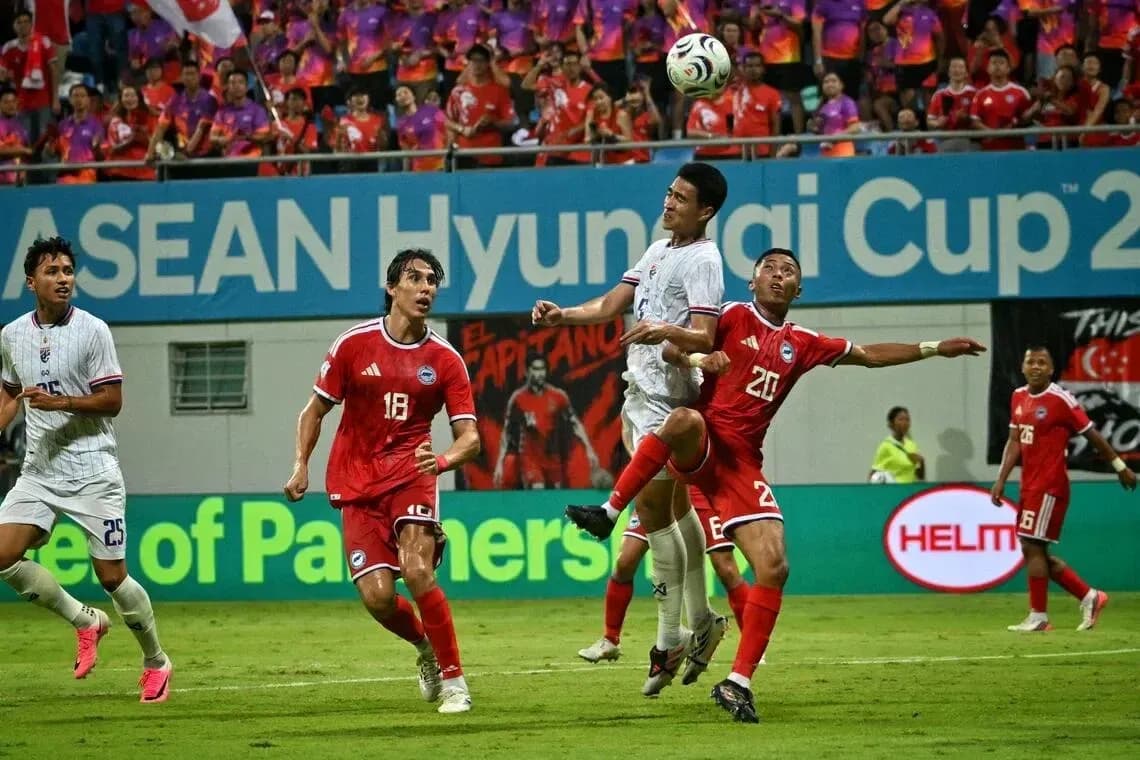
Singapore's Hopes Dwindle After ASEAN Championship Defeat to Thailand
SINGAPORE – The roar was there. The result was not.
Singapore’s dream of a first ASEAN Championship final since 2012 is hanging by the thinnest of threads after a 3-1 first-leg defeat to Thailand at a packed Jalan Besar Stadium on Aug 15 – a night when the Lions’ spirit outlasted their composure.
Thailand ruthless as Lions unravel
Gavin Lee’s side began with intent, pressing high and snapping into challenges, feeding off a restless crowd of 5,358 that included President Tharman Shanmugaratnam and his spouse Jane Ittogi. For 10 minutes, Thailand were pushed back, forced to play longer than they liked, forced to feel uncomfortable.
Then one mistake flipped the script.
In the 14th minute, Kyoga Nakamura lost the ball in his own half. Thailand pounced. Teerasak Poeiphimai needed only one chance, steering a precise low finish into the bottom corner. The stadium fell quiet. The War Elephants had barely settled and were already ahead.
Singapore wobbled. The high press that had looked bold suddenly appeared risky. Passes went astray. Touches grew heavy. Thailand, seven-time champions and serial punishers of such lapses, sensed weakness.
Twelve minutes after his opener, Teerasak struck again. Left unmarked in the box, the forward rose to meet a cross and powered a header past Izwan Mahbud. Two chances, two goals, and Singapore’s early optimism lay in pieces.
“We put ourselves in quite a few unnecessarily difficult moments and made it easy for them,” Lee admitted later. “When they have players of that quality, yeah, they will punish you.”
Missed penalty, missed chance
The Lions still had a lifeline before the break.
Lionel Tan’s long throw caused chaos in the Thai box on 35 minutes, and after a VAR review, the referee penalised Yotsakorn Burapha for a push on Shawal Anuar. Up stepped Shawal for the penalty, a chance to halve the deficit and drag the noise back into Jalan Besar.
Kampol Pathomakkakul guessed right. Diving to his right, the Thai goalkeeper pushed away Shawal’s effort and with it, a huge Singapore opportunity.
From the bench, Lee could only watch as his side’s hard running was undone by individual errors and a rare failure from the spot. It would not be the last time Thailand capitalised.
Gustavsson impact, Thai control
Thailand coach Anthony Hudson had rotated heavily, making six changes from the team that beat Myanmar 2-0 on Aug 8. Even then, he had the luxury of replacing two-goal Teerasak at half-time with Patrik Gustavsson.
The Swedish-born forward wasted no time justifying the decision.
Five minutes after the restart, Gustavsson outsprinted Lionel Tan down the flank and squared for Seksan Ratree, who calmly swept in Thailand’s third. The away bench erupted. The home stands sagged.
The numbers told one story. Singapore, aggressive and brave, ended the night with 72 per cent possession, forcing Thailand to sit deep and defend for long stretches. Hudson’s verdict told another.
“It was a frustrating game and there were a lot of tackles flying in,” the Englishman said. “I have to give credit to the players because they defended well and took their opportunities. We are at our best when we have closer connections and shorter passes, and we have players with the ability to run behind the line.
“We could have scored one or two more goals and that was the disappointing part. But in semi-finals and finals, it’s about winning the game, recovering, getting to Bangkok, and putting in an even bigger performance.”
His players had done exactly that – soaked up pressure, struck with precision, and left Singapore facing a mountain.
Ilhan’s spark and a sliver of hope
Lee, whose side came into the tie unbeaten in nine competitive matches under his watch, turned to his bench in search of a response. One change finally broke through.
Second-half substitute Ilhan Fandi, left out of the starting XI after beginning the 1-1 draw with Indonesia on Aug 7, stepped up when the game seemed gone. In the 84th minute, he collected the ball on the edge of the box and bent a superb effort in off the post.
It was his fourth goal of the tournament – and the first Thailand have conceded in four competitive matches. Jalan Besar erupted again, the noise rolling back across the artificial turf. For a brief spell, Thailand were the ones hanging on.
“Ultimately, we reduced the deficit by one, and with this group that we have, anything is possible,” Lee said. “If the fans didn’t give up on us, we cannot give up on ourselves.”
He knows, though, that the scoreline could have been harsher. Izwan produced several important saves to keep Singapore in the tie, denying Thailand further goals that would almost certainly have ended the contest before the second leg.
A resurgent team, a brutal reminder
The defeat stings not only because of the margin, but because of the momentum that preceded it.
Since Lee replaced Tsutomu Ogura in June 2025, the Lions have rediscovered an edge. They fought their way to a historic Asian Cup qualification for the January 2027 finals, showing resilience and belief in a November 2025 campaign that reignited national interest.
That resurgence carried into this ASEAN Championship. Singapore reached the semi-finals by holding defending champions Vietnam, ranked 99th in the world, to a 0-0 draw and drawing 1-1 with 118th-ranked Indonesia in the group stage. The public responded.
More than 4,000 home allocation tickets for this semi-final were snapped up in seven minutes when sales opened on Aug 12. Demand exploded to the point that scalpers were seen listing a pair of Category 1 tickets, worth around $100, for as much as $2,500 on online marketplaces.
The team that walked out at Jalan Besar carried that weight. For 90 minutes, they ran, pressed and chased. But against the 94th-ranked War Elephants – far from full strength, yet still stacked with quality – their errors proved fatal.
Thailand have now won five straight matches in this tournament, looking every bit like the region’s benchmark again.
History against the Lions
The numbers are not kind to Singapore as they head to Bangkok.
World No. 148, the Lions will be heavy underdogs at the Rajamangala Stadium on Aug 18, a venue where Thailand’s pedigree and home support have broken many visiting sides.
Since two-legged knockout ties were introduced in the 2004 edition of the ASEAN Championship, teams have overturned first-leg defeats to progress only five times. None have done it from a two-goal deficit.
Singapore do have history against Thailand to cling to. They beat the War Elephants in both of their previous knockout meetings – the 2007 and 2012 finals – winning the latter 3-2 on aggregate to claim their fourth title. Those triumphs, though, came from positions of strength, not from chasing a two-goal hole away from home.
This time, the equation is stark: the Lions must score at least twice in Bangkok, against a side that has conceded only once in four competitive outings in this campaign.
Fire still burning
Lee cut a frustrated but defiant figure after the final whistle, having exchanged heated words with Hudson and the Thai bench in the tense closing stages.
“Knowing the boys, they are kicking themselves,” he said. “But they will recover as best as they can, and they will want to right the wrong.”
His players will need that edge. They will walk into a Rajamangala cauldron with history against them, legs heavy from the first leg and minds replaying every misplaced pass and missed tackle from Jalan Besar.
The prize is clear. The winners of this semi-final will face either Vietnam or Malaysia, who begin their own last-four battle in Kuala Lumpur on Aug 16 before the return leg in Hanoi three days later.
For Thailand, the path looks familiar. For Singapore, the question is simple and unforgiving: can this resurgent generation turn defiance into the kind of miracle that rewrites the region’s record books?