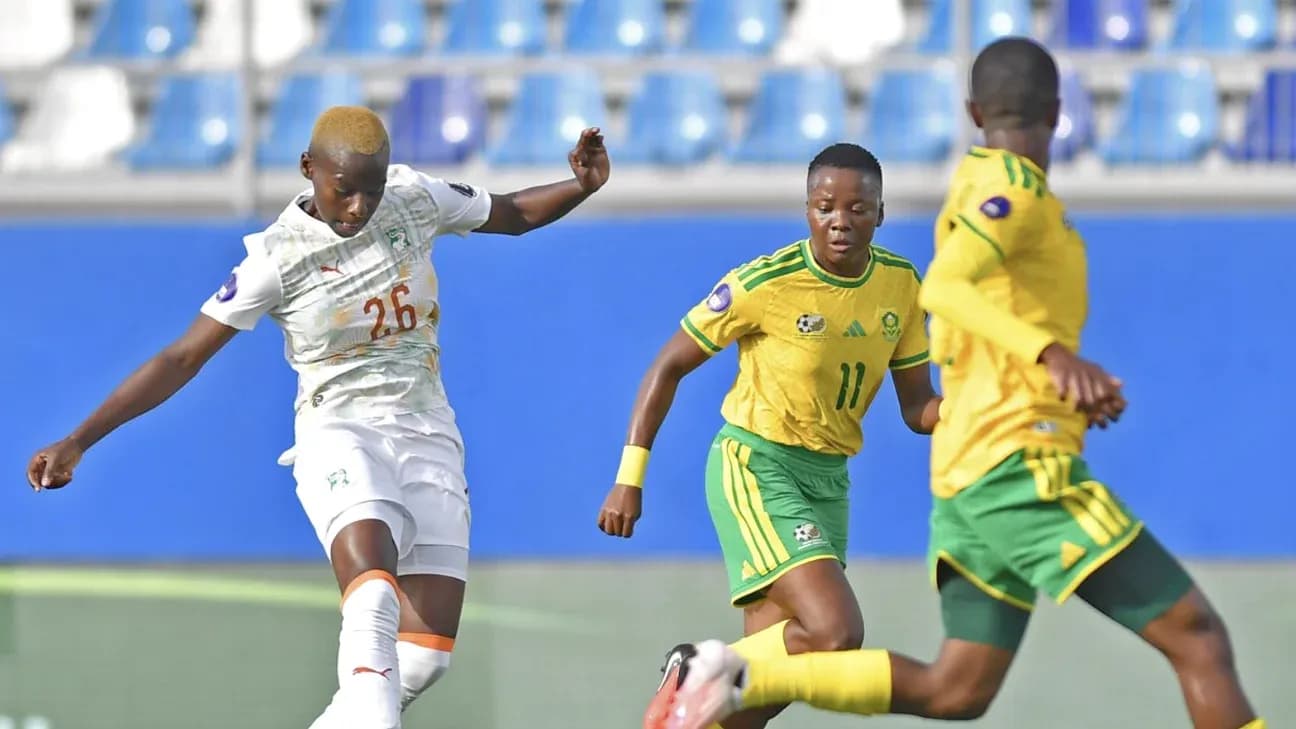
South Africa Fights Back Against Ivory Coast in WAFCON Draw
South Africa left Casablanca with their tournament lives still flickering, not roaring, after a ragged yet defiant 2-2 draw with Ivory Coast in the Women’s Africa Cup of Nations on Friday.
It was a point scraped from the edge of elimination. It was also a night when two much-questioned forwards refused to accept the narrative written about them.
Torn Apart, Then Torn Into
For 45 minutes, Banyana Banyana looked a shadow of the reigning African champions. Ivory Coast did not so much probe as slice straight through them.
Twice, South Africa were ripped open on the counter. Twice, Grace Sery finished with conviction. She struck first on 18 minutes, then again on 36, each time punishing a defence that left yawning spaces in transition and never quite got to grips with the tempo of the Ivorian breaks.
South Africa’s response before the interval? Almost nothing.
There was one moment – a reminder of what this side can be – when Linda Motlhalo slipped Thembi Kgatlana through with a clever pass that split the back line. Aramatou Diakité raced out and smothered the chance. Beyond that, Kgatlana was marooned, her runs ignored or misread, her influence reduced to hopeful sprints into dead ends.
The half-time verdict was brutal and obvious: Banyana were being outplayed, outpaced, and out-thought.
Kgatlana Answers the Question
Kgatlana has heard the whispers. That the Tigres UANL striker’s best days in South African colours are gone. That without Jermaine Seoposenwe knitting play behind her, she no longer looks the same threat.
For years, the diminutive forward thrived on Seoposenwe’s ability to link midfield and attack, to occupy defenders and free her to dart into space. Since Seoposenwe’s retirement last year, no one has truly claimed that role. The attack has often looked disjointed, Kgatlana isolated and easy to contain.
Not on this night. Not once the changes came and the game turned.
Desiree Ellis turned to Ronnel Donnelly, a player who has absorbed a disproportionate share of criticism given her limited minutes at Mamelodi Sundowns. Many questioned why she kept her place in the national setup. On Friday, she offered a sharp, physical answer.
Donnelly is not Seoposenwe. She does not pretend to be. But she brings her own weapons – aerial presence, a willingness to battle centre-backs, and a knack for occupying exactly the spaces that open doors for others.
Shortly after coming on, she carved out room for herself in the box. The shot never came, the window closed, and the chance seemed gone. Instead of panicking, South Africa recycled the ball. It found Kgatlana on the edge of the area.
This time, the star forward took control of the story.
She cut inside, created a sliver of room, and drilled her finish past Diakité to haul Banyana back into the contest with just under 20 minutes plus stoppage time remaining. One touch of quality, one reminder: give her support, and she will still decide matches.
Donnelly’s Redemption Arc
The goal changed the mood, but not the stakes. At 2-1 down, with the clock draining away, South Africa were still staring at the brink.
Donnelly kept fighting. She chased lost causes, leaned into defenders, and contested every aerial ball as if it were the last of the tournament. This was the version of her Ellis has insisted exists, the one that justifies the faith of repeated call-ups.
Deep into stoppage time, the pressure finally told.
A hopeful ball forward became a platform. Donnelly rose, flicked on a header, and turned what looked like a clearance into an assist. Hildah Magaia read it perfectly, arriving with the conviction of a player who has delivered on big stages before.
She did not hesitate. She smashed home the equaliser.
From 2-0 down and drifting towards disaster, Banyana had dragged themselves level at the death. Not through flowing football, not through control, but through stubborn refusal to accept defeat.
Group B on a Knife Edge
The draw leaves Group B delicately poised.
Ivory Coast, who thrashed Burkina Faso 4-1 in their opener, now sit on four points from two games with a +3 goal difference. Tanzania, having beaten South Africa 2-1 in their first outing, went into their Friday night clash with Burkina Faso on three points and a +1 goal difference.
South Africa’s late surge in Casablanca earned them their first point of the campaign. Their goal difference sits at -1. Burkina Faso remain pointless and wounded.
The maths is blunt. Banyana Banyana must beat Burkina Faso on August 4 to have any chance of reaching the quarter-finals. A draw will not do. A narrow, cautious win might not be enough either, given that head-to-head records will decide ties on points before goal difference even comes into play.
This is no longer a group stage. For South Africa, it is already knockout football.
Selection Questions, Attacking Answers
Ellis now faces a clear tactical question: does she lean into the chaos that almost rescued them, or retreat to caution?
If she wants to start on the front foot and chase not just victory but goals, the evidence from Casablanca points in one direction. A front four of Donnelly, Kgatlana, Lebohang Ramalepe and Magaia gave Ivory Coast more problems in half an hour than Banyana had managed in the previous game and a half combined.
Donnelly’s presence drew defenders and created space. Kgatlana’s movement looked sharper once she was no longer alone. Magaia’s timing and aggression in the box made the equaliser feel like a matter of when, not if. Ramalepe’s energy added width and urgency.
It was far from perfect. It was raw, frantic, and at times improvised. But it carried threat. It carried belief.
World Cup Path Still Open
Beyond the group, the stakes are enormous. The four semi-finalists in this WAFCON will secure direct passage to the 2027 FIFA Women’s World Cup in Brazil. Two more teams – the best losing quarter-finalists – will still have a route via internal African playoffs and then the Inter-Confederation Playoff.
For a side that arrived at this tournament as continental champions, the idea of missing out on those pathways would be a jarring step back.
Right now, though, Banyana are not thinking about Brazil. They are thinking about Burkina Faso, about one game that will decide whether this campaign can still become a story of recovery rather than regret.
Their backs are pressed firmly against the wall. But if the closing stages in Casablanca proved anything, it is that this team still has fight left in it.
The question is simple: will Ellis trust the forwards who dragged South Africa off the canvas to start throwing punches from the opening whistle in their final group match?