South Africa's World Cup Journey: Tears and a New Era
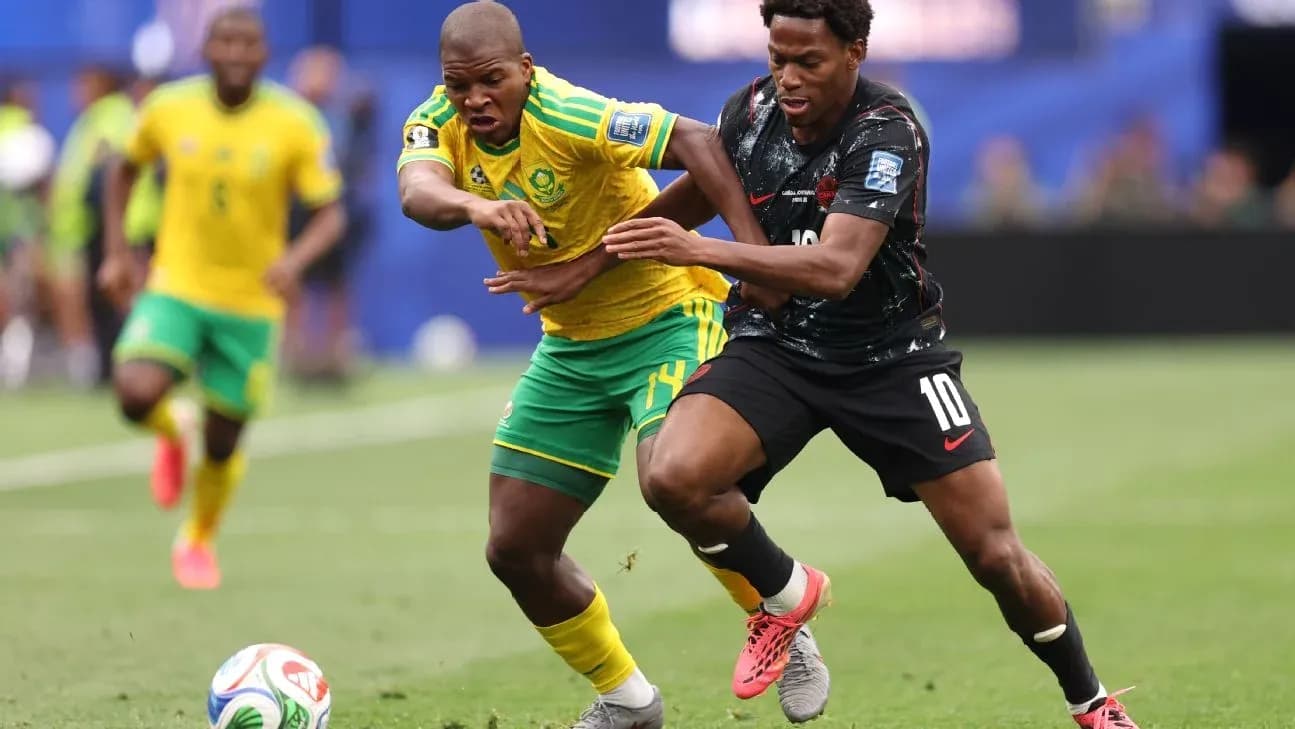
South Africa’s World Cup ended with a thud, not a roar. A 1-0 defeat to Canada in the round of 32, a nation stunned and silent, Bafana Bafana players slumped on the turf.
Yet this was no ordinary exit.
Sixteen years after their last appearance on the biggest stage, South Africa not only returned, they broke new ground with a first-ever knockout appearance. The pain was real. So was the sense that something had shifted in South African football.
This campaign did not feel like a last hurrah. It felt like a beginning.
Centre-backs for a generation
If there is one department South Africa can stop worrying about, it is the heart of their defence.
At this World Cup, Mbokazi and Okon did more than just start. They owned the stage. Both were trusted from the first whistle of the tournament, and both rose with the pressure. Mbokazi, in particular, emerged as one of the standout centre-backs of the entire competition, reading danger early, stepping into duels with conviction, and looking every inch a defender built for elite football.
Behind them, the production line is already humming.
Olwethu Makhanya, Khulumani Ndamane, Tylon Smith, Malibongwe Khoza, Aden McCarthy and others are pushing from beneath, forming a group of young defenders who can step in if either “TLB” or Okon is ever sidelined or moved on. The names keep coming, and they are not just filling squad lists; they are genuinely capable replacements.
Whether Hugo Broos remains in charge or a new coach takes the reins, the next World Cup cycle begins with one rare luxury: a settled, competitive core at centre-back that can carry the team through qualifying and beyond.
Mofokeng: the talent waiting to explode
If there was a frustration that lingered among Bafana supporters, it centred on one player: Relebohile Mofokeng.
The Orlando Pirates attacking midfielder arrived at the tournament as a fan favourite, a player many in South Africa wanted to see unleashed. Broos, though, did not fully share that unshakeable trust. Minutes were limited. Influence, at times, felt constrained.
Yet the story of Mofokeng in 2026 should not be written in disappointment.
He is only 21. His ceiling is still out of sight. When he did get the stage, he showed exactly why the hype refuses to die down. His performance in the 1-0 win over South Korea was a statement – sharp, fearless, technically assured. It was the kind of display that said he belongs on this level, that he can live with global stars rather than simply admire them.
A move to Belgium’s Royale Union Saint-Gilloise is widely reported to be close. If it materialises, it will offer him a crucial platform: regular European football, higher tempo, new demands. By 2030, the Bafana coach – whoever that is – could have a fully formed game-changer in his hands, an attacking wildcard capable of tilting tight World Cup matches.
This World Cup hinted at what he can be. The next one might belong to him.
Homegrown, and good enough for the world
For years, a familiar refrain has followed South African football: players need to leave home to truly grow.
This World Cup pushed back against that assumption.
Several of Bafana’s most influential figures have built their entire careers in the South African Premiership, and in this tournament they showed that staying home does not mean staying small.
Teboho Mokoena, the heartbeat in midfield for Mamelodi Sundowns, translated his domestic dominance onto the global stage. Thalente Mbatha of Orlando Pirates added bite and balance, proving he can control games against the world’s best. On the flanks, Sundowns fullbacks Khuliso Mudau and Aubrey Modiba drove forward with purpose, defending aggressively and offering constant width.
Behind them all stood Ronwen Williams, captain and last line of resistance. The goalkeeper’s interventions in key moments were reminders of why his reputation has soared beyond South Africa’s borders, despite him never leaving home in his club career – first at SuperSport United, now at Sundowns. His composure and command under pressure looked entirely at home on the World Cup stage.
Of course, young talents will benefit from testing themselves abroad, facing different styles and environments. But this tournament underlined a crucial truth: the South African Premiership is producing players who can walk into a World Cup and compete, not just participate. For aspiring youngsters, a local career no longer feels like a compromise.
Maseko: from the brink to a nation’s spark
Some stories cut deeper than tactics or formations. Thapelo Maseko’s is one of them.
The winger’s talent has never been a secret. Hugo Broos liked him early, and Maseko announced himself on the continental stage by scoring at the 2023 Africa Cup of Nations, played in early 2024, when he was just 20. It looked like the start of a smooth rise.
It wasn’t.
His move from SuperSport United to Mamelodi Sundowns should have been a launchpad. Instead, it became a roadblock. Under Miguel Cardoso, who arrived as Sundowns head coach in December 2024, Maseko struggled to find a place. Opportunities dried up. He slipped into the reserves. By mid-2025, he was publicly admitting on social media that he was losing his love for the game.
Then came January 2026. A loan move to AEL Limassol in Cyprus. A change of scenery. A reset.
The transformation was swift. By March, he had fought his way back into the Bafana squad. By this month, he had written himself into South African football history. His goal against South Korea did not just win a match; it broke a barrier, sending South Africa into the World Cup knockout rounds for the first time.
In a country often worn down by off-field problems and sporting near-misses, Maseko’s resurgence offered something rare: proof that a career can be rebuilt, that a player can fall out of favour, lose his way, and still come back to carry a nation.
His journey will be remembered long after the scorelines fade.
SAFA’s lifeline – and responsibility
Away from the pitch, the stakes were just as high.
The South African Football Association (SAFA) arrived at this World Cup under a financial cloud. Late payments to players after the previous African Nations Championship, operating costs outstripping revenue, and a governing body that seemed trapped in a permanent state of firefighting.
This tournament has given them breathing room.
Qualification alone guaranteed SAFA at least $9 million in performance-based payouts for reaching the group stage, excluding preparation funds. Reaching the round of 32 added another $2 million, lifting the total to $11 million. For an association under strain, that is not just prize money; it is a lifeline.
The impact goes beyond FIFA’s cheque. Sponsors look differently at a team that not only qualifies but competes, that reaches knockouts and captures imaginations back home. Negotiating new deals, or improving existing ones, suddenly becomes easier when Bafana are a story of progress rather than decline.
This cash injection will not erase years of mismanagement or poor decisions. It will not fix everything overnight. But it does offer a chance – perhaps the last, for a while – to shift from survival mode into proper planning.
The task now for SAFA is clear and unforgiving: protect this momentum, invest wisely, and build structures that allow the next generation – the Mbokazis, the Okons, the Mofokengs, the Masekos – to thrive.
South Africa left this World Cup with a broken heart and an open door. The question is no longer whether the talent exists. It is whether the country’s football leaders can match that talent with vision.