St. Pauli's Journey: From Bundesliga Relegation to 2. Bundesliga Ambitions
The party didn’t last long on the Kiez.
After the emotional high of survival in 2024/25 – their first successful Bundesliga stay since 1995/96 – St. Pauli fell straight through the trapdoor the following year. Six wins, eight draws, 20 defeats. Bottom of the table. Back to the 2. Bundesliga in 2025/26 with a thud that could be heard all the way down the Reeperbahn.
Relegation always leaves rubble. At the Millerntor, it also left vacancies: on the pitch, in the dressing room, and on the bench. Head coach Alexander Blessin was dismissed within weeks of the season ending. Key figures moved on. The squad that had dragged the club back into the top flight suddenly looked like a memory.
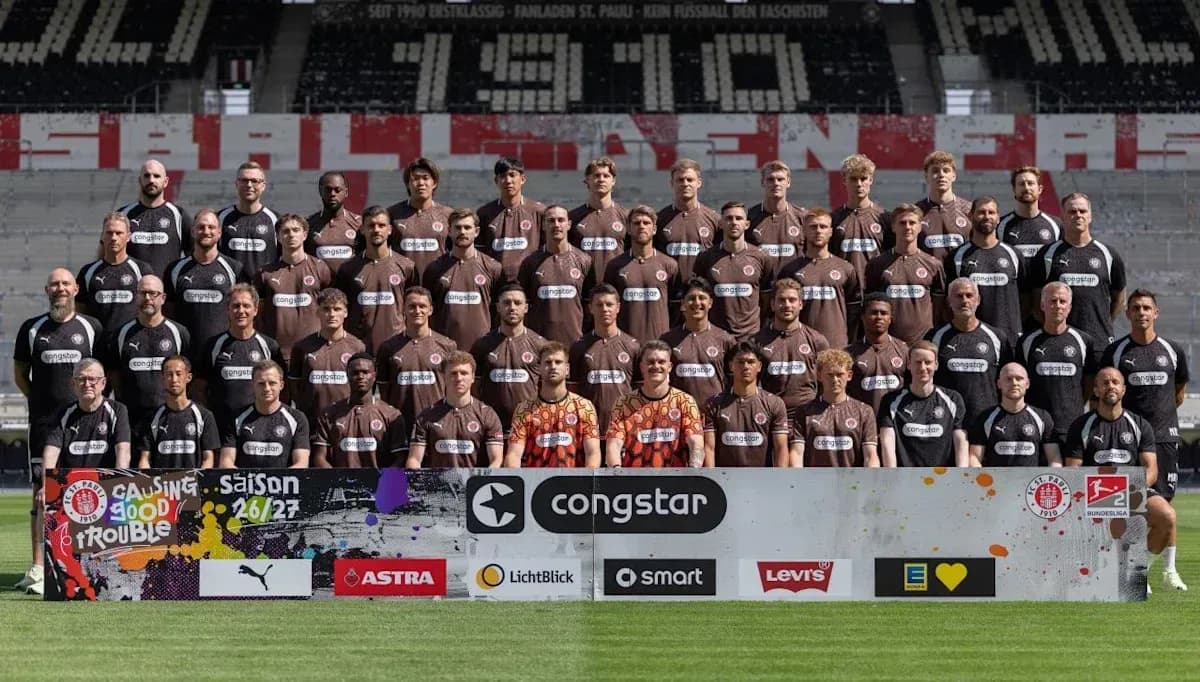
And yet, as another season dawns, there’s that familiar hum of defiance around the ground. New coach. New faces. Same restless club.
A captain leaves, a core survives
The most painful goodbye came late in the window and cut right through the fanbase: Jackson Irvine is gone.
The Australian didn’t just clock up numbers – 153 appearances, 15 goals, 21 assists – he embedded himself in the club’s identity. Captain in the promotion season of 2023/24, heartbeat in midfield, visible presence in the St. Pauli community. Then, almost out of nowhere, came his request to move to Cerezo Osaka. The deal was announced less than a week before the first league fixture.
That’s not a normal loss. That’s tearing out a reference point.
He wasn’t the only one. The spine that had carried St. Pauli through those turbulent years has been chipped away. Goalkeeper Nikola Vasilj, 167 appearances and 43 clean sheets, left for Al-Diriyah on a free. Karol Mets joined Bochum, also for nothing, after 91 games in brown and white.
On the right flank, Manolis Saliakas departed for Olympiacos in a €1.3 million deal after 120 appearances. At centre-back, Hauke Wahl moved to Wolfsburg for €2 million following 105 games. And further forward, Daniel Sinani, who featured 70 times, signed for Sampdoria on a free.
These aren’t fringe players. These are names that had become part of the weekly ritual.
Yet the squad hasn’t been stripped bare. A solid core remains, and the club has moved quickly to plug gaps rather than wallow in what’s been lost.
Hrgota’s goals and Rapp’s promotion pedigree
The headline arrival is a familiar face to 2. Bundesliga watchers: Branimir Hrgota.
The veteran striker arrives from Fürth, where he became the club’s all-time leading scorer across the top two tiers of German football – 69 goals and 41 assists in 238 appearances. He knows this division inside out. He knows what it takes to drag a team back up.
His 16 goals and 7 assists in 2020/21 powered Fürth to just their second-ever Bundesliga promotion. Now he’s been picked up on a free, asked to inject cutting edge and leadership into a St. Pauli attack that suddenly needs both.
At the back, the club has added Marcus Mathisen from Magdeburg, again on a free. An experienced centre-back, he arrives at exactly the moment St. Pauli’s defensive line has been punctured by departures. He’s not a marquee signing; he’s a stabiliser. Right now, that matters more.
The most intriguing arrival, though, stands on the touchline.
Marcel Rapp, 47, comes in from Holstein Kiel with a fresh promotion on his CV. In 2023/24, he led Kiel to the Bundesliga for the first time in their history – the very same season St. Pauli won the league. Two parallel success stories now converge in Hamburg.
Rapp doesn’t arrive as a romantic choice or a nostalgia hire. He comes as a coach who has just proved he can build a promotion team in this exact landscape. That’s a powerful calling card.
Pre-season hints: structure, goals, and a warning shot
Pre-season friendlies rarely tell the whole truth, but they do whisper clues. Rapp’s St. Pauli have already started to show theirs.
The tour opened with a local tune-up: a 2-6 win over Altona 93, a scoreline that matched the gulf in quality and loosened a few attacking shoulders. Next came a 1-3 victory over Regionalliga Nord side Kickers Emden – not spectacular, but another step in the right direction.
Then came the kind of game that suits St. Pauli’s soul. A trip to Babelsberg, a club with whom the fanbases share a well-known friendship, brought a 1-4 win and a standout performance from Abdoulie Ceesay. He hit a first-half hat-trick, the sort of ruthless burst that instantly raises expectations around a player.
The first European test followed against Croatian side Gorica. St. Pauli edged it 2-1 thanks to goals from Louis Oppie and Ricky-Jade Jones. The victory came at a price: Ceesay, fresh from his hat-trick, suffered a capsule-ligament injury in his right ankle and was forced off. For a team already dealing with departures, losing a hot hand in attack is a sharp reminder of how quickly momentum can twist.
The penultimate friendly, against Premier League and Europa League outfit Bournemouth in Austria, brought the first real jolt. Kaars opened the scoring in the 22nd minute, but St. Pauli then crumbled, conceding four times in 27 minutes in a 4-1 defeat. A reality check. Rapp’s structure is still under construction, and when the press or concentration levels drop, this team can be punished quickly.
The final dress rehearsal was at the Millerntor against newly promoted LaLiga side Deportivo de La Coruña. St. Pauli led twice, through Taichi Hara and then Kaars, but an 84th-minute equaliser from the visitors sealed a 2-2 draw. Encouraging attacking patterns, frustrating late lapses. A familiar cocktail for a club trying to rewire itself.
Rapp’s shape: three at the back, options up front
Rapp looks set to stay loyal to a three-man backline. That much seems clear from pre-season.
With Eric Smith’s fitness still in doubt ahead of the opener against Fürth, there’s a strong chance Tomoya Ando or Adam Dzwigala will be asked to step in at the back. The new signing Mathisen is expected to anchor that defence, with Nemeth also in the frame.
In midfield, Fujita is likely to be the central pivot. Around him, Rasmussen or Metcalfe should provide the legs and balance, while Pyrka and Oppie patrol the flanks. There’s depth here: Lars Ritzka and Erik Ahlstrand offer reliable alternatives in the middle if injuries or form demand changes.
Up front, Rapp has options, even with Ceesay sidelined for now. Hrgota should start as one of the two supporting forwards, bringing guile and movement, with Jones or Hara competing to partner him. Kaars is expected to lead the line as the focal point.
On paper, the predicted 3-4-2-1 looks like this: Voll – Nemeth, Mathisen, Ando – Pyrka, Rasmussen, Fujita, Oppie – Hrgota, Jones – Kaars.
Given the exodus and the current absences, that’s still a strong XI with credible backup. It’s not a squad stripped to the bone; it’s one that’s been reshaped on the fly.
Promotion talk: hope, history, and a brutal league
There’s a cold statistic that hovers over this season.
The last time St. Pauli were relegated from the Bundesliga before this recent drop – back in 2010/11 – it took 13 years for them to return. The fastest turnaround in the club’s history is four years, a mark they’ve hit twice in the 90s and early 2000s. This is not a club with a habit of bouncing straight back.
Yet the context this time is different.
Despite the exits, St. Pauli still possess one of the strongest squads in the division. By market value, they sit second in the 2. Bundesliga, behind only VfL Wolfsburg – though the gap to Wolfsburg is almost €200 million, a reminder of the financial muscle the relegated giants bring.
Pre-season has shown that this St. Pauli side can still punch up. They’ve scored freely, adapted quickly to Rapp’s ideas, and only really been exposed by a Premier League opponent. The foundations for a serious promotion push are visible.
But the league won’t wait. Wolfsburg will start as clear title favourites. Behind them, the scrap for second and third looks ferocious, with Hannover and fellow relegated side Heidenheim among those circling the promotion places. This isn’t a gentle runway back to the top flight; it’s a crowded airspace.
Realistically, St. Pauli should be aiming no lower than the top six. Anything less, with this squad and this coach, would feel like a wasted year. If the new signings settle quickly and Rapp’s 3-at-the-back system beds in, a top-three finish is a genuine possibility.
The question is not whether St. Pauli can compete. The question is whether, after the shock of last season’s fall, they can rediscover the relentlessness required to climb again – and do it before history’s long shadows creep back over the Millerntor.