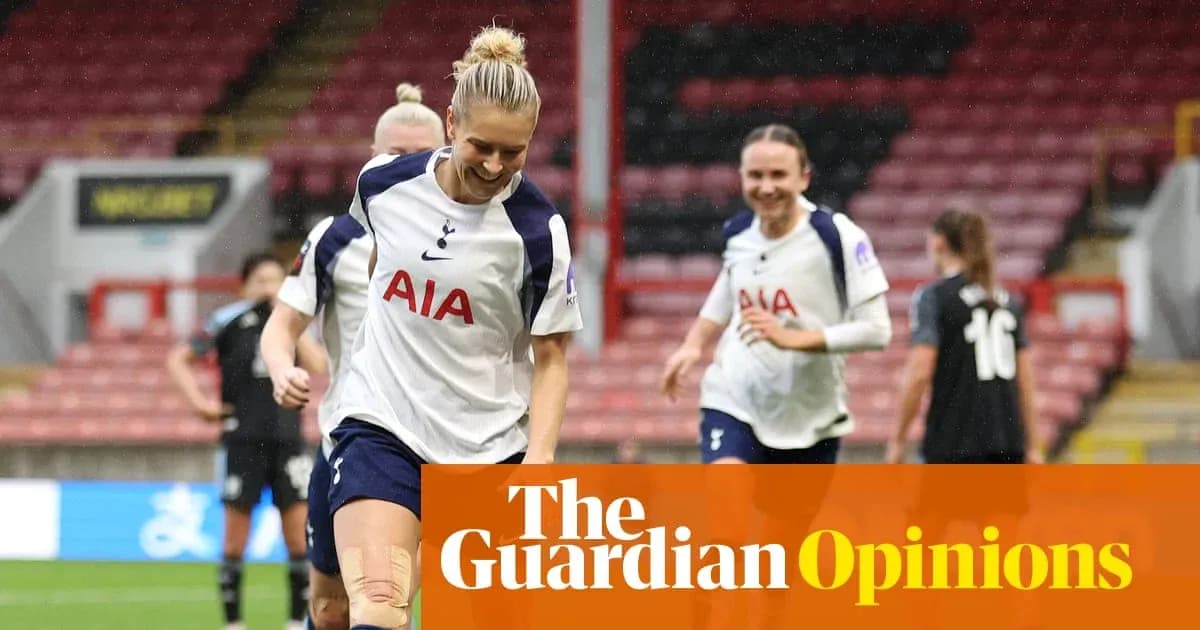
Tottenham Women: A Historic Season of Triumph
Tottenham’s women did more than win football matches last season. They rescued a fanbase that had spent months staring into the abyss with the men’s team.
While Ange Postecoglou’s side toyed with disaster, spiralling so close to the relegation trapdoor that jokes about Lincoln at the Tottenham Hotspur Stadium stopped being funny, the women’s team quietly built the best WSL campaign in the club’s history. Where the men offered anxiety, the women supplied joy. And goals. Lots of them.
A season that crackled
The numbers alone tell you it was different. Highest-ever WSL points tally. Fifth place, tucked in just behind the league’s established giants: Manchester City, Arsenal, Chelsea and Manchester United. Not gatecrashing the elite yet, but close enough to see the whites of their eyes.
The football had a swagger to it. There was the 7-2 demolition of Aston Villa, a game that felt more like a basketball scoreline than a Premier League-affiliated club’s women’s side politely going about its business. There was that surreal FA Cup tie against London City Lionesses, where the first 17 penalties in the shootout went in before Spurs finally edged it. And there were the moments that live in the memory long after the final whistle – like Cathinka Tandberg lashing in a 40-yard screamer that belonged on every highlight reel in Europe.
While the men shuffled the ball endlessly around the edge of the box and fans on WhatsApp asked whether any of those passes were strictly necessary, the women played with clarity and purpose. Where the men’s transfer strategy looked like a patchwork of short-term fixes and unanswered questions, the women’s squad felt increasingly coherent.
Martin Ho’s imprint
The turning point arrived last year with the appointment of Martin Ho as head coach. On paper, his CV already carried weight: assistant at Manchester United, head coach at Brann in Norway. On the pitch, his impact was immediate.
Spurs under Ho looked organised but never rigid, adventurous without being reckless. Players understood their roles. They knew where their passing options were, when to press, when to drop. It showed in the way they started the season: five wins in their first six league games, a complete transformation from the side that had limped to a finish just one place above relegation in 2024-25 under Robert Vilahamn.
Behind the scenes, the word from the dressing room was simple: the players liked him, and they respected him. That matters. It showed in the way previously underperforming players rediscovered their form. There was no need for an Igor Tudor-style demolition job of confidence – no declarations that they couldn’t attack, defend or run. Tottenham did all three, and did them well.
Ho has also understood the value of connection. His habit of wandering through the Legends Lounge at Leyton Orient – where Spurs Women play most of their home games – for pre-match chats has built a bridge between the technical area and the stands. It’s small, it’s human, and it works.
Smart recruitment, sharper edge
Ho’s tactical work has been matched by shrewd recruitment. Olivia Holdt emerged as the club’s top scorer from midfield, a constant threat between the lines. At the back, Toko Koga anchored central defence with a calm authority that belied the chaos often swirling around WSL attacks.
January brought another injection of energy with the arrival of Signe Gaupset, a midfielder who doesn’t so much carry the ball as tear through the middle third with it. Her direct running gave Spurs an extra gear, the kind of vertical thrust that turns controlled possession into genuine danger.
Around them, a core of players delivered week after week. Eveliina Summanen’s industry, Amanda Nildén’s intelligence, Lize Kop’s presence in goal, Drew Spence’s experience, Clare Hunt’s defensive steel – this was a team, not a collection of names.
They still took their lumps. Manchester City thumped them a couple of times, but City have Khadija ‘Bunny’ Shaw, whose goals-per-game ratio even outstrips Erling Haaland’s. City went on to win the league ahead of Arsenal, Chelsea and United. Against that kind of firepower, Spurs’ fifth-place finish felt less like a ceiling and more like a staging post.
Breaking that top four stranglehold no longer feels fanciful. It feels like the logical next step.
Building for the next step
The intent from the club arrived swiftly. Within days of the season ending, Spurs moved in the market. Caitlin Dijkstra, a highly rated Netherlands international, joined from Wolfsburg to strengthen the defence. Up front, Shekiera Martinez came in from West Ham, where she had stood out as a ruthless finisher in a side that struggled around her.
The reinforcements kept coming. Kirsty Hanson arrived from Aston Villa, bringing WSL know-how and attacking bite. Alice Sombath joined from OL Lyonnais, another sign that Spurs are now an attractive destination for players used to operating at the sharp end of European football.
There has been pain, too. Saying goodbye to Bethany England – the club’s record goalscorer – jarred. No one doubted Ashleigh Neville’s desire to move closer to home with a transfer to Leicester; that made sense on a human level. England’s departure was harder to process. For a striker who had given so much, the absence of even a one-year extension felt like a cold decision in a warm-hearted project.
The team that walks out at the start of the new season will look very different from the one that first drew in many of today’s regulars three years ago. The badge stays the same. The bond in the stands does too.
A different kind of matchday
That bond runs deep. The regulars at Spurs Women games are not casual observers. Many of them have followed both the men’s and women’s sides for years. They write blogs, record podcasts, travel to West Ham away to stand in the rain and wind, and still come back for more. Some remember the days when a handful of fans watched Broxbourne Ladies – as the club was then known – graft their way up the pyramid.
The matchday atmosphere reflects that history. It’s passionate but rarely poisonous. Frustration gets aired, of course. Referees are politely invited to consider a visit to a well-known high street optician. But the fury and bile that can engulf men’s fixtures are largely absent.
Instead, there are banners. Before kick-off, fans drape the stands with flags bearing the faces of Spurs players, framed by the colours of the Progress Pride flag. It’s not tokenism; it’s a statement. Everyone is welcome. For many, following Spurs Women has sharpened their sense of how football can be a force for inclusion and change, not just a weekly test of nerves.
On the pitch, the product is compelling. Women’s football might be fractionally slower than the men’s game, but it’s direct, it’s open and, crucially, it’s played without VAR. That means the odd glaring refereeing mistake, yes. It also means no five-minute purgatory while a crowd of thousands stare at a screen and wait for someone in a remote bunker to draw lines on a freeze frame. Decisions are made, the game flows, emotions are real-time, not on delay.
The pull of what comes next
The hope now is simple: more people in the stands, more voices joining the songs, more children growing up thinking of Tottenham Women as a natural part of the club’s identity rather than an optional extra.
Spurs have built something worth watching – tactically, emotionally, culturally. The football is good, the direction is clear, and the gap to the WSL’s superpowers is shrinking. The only real question is how long it will be before a side that once played in front of a smattering of diehards is no longer looking up at the top four, but staring them straight in the eye.