UEFA Champions League Final: Paris Saint Germain vs Arsenal
On 30 May 2026, under the vast steel arch of the Puskas Arena in Budapest, Paris Saint Germain and Arsenal walk out knowing there is nothing bigger left to chase: the UEFA Champions League trophy sits a few metres away, the end point of a campaign where Paris Saint Germain have powered through with heavy scoring (21 goals in 8 games) and Arsenal have been almost flawless (24 points from 8 matches). For Paris Saint Germain, this is the chance to turn a strong but imperfect run into immortality; for Arsenal, top of the standings and already assured of a deeper play-off path, it is about confirming their rise by conquering the final step on the grandest stage.
Season Context
Paris Saint Germain arrive in Budapest from a position of strength but not invincibility: 8 matches played, 4 wins, 2 draws and 2 defeats, with 21 goals scored and 11 conceded for 14 points. That attacking output (21 goals in 8 games) has fuelled a positive goal difference of +10, enough to secure a place in the Champions League play-offs (description: Promotion - Champions League (Play Offs: 1/16-finals)), yet their record hints at moments of vulnerability at the back (11 goals conceded in 8).
Arsenal’s path has been far more ruthless: 8 games, 8 wins, 23 goals scored and just 4 conceded, giving them 24 points and a goal difference of +19. They sit at the summit of the competition table (rank 1) and are already in the Champions League play-off bracket at a more advanced stage (description: Promotion - Champions League (Play Offs: 1/8-finals)), combining efficiency in attack (23 goals in 8) with a remarkably tight defence (4 conceded in 8).
Form & Momentum
Paris Saint Germain’s recent form line reads “DLDWL”, a sequence that underlines their inconsistency (2 wins in 8 overall but 14 points from the group) yet also their resilience: even when they have dropped points, they have continued to score at a rate of more than 2.6 goals per game (21 goals in 8). That blend of firepower and occasional defensive looseness (11 goals conceded in 8) makes them unpredictable but dangerous in a one-off final.
Arsenal’s form string, “WWWWW”, tells the story of a side arriving in Budapest with maximum momentum (5 straight wins in the latest sequence and 8 wins in 8 overall). Their attack has been efficient rather than wild (23 goals in 8, just under 3 per match), but the real foundation is a miserly defence (4 goals conceded in 8), which justifies describing them as defensively formidable (4 conceded in 8).
Head-to-Head Patterns
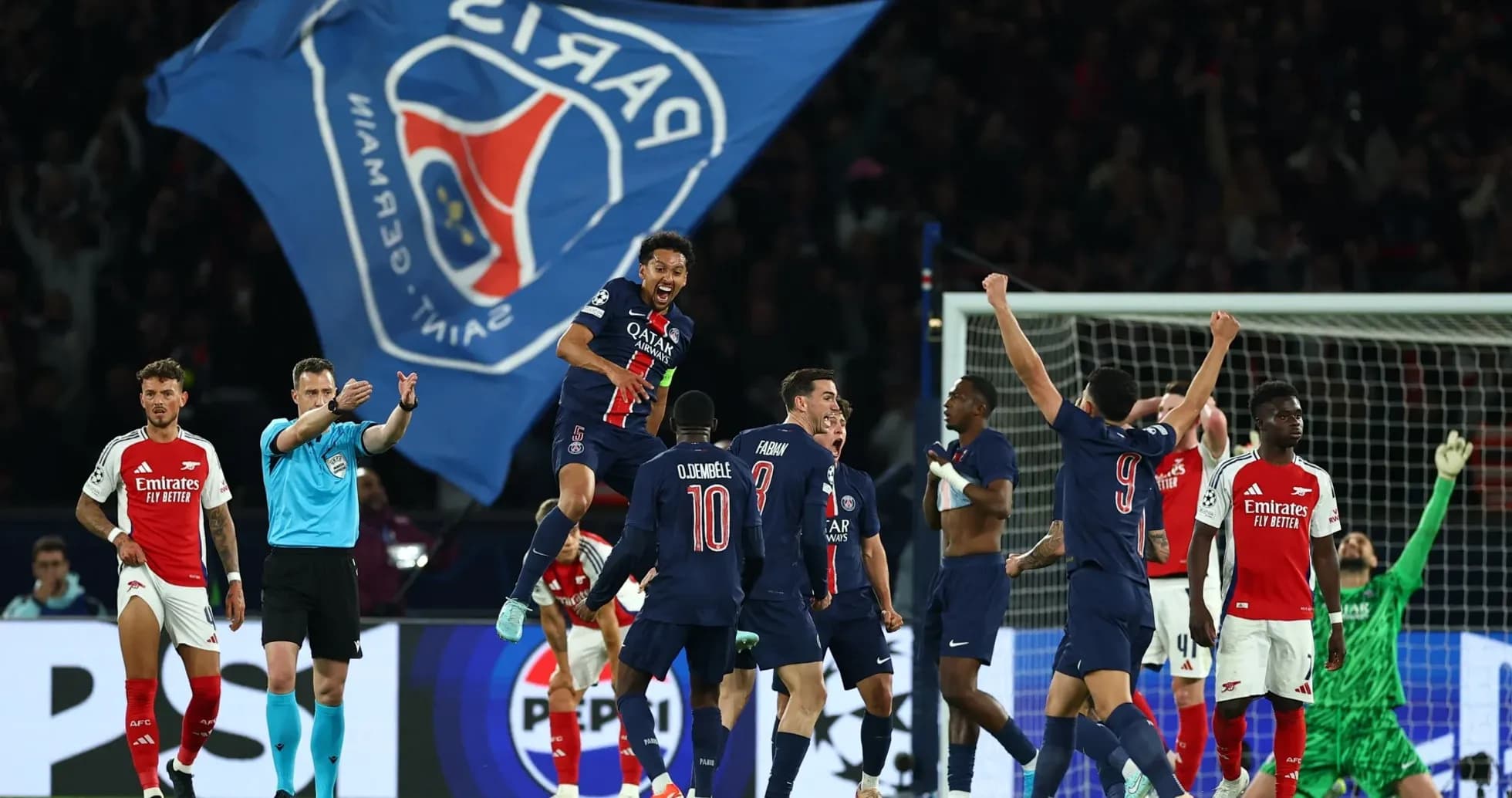
Recent history between these clubs in Europe has been finely balanced and fiercely contested. On 7 May 2025, Paris Saint Germain edged Arsenal 2-1 at Parc des Princes (UEFA Champions League, season 2024, May 2025), a semi-final where the French side’s home edge proved decisive. Just days earlier, on 29 April 2025, Paris Saint Germain had also prevailed 1-0 at Emirates Stadium (UEFA Champions League, season 2024, April 2025), showing they could impose themselves in London as well. However, on 1 October 2024, Arsenal had produced a controlled 2-0 victory over Paris Saint Germain at Emirates Stadium (UEFA Champions League, season 2024, October 2024), a reminder that the English side are capable of dictating this matchup when their structure clicks.
Tactical Preview
Paris Saint Germain’s statistical profile points clearly towards a 4-3-3 base, their most-used shape with 16 recorded appearances. That structure supports a high-octane attack (44 goals across 16 wider fixtures in the predictions dataset and 21 in 8 in the standings sample), with wide forwards like K. Kvaratskhelia thriving: K. Kvaratskhelia has 10 goals and 6 assists in this Champions League campaign, backed by 30 shots and 18 on target, making K. Kvaratskhelia the central creative and scoring reference. O. Dembélé adds another sharp edge with 7 goals and 2 assists (24 shots, 13 on target), while D. Doué’s blend of 5 goals and 4 assists plus 50 attempted dribbles (23 successful) gives Paris Saint Germain multiple one‑v‑one threats.
Behind them, Vitinha is the metronome in midfield, with 6 goals, 1 assist and an outstanding passing platform (1,553 passes at 93% accuracy), allowing Paris Saint Germain to sustain pressure and recycle attacks. A. Hakimi, listed as a defender, still contributes heavily in the final third (1 goal, 6 assists, 23 key passes), suggesting Paris Saint Germain will look for overlapping runs and width on the right. The flip side is discipline: I. Zabarnyi and L. Hernández both have one red card in this Champions League campaign, hinting at a back line that can be stretched into risky challenges under pressure (2 red cards among Paris Saint Germain defenders).
Arsenal, by contrast, show a dual-identity tactical profile, frequently alternating between 4-3-3 (9 times) and 4-2-3-1 (5 times). That flexibility underpins their outstanding defensive record in the standings sample (4 goals conceded in 8) and in the broader data (6 conceded in 14), justifying the label of a highly organised unit (0.4 goals conceded per game in the wider sample). Martín Zubimendi, although classified here as a defender, functions as a ball-winning presence with 14 tackles, 5 blocks, 10 interceptions and 4 yellow cards, anchoring the central areas and disrupting opposition build-up.
In attack, Arsenal’s threat is more distributed. Gabriel Martinelli, listed as a midfielder, brings 6 goals and 2 assists with 38 attempted dribbles (17 successful), giving Arsenal a direct outlet on the flank. Around him, the squad list shows a deep pool of forwards such as Gabriel Jesus, V. Gyökeres, K. Havertz, B. Saka and L. Trossard, allowing Arsenal to tailor their front line to exploit Paris Saint Germain’s defensive lapses (11 goals conceded in 8 in the standings sample). The predictions data underline this balance: Arsenal’s last-five defensive index is 95% and their last-five form index is 73%, while Paris Saint Germain’s last-five attacking index is 62% and defensive index 76%, setting up a classic clash between a free-scoring side and an elite rearguard.
The model comparison tilts towards Arsenal despite Paris Saint Germain’s attacking numbers: the overall model rating gives Paris Saint Germain 42.0% against Arsenal’s 58.2%, and the predictions engine leans to the away side on a “win or draw” basis. Yet Paris Saint Germain’s own attacking comparison edge (attacking share 72% versus Arsenal’s 28% in the model) suggests that if the game opens up, their forwards have the weapons to punish any rare Arsenal mistakes.
Statistical Snapshot
- Competition: UEFA Champions League, season 2025 — 30 May 2026.
- Venue: Puskas Arena, Budapest.
- Prediction: Win or draw — Double chance : draw or Arsenal.
- Win Probabilities: Home 10% / Draw 45% / Away 45%.
- Model: Paris Saint Germain 42.0% — Arsenal 58.2%.
Betting Verdict
With Arsenal perfect in the standings sample (8 wins from 8, 23 goals scored and 4 conceded) and holding a strong defensive profile (0.4 goals conceded per game in the wider data), the analytical case backs them to avoid defeat, especially after their controlled 2-0 win over Paris Saint Germain at Emirates Stadium in October 2024 and despite the two narrow defeats in the semi-finals in April and May 2025. Paris Saint Germain’s explosive attack (21 goals in 8) and star quality in K. Kvaratskhelia, O. Dembélé and D. Doué mean they can absolutely force a high‑variance contest, but their disciplinary record and 11 goals conceded in 8 suggest more risk against such a clinical opponent. With most major bookmakers pricing the home win around 2.30–2.40, the draw around 3.10–3.37 and the away win around 3.00–3.30, the value aligns with the prediction model: the double chance on draw or Arsenal fits both the numbers and the recent head‑to‑head pattern of tight, tactical encounters.