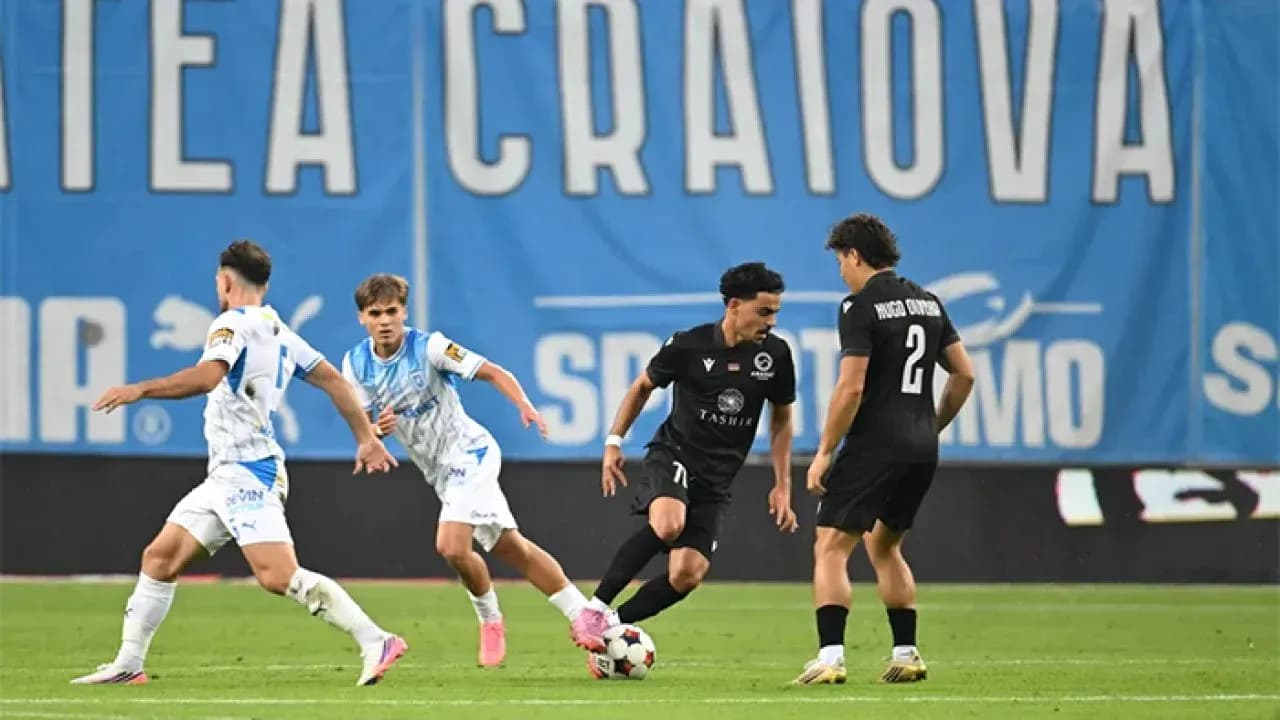
Universitatea Craiova vs Ararat-Armenia Tactical Analysis
Universitatea Craiova’s 3-4-3 at Stadionul Ion Oblemenco was built to dominate territory and width, and the shot profile underlines that intent. They produced 7 shots on goal and 7 shots off goal, plus 1 blocked effort, against an Ararat-Armenia side that managed only 2 shots on goal and 4 off target with 2 blocked. Despite the official possession reading “0%” for both teams, the volume and distribution of Craiova’s attempts, along with an 8–4 advantage in corners, point to a home side that spent long stretches in the attacking half, forcing the visitors into a compact, low-risk defensive block.
Defensive Structure
Structurally, Craiova’s back three of V. Screciu, A. Rus and O. Romanchuk gave Filipe Coelho a stable rest-defense platform against Ararat-Armenia’s 4-3-3. With wing-oriented midfielders N. Bancu and C. Mora operating as de facto wing-backs in the line of four, the hosts could pin Ararat’s full-backs, especially E. Grigoryan and Junior Julio, and generate consistent wide overloads. The equalising goal on 33 minutes, scored by Bancu and assisted by A. Cicaldau, was the clearest expression of that pattern: a midfielder starting wide, arriving in the final third from the left lane and exploiting the space outside Ararat’s narrow central trio.
Ararat's Approach
In contrast, Tulipa’s 4-3-3 for Ararat-Armenia was more conservative than the nominal shape suggests. With H. Oliveira listed in the defensive line and Benny and K. Muradyan forming part of a three-man midfield, Ararat frequently collapsed into a 4-5-1 without the ball, with Sandro Lima isolated as the lone outlet. Their opener at 20 minutes, scored by centre-back A. Malis from a delivery by Oliveira, reflected a set-piece or second-phase scenario rather than sustained open-play pressure. That aligns with their modest shot count and limited corner output: Ararat’s attacking threat came in short, targeted moments rather than long possessions.
Disciplinary Pattern
The disciplinary pattern further highlights Craiova’s territorial aggression and defensive risk. All four yellow cards in the match went to Universitatea Craiova players: David Matei at 39 minutes, Oleksandr Romanchuk at 47, Adrian Rus at 69 and Monday Etim at 78. While the reasons are not specified, the clustering of cautions among defenders and central midfielders suggests repeated interventions to stop transitions or counter-attacks once Ararat broke the first press. Ararat-Armenia, by contrast, finished without a single booking, consistent with a deeper, more reactive block that avoided the kind of high duels and tactical fouls common in pressing sides.
Substitution Patterns
Craiova’s substitution pattern from the 62nd minute onward underlines a clear attempt to increase verticality and attacking freshness. At 62 minutes, S. Nsimba (IN) came on for A. Al Hamlawi (OUT), and M. Etim (IN) replaced D. Matei (OUT), injecting pace and direct running into the front line and midfield. At 69 minutes, Teles (IN) replaced Cicaldau (OUT), suggesting a shift towards a slightly different profile in the middle—potentially more energy and box-to-box coverage to sustain pressure as Ararat dropped deeper. The late double change at 85 minutes, with T. Baluta (IN) for A. Mekvabishvili (OUT) and L. Basceanu (IN) for S. Baiaram (OUT), was a final attempt to refresh both central lanes and wide attacking channels for a late winner.
Ararat-Armenia’s changes were more about stabilising and redistributing defensive load than chasing the game. At 69 minutes, Franca Carlos (IN) replaced Benny (OUT), a like-for-like midfield adjustment that maintained the 4-3-3 structure. At 75, J. A. Balanta (IN) for H. Oliveira (OUT) shifted responsibilities on the right side and in deeper build-up. The triple change on 80 minutes—Z. Shaghoyan (IN) for Z. Banjaqui (OUT), M. Carlier (IN) for K. Muradyan (OUT), and A. Tera (IN) for A. Serobyan (OUT)—reconfigured all three lines behind Sandro Lima, effectively freshening the defensive block and midfield legs to cope with Craiova’s late pressure rather than adding extra forwards.
Tactical Battlegrounds
Set pieces were another tactical battleground. Craiova’s 8 corner kicks to Ararat’s 4 show how often the home side forced last-ditch interventions around the box. With three centre-backs and aerially capable midfielders, they could load the penalty area, while Ararat relied more on direct deliveries from deeper positions, as seen in the Malis goal. Yet Ararat’s ability to defend a high number of corners without conceding again reflects well-organised zonal or mixed marking, with central defenders B. R. Wilson Valdez and Malis repeatedly clearing.
The foul count—15 for Craiova versus 5 for Ararat-Armenia—reinforces the narrative of a home side pressing and counter-pressing aggressively, accepting defensive fouls as the price of territorial dominance. Ararat’s low foul tally fits a strategy of positional defending: dropping off into shape rather than stepping out into risky duels.
With goalkeeper-specific data absent, the shot numbers still suggest that Joao Bravim (Ararat-Armenia) had the heavier workload than L. Popescu (Universitatea Craiova). Facing 7 shots on goal, Bravim had to anchor a side under sustained pressure, while Popescu dealt with just 2 shots on target, mostly protecting against sporadic counters and set plays. That contrast mirrors the overall tactical story: Craiova’s 3-4-3 imposed the game, generated volume and width, but Ararat-Armenia’s compact 4-3-3, disciplined defending and selective attacking moments were enough to preserve a 1-1 draw in this UEFA Europa League Play-offs tie.