Vinicius Jr and the Premier League's Superstar Dilemma
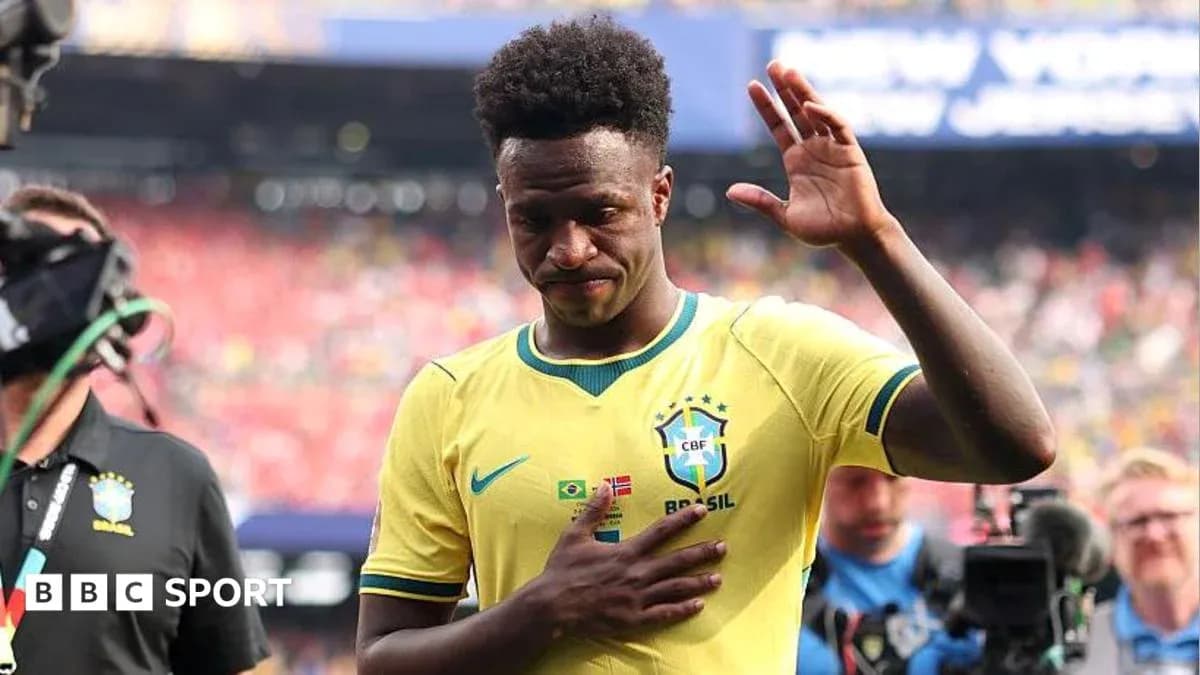
If Vinicius Jr had walked into London Colney this summer, he would have arrived as something English football almost never sees: a fully formed, global superstar at the absolute peak of his powers choosing the Premier League over Real Madrid.
Arsenal were ready. He was their primary target if he ever chose to leave the Bernabeu. At 26, with multiple Champions Leagues behind him and his name already lodged in every Ballon d'Or conversation, Vinicius was at the kind of level clubs usually only dream about, not actively pursue.
He was open to the idea. For a moment, the door creaked.
Then he shut it himself, signing a new deal at Real Madrid until 2032.
A rare chance gone, and with it another reminder of a strange contradiction at the heart of the modern game.
England’s wealth, Spain’s allure
No league spends like the Premier League. No league sells itself quite as relentlessly as the strongest, fastest, most competitive domestic competition on the planet. The TV money dwarfs rivals. The global reach is unmatched. The stadiums are full, the drama constant.
Yet when it comes to attracting the very top tier of attacking talent — the players who live permanently on the Ballon d'Or shortlist — England still often watches from the outside.
Elite centre-backs? No problem. Goalkeepers? The league is stacked with them. But the true headline forwards and attacking midfielders, the ones whose faces front global campaigns, still tend to gravitate to Madrid, Barcelona, Bayern, Paris. Or they stay exactly where they are.
Since the Premier League’s inception in 1992, only three players have lifted the men’s Ballon d'Or while playing for an English club: Michael Owen for Liverpool in 2001, Cristiano Ronaldo for Manchester United in 2008, and Rodri for Manchester City in 2024.
Three, in more than three decades of unprecedented wealth.
England, though, has become a different kind of powerhouse. Not the final destination for the finished article, but the proving ground where elite talents become global stars.
A league that makes superstars, not just buys them
Look down the Premier League’s modern history and a pattern emerges.
Dennis Bergkamp arrived at Arsenal after a bruising spell at Inter Milan, his reputation dented, his confidence questioned. In north London he turned into one of the most influential players the league has ever seen, the brain and brushstroke behind Arsène Wenger’s revolution.
Eric Cantona came to England already mercurial, already volatile, already brilliant in flashes for Auxerre, Marseille, Nimes and Leeds. At Manchester United he became something else entirely — the symbol of their first great Premier League dynasty, the swaggering leader who changed a club’s mentality.
Thierry Henry reached Arsenal from Juventus as a winger who had flattered to deceive in Serie A. In England he transformed into one of his generation’s defining forwards, a player who seemed to redraw the geometry of the pitch every time he picked up the ball.
Cristiano Ronaldo is the clearest template. United signed him at 18 from Sporting, a raw, electric winger with tricks and potential. Five years later he was a Ballon d'Or winner, and the following summer he was gone, bound for Real Madrid, the finished superstar returning to the traditional home of the galactico.
Erling Haaland fits the same arc. Manchester City took him from Borussia Dortmund in 2022 as one of Europe’s most coveted young strikers, already prolific but still developing. In England, he has become something more terrifying: a machine-like number nine whose goals bend seasons.
The Premier League excels at this stage of the story. It takes the almost-complete and polishes them into giants.
Signing someone like Vinicius now, though, is something else entirely. This is not a project. This is a player already at the summit.
The rarest of moves
There have been exceptions. But they are so rare that each one still feels like an anomaly.
The closest comparison to Vinicius is Andriy Shevchenko. When he joined Chelsea from AC Milan in 2006 at 29, he arrived as a reigning member of the elite. He had won the Ballon d'Or in 2004 and finished fifth in 2005. He was not a prospect. He was a finished masterpiece being shipped to a new gallery.
That kind of move almost never happens at that level, at that age, into this league.
Others came with the golden trophy already on the mantelpiece but with their peak years behind them. Ruud Gullit and George Weah both joined Chelsea late in their careers. Ronaldo returned to Manchester United at 36, no longer the explosive winger or relentless goal machine of his first spell. Zlatan Ibrahimovic arrived at Old Trafford at 34, still a box-office act but well past his physical zenith. Jurgen Klinsmann signed for Tottenham at 30, a superstar, yes, but already on the downward slope of a glittering journey.
Those deals brought glamour and headlines. They did not change the underlying trend.
From Serie A’s age of stars to England’s age of depth
To understand that trend, you have to look back.
In the 1980s and 1990s, Serie A stood where the Premier League stands financially today — but with a different gravitational pull. Italy was the place where the very best went and stayed in their prime.
Diego Maradona left Barcelona for Napoli and became a demigod. Brazil’s Ronaldo swapped Barcelona for Inter at his most explosive. Michel Platini, Marco van Basten, Lothar Matthaus, Zinedine Zidane — all spent some of their finest years under the Italian spotlight.
The Premier League’s modern dominance has not recreated that model. It has produced something more fragmented.
English clubs spend extraordinary sums, but the money often spreads across entire squads rather than being sunk into one or two totemic figures. Or it circulates inside the league itself.
Alexander Isak, Morgan Rogers, Elliot Anderson, Moises Caicedo, Declan Rice, Jack Grealish — all have moved between Premier League clubs for fees north of £100m. Not global icons, not Ballon d'Or favourites, but elite or emerging players whose value is driven by internal competition and financial muscle.
From abroad, Liverpool’s signing of Florian Wirtz fits the same pattern. A player with a huge reputation, yes, but one whose best years almost certainly lie ahead, whose ceiling has not yet been hit.
This is the Premier League’s modern transfer model: not importing a single galactico to sit on top of the pyramid, but assembling 18 to 22 high-level players capable of surviving a 60-game season across multiple fronts. Depth over deity.
Haaland, Madrid and the ceiling problem
Haaland, again, is the outlier who proves the rule.
City took him at 21. He has since become one of the most feared strikers in the world, breaking records at a pace that makes historical comparisons feel flimsy. If any signing looked like a landmark shift in power, it was that one.
Yet even Haaland’s story underlines the enduring pull of Real Madrid.
During the 2026 World Cup, his father Alfie spoke to DAZN about the prospect of his son one day moving to the Bernabeu. The message was clear: Haaland is happy at City, he has a long contract, but Real Madrid remains the club any player would want to represent.
It was not a transfer plea. It was an admission of hierarchy.
The Premier League can build the stage. It can fill the stands, pump up the noise, and turn talent into superstardom. But when players reach the absolute summit, the old magnets still hum in the background — the white of Madrid, the mythology of that stadium, the idea that the final chapter of a great career belongs there.
Vinicius Jr choosing to stay at Real Madrid until 2032 simply reinforces that reality. Arsenal dared to imagine something different. The league itself briefly glimpsed a future in which one of the game’s defining attackers chose England over the Bernabeu at his peak.
For now, that future remains hypothetical. The Premier League will keep making superstars. The question that lingers is whether it will ever consistently convince the very biggest of them to make England their final destination, rather than just the most lucrative part of the journey.