Wirtz Shines as Germany's Key Player in International Matches
Kai Havertz walked off with a goal to his name and the coach’s trust intact. Yet again, though, the lingering feeling was that he should have had more. That contrast – between promise and end product, faith and frustration – ran through Germany’s entire international window.
Florian Wirtz, by contrast, left no room for doubt.
Wirtz takes centre stage
In Switzerland, Wirtz delivered the kind of performance that shifts hierarchies. Nominally stationed on the left, with Serge Gnabry in the No. 10 role, he played as if the pitch belonged to him. Two goals, involvement in all four strikes, and a shooting technique that sliced through a good side away from home. This was not just a good outing in a Germany shirt; it was arguably his best yet.
Nagelsmann’s tweak was clear. Gnabry, darting into the box with short, sharp runs, dragged defenders inside. Wirtz then roamed into the gaps, dictating tempo and angles. The second goal against Switzerland showed the idea in full colour. Against Ghana, the same pattern never really caught fire, with Gnabry far more subdued.
Still, the template is there. Wirtz has moved from talented piece to central pillar.
Havertz: trusted, but still wasteful
Havertz remains the puzzle Nagelsmann refuses to put back in the box. The 26-year-old led the line again, knitted play together, found good positions – and squandered chances. Clear chances. Repeatedly.
His only goal came from the penalty spot, just as at the European Championship, where both of his strikes were also from 11 metres. The pattern is impossible to ignore: excellent movement, intelligent link-up, but a lack of cold-blooded finishing.
Nagelsmann, though, is unwavering. Havertz is a starter. The only variable is where. If Jamal Musiala shakes off his injury issues and hits rhythm, he is likely to play as the lone striker or, as against Ghana, from the right. That would push the debate into a straight fight between Gnabry and Nick Woltemade for another attacking berth.
Woltemade, Undav and the No. 9 debate
Despite a recent dip at a troubled Newcastle United, Woltemade remains Nagelsmann’s first option if he wants a classic centre-forward. Against Ghana, the tall striker made a strong case as a target man. He held the ball up, offered a focal point, and brought others into play. Only the goal was missing.
His edge is obvious: he offers something different. He’s not a copy of Havertz, not another drifting forward. He is a reference point.
Deniz Undav, by contrast, leaves this camp with a curious status: both success story and problem case.
The Stuttgart striker did exactly what the coach had asked of him. Coming off the bench against Ghana, he poached the winner in front of a home crowd, underlining why Nagelsmann sees him as a “finisher” best used against tired legs. The numbers back that view – 16 of his 23 goals for VfB came in the second half.
Then came the microphone.
Speaking to ARD, Undav voiced his hope for more minutes and questioned, if only indirectly, the rigid “role discussions” Nagelsmann has made a cornerstone of his squad management. The reaction from the coach was frosty and blunt. Very blunt.
Nagelsmann pointed out that Undav had barely been involved before the goal – just 13 touches – and admitted he “didn’t think his performance was good until the goal”. He praised him as a “top striker” for being there when it mattered, but then openly wondered whether Undav would have finished that chance if he had been running for 70 minutes.
The message was unmistakable: you are my super-sub. Accept it.
The striker said he did. Yet Nagelsmann’s visible irritation at the press conference suggested this story is far from over. “Deniz Undav has been the topic of conversation for seven days now,” he remarked, clearly weary of the subject. This is a battle of roles and egos that could rumble on right up to the World Cup.
Sané, Karl and the wing hierarchy
Leroy Sané’s call-up was always going to raise eyebrows. Nagelsmann had publicly challenged him after his move to Galatasaray, demanding more than he had shown in the Bundesliga. Instead, Sané has recently slipped out of the Turkish club’s starting XI.
So when his name appeared in the line-up against Switzerland, the spotlight sharpened. The response was disappointing. While Wirtz and others lit up the game, Sané flickered and then faded. He won just one of several attempted dribbles and drifted out of the contest.
Nagelsmann resisted the temptation to drop him altogether. His argument was simple: Germany need one-on-one players and don’t have many, especially in attack. He explicitly named Lennart Karl and Jamie Leweling as direct competition and laid down the challenge: “Leroy knows what’s required – and he has to show it.”
Against Ghana, he did. Brought on as a substitute, Sané cleverly created Undav’s winner and earned praise for a clear step up in performance.
Karl, though, may be the biggest revelation of the camp. The teenager came on in both games and immediately caught the eye with fearless, incisive dribbling. Nagelsmann’s verdict could hardly have been more telling: of all the young players brought in over time, Karl had made the best impression. Undav even reached for a comparison with Franck Ribéry, highlighting the youngster’s “cunning at such a young age.”
This no longer feels like a brief taste of the senior setup. Karl can start thinking seriously about a World Cup ticket.
Leweling missed both matches through injury, yet his place still looks relatively secure. His ability to play on both flanks and inject energy from the bench fits exactly what Nagelsmann wants. Chris Führich, however, failed to seize his opportunity against Ghana, and Kevin Schade never even got onto the pitch.
Schade, Adeyemi, Beier: sprint race for limited seats
Schade’s situation is particularly intriguing. Called up to “get a taste” of the environment and integrate, the lightning-quick Brentford forward ended up restricted to training-ground auditions only. On the surface, that helps him; in reality, it keeps the door open for his rivals.
Karim Adeyemi and Maximilian Beier stayed at home this time, not even drafted in after Leweling’s withdrawal. Nagelsmann had been brutally clear with the trio: at most, one or two of these counter-attacking forwards will go to the World Cup. Schade’s advantage was simply timing – he could show himself now. Previously, the others had that same advantage.
Beier, currently in top form at BVB and already effective as a super-sub there, may yet profit most. His relentless running and pressing make him a near-perfect fit for Nagelsmann’s preferred high-intensity style. Adeyemi, in contrast, stands on shaky ground. He has lost his starting place under Niko Kovac and has offered little from the bench in recent weeks.
The sprint for those final attacking spots is far from decided.
Brown turns up the heat on Raum
On the left side of defence, Nathaniel Brown made a powerful statement. Starting against Ghana, he interpreted the full-back role far more centrally than David Raum, mirroring the hybrid responsibilities he has taken on at Eintracht Frankfurt under Albert Riera as a defensive midfielder and attacking midfielder.
Brown shielded the adventurous attackers, read the game cleanly and dealt with Ghana’s main threat, Antoine Semenyo, with authority. When the visitors countered, he was there, winning duels in key moments.
Does that put Raum’s starting place at risk? Not yet. The Leipzig man has been a major attacking weapon this season, even if his defensive work still wobbles at times. The loss to Switzerland summed him up: beaten by Silvan Widmer before Breel Embolo’s goal, then making a crucial intervention to deny Johan Manzambi a likely 3-2.
For now, Raum stays first choice. But Brown has moved from long shot to genuine alternative. The irony is hard to miss: at the home European Championship, Raum himself was the Plan B who ousted Maximilian Mittelstädt. Now he feels the breath of competition on his own neck.
For Mittelstädt, omitted this time, the door appears firmly closed.
Midfield battles: Stiller, Pavlovic, Nmecha and Goretzka
In central midfield, the picture is just as nuanced. Angelo Stiller, called up late, started both friendlies and delivered solid, if unspectacular, performances. He did little wrong, but also little to overturn Nagelsmann’s existing pecking order. Aleksandar Pavlovic, already back in training, still holds the edge in the coach’s eyes.
Felix Nmecha is the real wildcard. His fitness is a race against time, yet if he makes it, Stiller’s path narrows sharply. Nmecha’s absence currently looks like Stiller’s only realistic route onto the World Cup plane.
Pascal Groß, by contrast, enjoys a special status. The Brighton man is the coach’s on-field extension, a link-up player and organiser. His showing against Ghana was far from sparkling, but Nagelsmann clearly values his brain and reliability over highlights.
That leaves Anton Stach in the shadows. The Leeds midfielder impressed in his brief cameo against Switzerland, even setting up the winner in the 4-3 thriller and offering exactly the kind of counter-attack protection that could free Joshua Kimmich. Yet he did not see the pitch again. Nagelsmann clearly has a different blueprint.
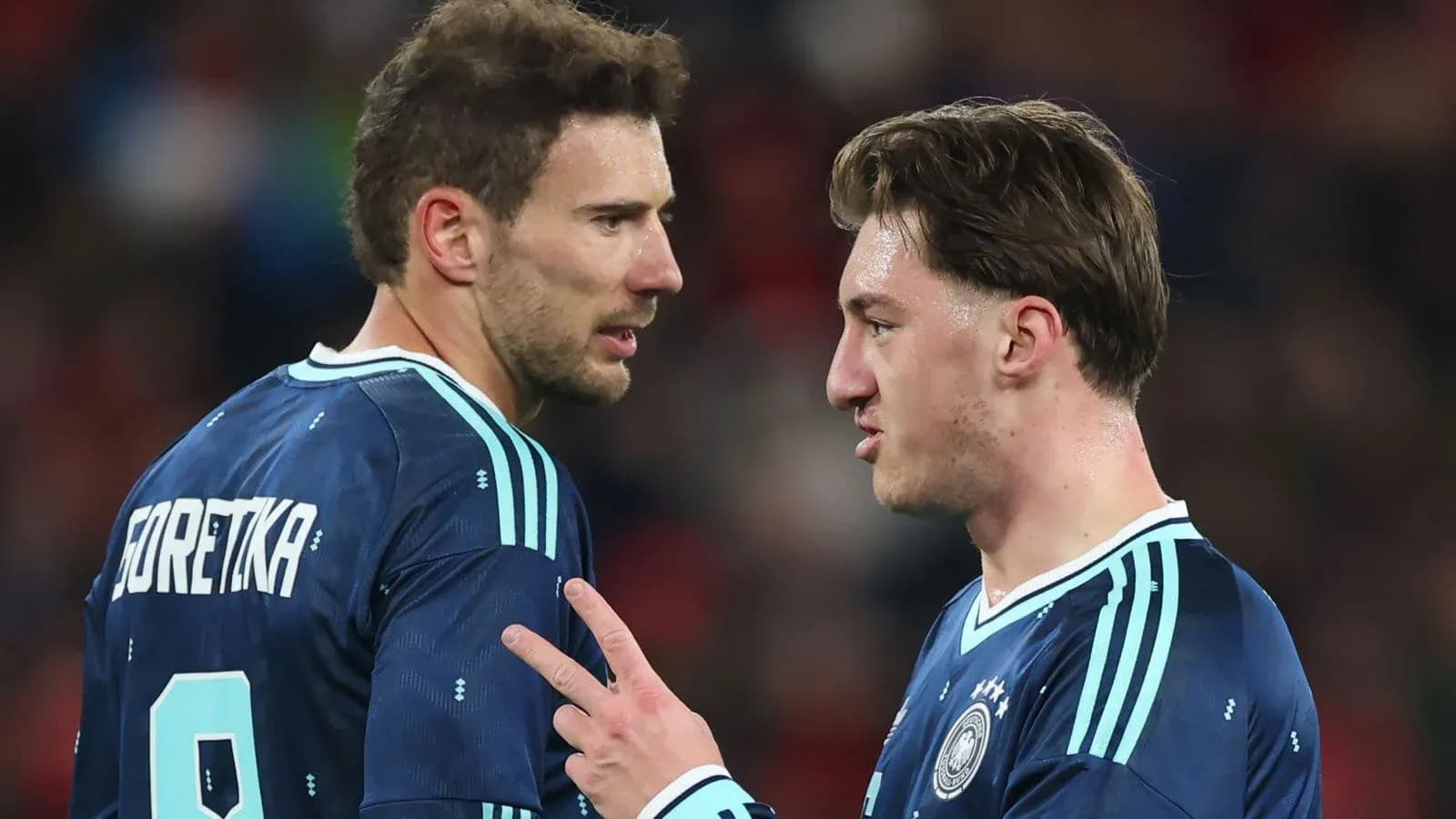
That blueprint includes Leon Goretzka. The Bayern midfielder was not spectacular, but he fits the role profile: a line-breaker who pushes into the front line, ties down opponents and offers a vertical passing option. Against Ghana, he did exactly that late on, feeding the ball that led to Sané’s assist for Undav.
With Kimmich shuttling between right-back and central midfield, Goretzka’s absence in deeper zones is less of an issue in games where Germany dominate possession. Kimmich, for his part, played with familiar authority on the ball and did a reasonable defensive job, although he left too much space behind him at times and was partly at fault for Switzerland’s opener.
The problem is that Nagelsmann has no convincing alternative at right-back. Josha Vagnoman’s rusty return after three years away from the national team – including poor tackling for Ghana’s equaliser – did little to change that. It would be no surprise if Benjamin Henrichs or Ridle Baku reappeared in the squad soon.
Schlotterbeck, Tah and a settled core at the back
At centre-back, the hierarchy is clear. Nico Schlotterbeck and Jonathan Tah will go into the World Cup as the starting pair, come what may.
Even Schlotterbeck’s two costly errors against Switzerland have not shaken Nagelsmann’s conviction. The coach had already promised him a starting berth and doubled down after the game. The reason is straightforward: Schlotterbeck is the only naturally left-footed central defender in the squad. In a possession-heavy, structure-obsessed system, that matters.
The hope, of course, is that the mistakes remain an exception. In open space and one-on-one defending, his quality is not in question. Tah benefits from that, especially as he can be slow to react in rapid transitions. Against Switzerland, he was too passive on two of the goals conceded, yet he still sits comfortably ahead of Antonio Rüdiger in the pecking order.
Rüdiger, now at Bayern, did not cover himself in glory against Ghana either and needed Schlotterbeck to bail him out to prevent an earlier equaliser. He remains the first reserve, provided he avoids further controversy at Real Madrid.
Waldemar Anton, despite not playing a single minute, can also feel secure. Like Groß, the Dortmund defender is a valued squad presence, a reliable closer of tight games and a reward for a strong club season. Nagelsmann even hinted that Anton is “very likely” to be in the World Cup squad, praising his full-throttle training attitude and quiet professionalism.
Malick Thiaw, who also did not feature, leaves the camp in a far more uncertain position.
Nagelsmann: bold ideas, sharp edges
Hovering over all of this is Nagelsmann himself, a coach whose tactical clarity is sometimes undermined by his own words.
His handling of Undav has been clumsy at best. Publicly challenging a player who had just scored a winner, then questioning his ability to repeat that feat over 70 minutes, felt unnecessarily abrasive. Add in the mixed messages – from the Schlotterbeck interview in kicker to the sudden shift on Sané – and a pattern emerges: a coach whose communication repeatedly stirs controversy.
Yet on the pitch, many of his calls have been vindicated. Bringing in Alfred Schreuder and giving set-piece specialist Mads Buttgereit more freedom has already paid off, with two rehearsed routines producing goals for Tah and Wirtz against Switzerland.
The football is taking shape. The structure is visible. The squad lines are being drawn.
What remains unclear is whether Nagelsmann’s sharp tongue will help forge a hardened group or leave bruises that linger into the World Cup. If he wins, nobody will care. If he falls short, every quote, every public jab, every role lecture will be replayed and dissected.
For now, Germany leave this window with a clearer spine, a clutch of emerging winners, and a coach walking a tightrope of his own making.