The World Cup That Defied Expectations and Created Legends
This was a World Cup that refused to behave. It was supposed to be neat, predictable, corporate. Instead it lurched from chaos to catharsis, from Sidny Lopes Cabral’s impossible arc into the top corner to Vozinha’s 40‑year‑old hands clawing away shots that should have ended his story, not defined it.
By the end, the tournament felt less like a bracket and more like a fever dream stitched together across three nations and countless time zones.
Matches that bent reality
Start with the penalty shootout Germany were never meant to lose. Paraguay 1-1 Germany in the last 32 did not boast the most goals, but it had a tension that gripped and refused to let go. Germany’s relationship with shootouts is part myth, part muscle memory. This time, the myth snapped. They went out in spectacular fashion, the kind of collapse that lingers long after the final kick.
Elsewhere, Algeria 3-3 Austria unfolded like a glitch in the matrix. It arrived with the expectation of a biscotto – a gentle, mutually beneficial draw that would send both sides through. For long stretches of the second half, that seemed exactly what it would be: a game played at arm’s length, both teams half-looking at the clock. Then stoppage time detonated. The match descended into chaos, the pre-arranged script shredded in front of a global audience. Not the highest quality, not the purest drama, but unquestionably the strangest.
Mexico 2-3 England at the Azteca belonged to a different category altogether. The buildup started almost as soon as the draw came out, a pilgrimage to one of football’s great cathedrals. The stadium delivered. A thunderstorm pushed kick-off back, the noise ricocheted around the concrete bowl and Thomas Tuchel’s side were dragged into a contest that felt like it might never end. England clung on, then surged, then clung on again. It became, in the words of more than one observer, like “drinking cortisol neat”. For those inside the Azteca, it was an epic night at an iconic venue; for those watching on television, it was pure cinema.
England kept finding themselves in the eye of the storm. France 4-6 England bordered on slapstick, a scoreline from a video game, while England 1-2 Argentina had the weight of something more familiar, more fated. The tournament kept dragging them back to the centre of the narrative, only to spit them out again.
Argentina, though, specialised in the impossible. Their 3-2 win over Egypt in the last 16 felt, for a long time, like the end of an era. Two goals down, the defending champions were already mentally on the plane home. Then Lionel Messi took hold of the game, as he has done so often, and dragged them back from the brink. A two-goal deficit vanished, the comeback complete in normal time, the referee’s questionable decisions only heightening the sense of delirium.
Cape Verde wrote their own chapter. A 2-2 draw with Uruguay in Miami showcased a team whose attitude and discipline turned them into neutral favourites. Their 3-2 defeat to Argentina produced something else entirely: Sidny Lopes Cabral bending a long-range equaliser into the top corner in extra time, a goal that seemed to hang in the air for an eternity before dropping like a hammer. For improbable wonder, that tie had few rivals.
Even the games that “no one wanted to play” carried a strange pull. The dead rubbers, the consolation fixtures, the third-place oddities – they all picked up the tournament’s offbeat rhythm. Egypt 1-1 Iran in Seattle produced a disallowed stoppage-time winner, two late efforts off the woodwork and, in the end, a draw that left unbeaten Iran stranded, their path blocked by forces both footballing and political.
By the time England edged Mexico, Argentina survived Cape Verde and Messi had broken more records against Austria in Dallas, the tournament had fully detached from expectation. You didn’t so much follow it as hang on.
Rodri, Vozinha and the men who owned the month
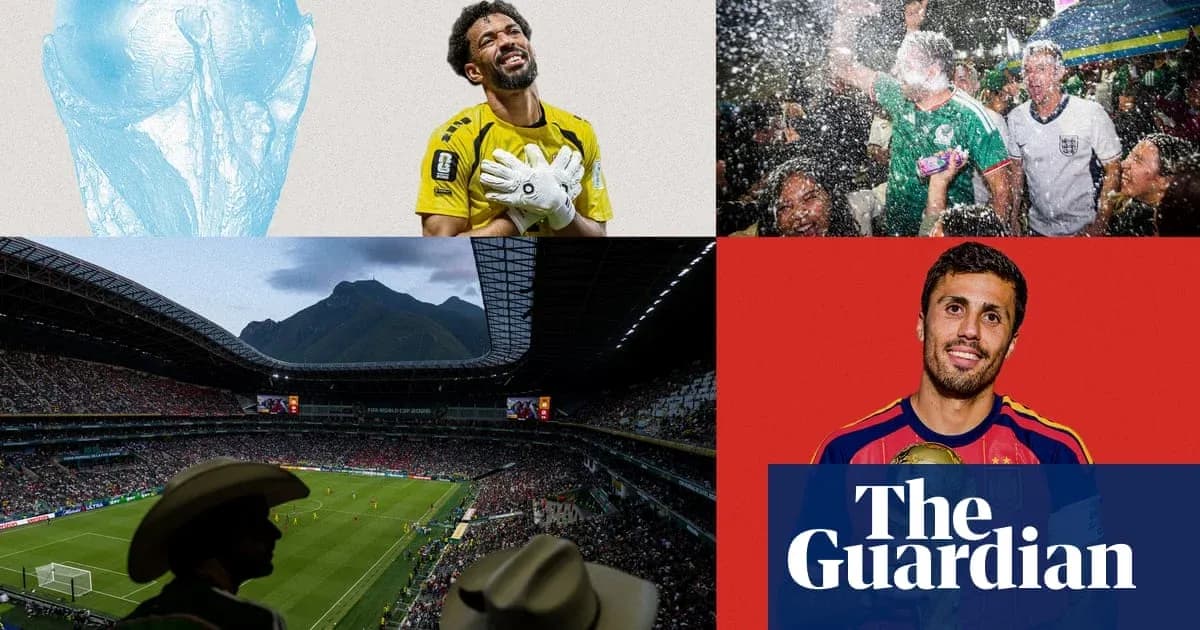
On the pitch, one constant cut through the noise. Rodri anchored the best team in the tournament and did it with such authority that consensus formed almost without argument. Spain reverted to a more possession-heavy model and he became their metronome, the fulcrum, the captain who set the tempo and suffocated opponents without fuss. Capitán, líder, leyenda – and, by common acclaim, player of the tournament.
Kylian Mbappé lit up France’s run, his Golden Boot inflated by that wild third-place game yet underpinned by the sense that he remained the sharpest weapon in a side that looked the class of the field until Spain dismantled them in the semi-final. Erling Haaland left with his own haul: a short but credible Golden Boot push, Norway’s first-ever quarter-final and a significant leap in global star power, particularly in the North American market that hosted his coming-out party.
Lionel Messi still bent games to his will. Jude Bellingham justified every argument for his inclusion and then some, driving England from midfield, while Michael Olise floated through matches with a grace that deserved even more end product. Dani Olmo added his name to the list of standouts. Pau Cubarsí, barely out of childhood, played like he’d been there for a decade.
And then there was Vozinha. Cape Verde’s 40-year-old goalkeeper, without a club, arrived with a backstory that would have sounded too neat in a commercial. He left as a cult hero. His saves were not just spectacular; they came against some of the tournament’s heavyweight attacks, turning group games and knockout ties into personal showcases. For many, he eclipsed even Eloy Room, who broke the World Cup record for most saves in a 90-minute match for Curaçao against Ecuador and still had to watch the older man steal the headlines.
Pico Lopes, throwing himself into tackles for Cape Verde and Shamrock Rovers, played as if every block might change the course of his career. It may not, given his age, but he walked away a legend in two homelands.
This was a World Cup in which the megastars largely delivered, but the spine of the story belonged to players who treated every minute as a once-in-a-lifetime chance.
Goals that stopped time
Some tournaments produce a catalogue of great goals. This one produced a hierarchy, with one effort sitting above the rest.
Sidny Lopes Cabral’s equaliser for Cape Verde against Argentina became the reference point. Long range, audacious, struck with a purity that made time slow. Emi Martínez flew. The ball ignored him. As it curled inside the far post, Cabral clasped his hands to his head, disbelief written across his face, before finding his girlfriend in the crowd to celebrate. It was a goal that changed not just a game but a nation’s relationship with the sport.
Everything else lived in its shadow, but plenty demanded attention. Eldor Shomurodov’s instinctive lob for Uzbekistan against the Democratic Republic of the Congo, from a tight angle and with an odd, satisfying trajectory, felt like a one-off piece of ingenuity. Julián Álvarez, quiet for much of the tournament, detonated a vicious, swerving drive in extra time against Switzerland in Kansas City that lit up the stadium and reminded everyone of his ceiling.
Bosnia and Herzegovina’s Kerim Alajbegovic arrived with a buzz and justified it by dancing past defenders and thrashing in a shot from outside the box against Qatar, off-balance and utterly fearless. Johan Manzambi’s run and pass in the build-up to Breel Embolo’s opener against Algeria offered a different kind of beauty: balance, timing, weight of pass.
Wilson Isidor’s long-range thunderbolt for Haiti against Morocco, which briefly put the Caribbean side 2-1 up, belonged in any all-time World Cup montage. Some argued it was as sweetly struck as anything the competition has ever seen. For Haiti, it became a permanent piece of sporting folklore.
Harry Kane’s second against DRC, placed with cold precision into the bottom-right corner from outside the box, summed up his ruthless streak. Haaland’s second against Brazil did the same for him: precise, powerful, almost casual in its brutality as it sealed one of the shocks of the tournament.
Some of the best strikes didn’t even count. One disallowed rocket, probably for Uzbekistan, flew into the top corner and was scrubbed from the record, surviving only in the memory of those who watched it live.
But every conversation about goals in this World Cup eventually circled back to Cabral. The flight of the ball. The silence before the roar. The idea that Cape Verde, debutants on this stage, could produce the defining moment of the entire tournament.
Moments that won’t leave
Away from the highlights packages, the World Cup lived in the margins.
Eloy Room standing tall for Curaçao, joking that he deserved a statue after his record-breaking night. Senegalese journalists quietly passing around malted milk biscuits during their anthem, a small act of normality before a collapse against Belgium. Nestory Irankunda copying Tim Cahill’s iconic celebration 26 minutes into Australia’s opening win over Turkey, a symbolic handover from one era to the next.
There were personal pilgrimages. First visits to the Azteca that delivered on every myth about its noise and scale. Messi’s record-breaking goals against Austria in Dallas, early in the tournament but already feeling like the closing chapters of a career. Those games turned into rolling Messi pilgrimages, fans travelling not just to watch Argentina but to witness a living relic.
Some memories barely involved football. A motorcade carrying the Spain bus passing the sixth-floor window from which Lee Harvey Oswald shot JFK. Journalists standing knee-deep in floodwater in Monterrey, waiting for a bus after retrieving an iPad that would be lost again a week later. Pancakes at Mile End Deli. A live show in Manhattan that allowed the host to bellow “HELLO NEW YORK!” with complete justification.
There was joy in small details: bagpipes blasting out Scotland the Brave in Foxborough as the Tartan Army finally arrived at a World Cup again, even if what followed on the pitch is best left unspoken. Vozinha’s mother, against all odds, travelling from Cape Verde to see her son play on the biggest stage of all.
In North America, the tournament burrowed into everyday life. Conversations about football broke out in queues, bars, hotel lobbies. For some reporters, it offered a respite from the isolationist mood of US politics, a reminder that the country could still rally around something open and outward-looking.
And then there was Mexico 2-3 England again, this time from the press box. A thunderstorm, a delayed start, Bellingham running himself into the ground, players and journalists alike exhausted at the final whistle. England’s campaign would end in disappointment, but that night at the Azteca stood apart: their greatest away win in years, achieved in a stadium that feels less like a venue and more like a test of character.
Hosts under the microscope
The World Cup’s spread across the US, Mexico and Canada turned it into a logistical marathon. Travel between venues became an endurance test. Stadiums sat miles from city centres, public transport in some American cities felt more suggestion than reality, and traffic – Boston, especially – turned every journey into a gamble.
Yet the human element largely redeemed the grind. In the US, hotel staff, bartenders and strangers on the street leaned into the tournament, eager to show a warmer side of a country often defined by its politics. Many fans and journalists spoke of an almost relentless friendliness, occasionally undercut by the omnipresent tipping culture and a sense that visitors were expected to feel grateful simply for being there.
Canada embraced its role with enthusiasm. Toronto buzzed for the country’s first World Cup match on home soil, even as Bosnia and Herzegovina held them to a draw. Vancouver and Seattle, with their downtown stadiums and existing football cultures, felt like natural hosts. Mexico, meanwhile, offered a fervent, febrile football environment that never deserved to be overshadowed. The Azteca, Monterrey, the celebrations after Mexico’s win over Ecuador – all of it underlined a country that lives the sport rather than merely stages it.
On the field, the co-hosts did themselves credit. Canada played with verve, hammering Qatar 6-0 in Vancouver and riding the energy of Jesse Marsch, part coach, part hype man. The USA produced some of the prettiest football their men’s national team has ever played, only to fall short against Belgium and rue a chance missed. Mexico barnstormed through Group A, outclassed an Ecuador side on the rise and then emptied the tank against England at the Azteca before running out of ideas in the final half-hour.
Not everything sat easily. The Folarin Balogun saga, and the perception of political interference in his reprieve, left a sour taste, a reminder of how easily governance can warp sporting competition. Fifa’s decision to take direct control of tournament organisation, sidelining the traditional local organising committees, raised questions about how future World Cups will be run.
Still, when the final whistle blew on the last game in each stadium, something quietly beautiful happened. With the crowds gone, the carefully guarded natural grass pitches opened up to the people who had kept the show on the road: stadium workers, volunteers, low-level Fifa staff, security guards, local club representatives. They kicked balls around, posed for photos, sprinted across turf they had spent weeks protecting. For them, it was a rare, deserved reward.
A World Cup that began with questions about scale, politics and logistics ended with something simpler: a collection of stories that will be told and retold. About Rodri’s control, Messi’s defiance, Haaland’s precision. About Cape Verde’s fairytale, Mexico’s Azteca epic, and a ball struck by Sidny Lopes Cabral that seemed, for a moment, to bend the entire tournament around it.
Where does a World Cup go after that?