Žilina's Tactical Comeback Against HNK Hajduk Split
Žilina’s 2-1 comeback win over HNK Hajduk Split at Štadión pod Dubňom was defined far more by structural and in‑game tactical shifts than by raw statistics, which are largely absent from the data. With the tie played in the UEFA Europa League 1st Qualifying Round, Pavol Stano’s 3-4-3 eventually overpowered Gonzalo Garcia’s 4-2-3-1, especially after half-time adjustments and a late‑game psychological swing culminating in the 90th‑minute own goal from D. Melnjak.
Stano’s starting 3-4-3 was aggressive from the outset. The back three of T. Paliscak, J. Minarik and A. Narimanidze provided a wide base, with T. Hranica stepping high from the right side to act almost as a hybrid wide centre-back/wing-back. In central midfield, the double pivot of X. Adang and M. Kacer was tasked with both screening and progressing play, while K. Bari and Hranica gave width around them. Up front, the trio of F. Kosa, M. Roginic and P. Ilko were positioned narrow, aiming to pin Hajduk’s back four and create central overloads.
Hajduk’s 4-2-3-1, by contrast, was more orthodox and initially more stable. The back four of S. Hrgovic, A. Van Hoorenbeeck, M. Skelin and M. Acapandie was protected by the double pivot of R. Pukstas and A. Pajaziti, with R. Brajkovic and N. Skoko flanking D. Melnjak behind lone striker M. Sego. The early pattern saw Hajduk use their full-backs asymmetrically: Hrgovic was encouraged to advance and combine on the right, while Melnjak often underlapped from the left half-space, giving Hajduk a 3-2-4-1 structure in possession when one full-back stepped up and the opposite side held.
First Half
The first half’s key tactical story was Hajduk’s ability to exploit set phases and wide channels despite Žilina’s extra centre-back. The booking for Šimun Hrgović on 21' for “Foul” underlined how aggressive he was in duels high on the right touchline. Ten minutes later, Alec Van Hoorenbeeck’s yellow card, also for “Foul”, showed Hajduk’s willingness to defend forward and compress Žilina’s front three between the lines rather than dropping deep.
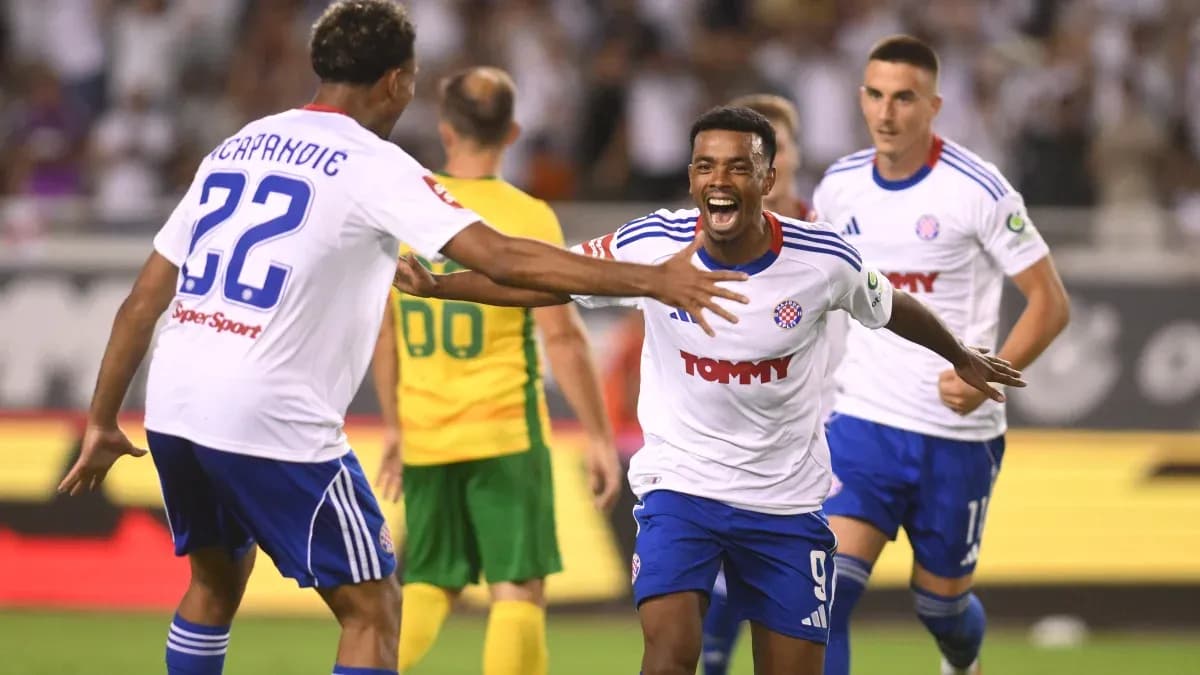
The breakthrough came from that same left-sided centre-back. On 45', A. Van Hoorenbeeck scored with S. Hrgovic providing the assist, a pattern consistent with Hajduk’s right‑side overloads drawing Žilina across before switching to exploit the far channel. VAR confirmed the goal at 45+3', reinforcing that Hajduk’s set-piece or second-phase execution around that moment was clean and structurally sound. At half-time, with the score 0-1, Hajduk’s 4-2-3-1 had successfully disrupted Žilina’s central build-up and turned their own full-backs into attacking assets.
Second Half
Stano’s response was immediate and telling. At 46', T. Paliscak (OUT) made way for M. Okal (IN), a like-for-like defensive change on paper but one that subtly rebalanced the back line. Okal’s introduction allowed Hranica to push even higher and more consistently, turning Žilina’s shape into something closer to a 2-4-4 in sustained possession, with wide defenders almost on the same line as the midfield.
The equaliser at 52' captured the effect of this adjustment. M. Roginic scored for Žilina, assisted by F. Kosa, after a spell in which the home side could commit more numbers between Hajduk’s lines. The VAR check at 54' confirming Roginic’s goal suggests a finely timed run or tight offside line, indicative of Žilina’s forwards beginning to exploit the spaces behind Hajduk’s defensive block as it was forced to turn and defend deeper.
From there, the match turned into a battle of benches and energy management. Garcia’s first change on 64' saw N. Skoko (OUT) replaced by D. de Almeida (IN), likely an attempt to refresh the No. 10 zone and regain control of second balls that Žilina’s now more aggressive midfield were starting to win. Stano countered two minutes later: on 66', M. Kacer (OUT) was replaced by F. Bzdyl (IN), and F. Kosa (OUT) by M. Fasko (IN). These twin substitutions sharpened Žilina’s attacking edge—Bzdyl adding dynamism in midfield and Fasko bringing fresh legs and vertical threat up front.
The 67' yellow card to Xavier Adang for “Persistent fouling” is tactically significant. It underlines how Žilina’s central pressure had intensified; Adang was repeatedly stepping into duels to break Hajduk’s attempts to transition. Even booked, he had already helped tilt the midfield balance towards the hosts.
Stano’s next move at 72' further reoriented the front line: P. Ilko (OUT) was replaced by S. Datko (IN), refreshing the left side and maintaining the pressing intensity on Hajduk’s build-up. Garcia responded on 75' with a double change: S. Hrgovic (OUT) for A. Sanyang (IN) and R. Brajkovic (OUT) for A. Guram (IN). Removing Hrgovic, who had been both an attacking outlet and a yellow-carded defender, slightly reduced Hajduk’s right‑flank ambition and hinted at a more conservative, result-protecting approach.
On 82', Stano made his most decisive structural tweak: X. Adang (OUT) for A. Florea (IN). Florea’s later yellow card at 90+2' for “Foul” shows he was used in an assertive, front-foot role in midfield, keeping Hajduk under pressure rather than sitting off. This substitution, combined with earlier attacking changes, left Žilina with a high-tempo, risk‑embracing shape aimed at pinning Hajduk back and forcing errors.
Garcia’s 84' substitution—M. Sego (OUT) for M. Livaja (IN)—was a late attempt to regain a counter-attacking outlet and hold-up presence, but by then Hajduk’s structure had sunk deeper, with the double pivot and back four increasingly focused on blocking central lanes and defending the box.
Without concrete possession or shot data, the tactical momentum is best read through discipline and events. Both sides finished with two yellow cards: Hajduk’s pair (Hrgović and Van Hoorenbeeck, both “Foul”) came in the first half as they defended high; Žilina’s (Adang for “Persistent fouling” and Florea for “Foul”) came as they pushed aggressively after the break. That temporal split mirrors the territorial shift: Hajduk on the front foot early, Žilina dictating later.
The decisive moment at 90'—D. Melnjak’s own goal credited to Žilina—fits that pattern. A left-sided defender under late pressure, after his side had already made defensive-minded changes and lost some of their earlier composure, is far more likely to misclear or misjudge a cross. Tactically, it encapsulated the second-half story: Žilina’s cumulative attacking pressure, aided by bold substitutions and a higher, more assertive block, eventually forced the error that turned a balanced tie into a 2-1 home win.
With no data on shots, xG, passes or goalkeeper saves, the statistical verdict rests on the timing and nature of events. Hajduk’s advantage was built on a well-structured 4-2-3-1 and proactive full-back usage before the interval; Žilina’s comeback was engineered through systemic risk, aggressive in‑game management, and an increasingly suffocating press. Over 90 minutes at Štadión pod Dubňom, the tactical arc clearly bent towards the side willing to increase tempo and accept defensive exposure in pursuit of control.