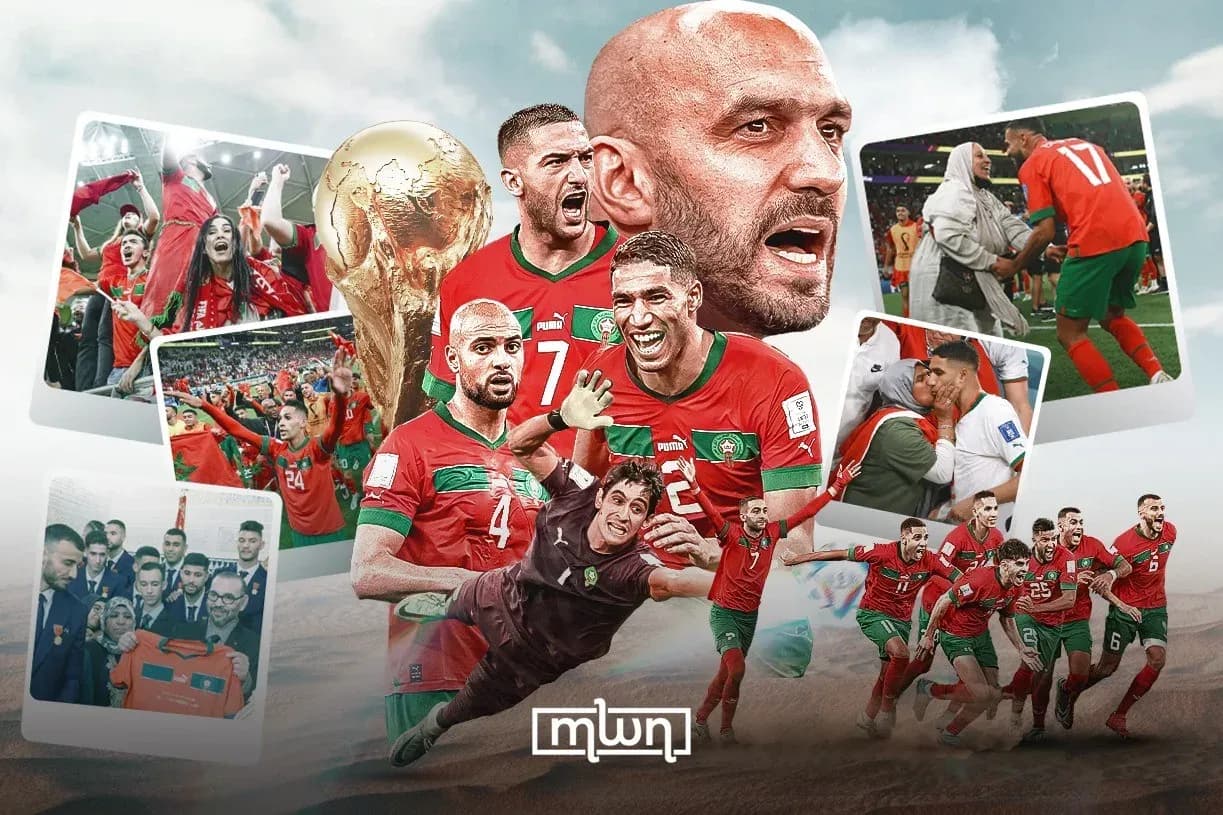
A Nation’s Story: Morocco’s Journey in the 2022 World Cup
The anthem hits first.
No commentary, no slow build. Just the sound of a nation singing in Doha on the night Morocco faced France in the 2022 World Cup semi-final. FIFA+’s 25-minute documentary, A Nation’s Story, starts there and never really lets go of that feeling. From the silence to the song, it sets the tone: this is not a tactics lecture, it’s a look inside a team that refused to accept its assigned place in world football.
Then the voices arrive.
Romain Saïss. Walid Regragui. Yassine Bounou. Snatches of teammates and staff. They circle one central theme from every angle: belief, and the stubborn work required to keep it alive when logic and history say it should fade.
“We already had it in our minds,” Saïss says early on. “We weren’t there just to play three matches. We were there to truly make history.”
That line becomes the film’s compass.
Building conviction in the group
The documentary moves through Qatar chronologically, but it doesn’t get bogged down in formations or passing maps. It is obsessed with mentality.
The opening 0-0 draw with Croatia, for example, is not treated as a cagey, forgettable start. It’s framed as the first brick in something much larger.
“It allowed us to enter the competition well,” Regragui says. “It gave us a lot of confidence, because entering the tournament with a defeat is never good.”
The camera and the testimonies keep returning to one turning point: the psychological shift after Regragui’s arrival. Morocco, so often cast as plucky outsiders, began to see themselves differently.
“The coach managed to remove the inferiority complex we felt,” Bounou explains.
Regragui’s message was stripped of romance and excuses. This squad did not have to pretend to belong. It did.
“There were players playing at big clubs,” he says. “There was no excuse not to be at the same level as the opponent.”
That conviction becomes the film’s spine. Regragui doesn’t talk about star players. He talks about a unit.
“We are first a family, first a team, and we will win together.”
The images back him up: players in tight circles, arms over shoulders, substitutes celebrating defensive blocks like goals. The football is there, but the emphasis is on sacrifice.
Spain: embracing the suffering
The round-of-16 tie against Spain is where the documentary truly catches fire.
On the pitch, Morocco spent long stretches running without the ball, chasing shadows crafted by one of the most technically polished sides in the world. In most narratives, that would read as survival. Here, it’s something closer to a plan.
“They made us run a lot,” Regragui says. “It’s an extraordinary team in terms of play.”
The film refuses to frame Morocco’s resistance as blind desperation. It leans into the idea of controlled suffering.
“The most important thing is that they accepted they were going to suffer,” Regragui says. “They stayed concentrated. They didn’t give up.”
By the time penalties arrive, the sense of belief inside the group feels almost unshakeable. The camera narrows in on Bounou, alone for a moment before the shootout, then cuts to a voiceover:
“We are lucky to have one of the best goalkeepers in the world. I think he will go down in the history of Moroccan football.”
The football briefly widens out beyond the pitch. The film lingers on the stands, on the red shirts and flags that turned Qatar into a temporary extension of Casablanca and Rabat.
“At every minute, it felt like we were playing in Morocco,” the narration says.
“We are passionate people,” Regragui adds. “Many people made sacrifices to support us.”
The bond between team and crowd becomes part of the tactical picture. The noise is not background; it’s a force.
Portugal: breaking the glass ceiling
By the time the quarter-final against Portugal arrives, the stakes have changed. This is no longer a charming run. It is a challenge to the established order.
“The ultimate goal for us was to become the first African nation to qualify for a semi-final.”
The documentary nods to the history between the two nations. Mexico 1986: Morocco 3-1 Portugal, a win that made Morocco the first African and Arab nation to reach the Round of 16. Russia 2018: Portugal 1-0 Morocco, a narrow defeat that sent the Atlas Lions home early despite a strong performance. Old scars, new ambitions.
The defining image, though, belongs to Youssef En-Nesyri. In the 42nd minute, he rises above the Portuguese defence with a 2.78-meter leap and heads Morocco into the lead. The replay slows his jump almost to a freeze-frame, his body suspended, the goalkeeper stranded.
From that moment, the match becomes a test of resilience. Key defenders fall. Saïss, already carrying an injury, is forced off. The back line bends but never breaks. Even reduced to 10 men in stoppage time, Morocco’s low block holds.
On the other side, Cristiano Ronaldo starts on the bench, enters on 51 minutes, and leaves the tournament in tears, disappearing down the tunnel after the final whistle. The documentary doesn’t dwell on him, but the contrast is clear: the global superstar in anguish, the collective in ecstasy.
By beating Portugal 1-0 and reaching the semi-finals, Morocco tear down a long-standing stereotype—that African teams are there to entertain, to light up group stages, to bow out gracefully in the knockouts. This is something else entirely.
The film treats the final whistle not just as a victory, but as a psychological barrier shattering in real time, for Morocco and for a continent.
France: the dream meets its limits
The semi-final against France is shot in a different light. The tone shifts. The joy is still there, but it’s layered with fatigue and the weight of what has already been spent.
This is the defending champion, the 2018 winner, the benchmark. It is also a match in which injuries begin to dictate as much as tactics.
“He is our captain. He is our leader,” Regragui says of Saïss. “If he could be ready, even at 80%, I would take the risk.”
Morocco concede early, but the belief does not crack.
“When you are in a World Cup semi-final and losing 1-0, you know you have to give everything,” Regragui says.
The cost of that effort is brutal. On what Regragui calls “a simple pass,” Saïss’ thigh gives way again. “That’s it. It stops.” Nayef Aguerd, another key defender, is also lost to injury.
Yet Morocco do not retreat. They dominate possession for long spells, push France back, and come agonisingly close to a spectacular equaliser when Jawad El Yamiq’s overhead kick crashes off the post. For a heartbeat, the stadium holds its breath.
France, though, have just enough. Kylian Mbappé slaloms through a crowded penalty area in the 79th minute, the ball eventually falling to Randal Kolo Muani to finish. 2-0. The final slips away.
Even here, the documentary refuses to paint Morocco as tragic victims of bad luck and tired legs.
“At the end of the match, we were disappointed because we truly believed,” Bounou says. “We wanted to play in that final.”
Then the film pivots. It calls this the “end of the miracle” but also the “start of a new reality” for African football. The semi-finals are no longer a fantasy. They are a reachable target. The defeat feels like a line in the sand: what was once unthinkable now sits inside the realm of expectation.
A loss that, in the broader story, looks a lot like a win.
Croatia and the final embrace
The third-place match against Croatia is not framed as a drama of revenge or redemption. It is portrayed as a game played on empty tanks.
Bounou describes the emotional and physical toll with blunt honesty. “You’re at the end,” he says.
Morocco still push. They chase an equaliser deep into stoppage time. En-Nesyri rises again in the 95th minute, almost repeating his Portugal heroics, but this time the header doesn’t bring salvation. Croatia win 2-1. Morocco finish fourth.
There are no slow-motion shots of heads bowed for too long. The closing images tell a different story: players laughing together, swapping shirts, saluting the stands, folding themselves into the embrace of their supporters.
Two defeats close out the campaign, yet the film has already moved past the old, rigid measure of success. The run in Qatar is not reduced to a medal count. It lives instead in altered expectations, in the faces in the stands, in the way a squad talks about itself.
A Nation’s Story ends not with mourning, but with a quiet, unmistakable question hanging over the images of red flags and smiling players.
If this is the new starting point for Morocco—and for Africa—what comes next?