AC Milan vs Juventus: Tactical Standoff Ends in Goalless Draw
Under the lights of the Stadio Giuseppe Meazza, AC Milan and Juventus played out a 0–0 that felt less like a stalemate and more like a chess problem left unsolved. Following this result in Serie A’s Regular Season - 34, Milan remain in 3rd on 67 points with a goal difference of 21 (48 scored, 27 conceded), Juventus in 4th on 64 with a goal difference of 28 (57 scored, 29 conceded). Two of Italy’s most potent attacks, averaging 1.4 total goals per game for Milan and 1.7 total for Juventus, were held scoreless – and the lineups tell us why.
I. Structural Standoff at San Siro
On paper, this was a duel of mirrored philosophies. Milan, under Massimiliano Allegri, leaned into their season-long identity with a 3-5-2, a shape they have used in 30 league matches. Juventus, guided by Luciano Spalletti, replied with their favoured 3-4-2-1, the base for 22 of their league outings.
For Milan, the back three of M. Maignan behind F. Tomori, M. Gabbia and S. Pavlovic formed a compact triangle, shielding a side that, heading into this game, conceded just 0.8 total goals per match and kept 15 clean sheets overall. Juventus matched them with M. Di Gregorio protected by P. Kalulu, Bremer and L. Kelly – a unit that had allowed only 0.9 total goals per game and also produced 15 clean sheets.
The stage was set for a tactical arm-wrestle: Milan’s structured 3-5-2, built on control and vertical surges, against Juventus’ 3-4-2-1, designed for quick, layered attacks through the half-spaces.
II. Tactical Voids and Discipline
Juventus arrived with notable absences. J. Cabal and A. Milik were both ruled out with muscle injuries, thinning Spalletti’s defensive depth and removing a penalty-box reference point from the bench. It placed more responsibility on J. David as the nominal striker and on the fluid front line behind him.
Discipline loomed large in the pre-match narrative. Milan, heading into this game, showed a tendency toward late yellow cards: 23.08% of their bookings arrived between 76-90', and another 17.31% in 91-105'. Juventus mirrored that late-game edge, with 23.40% of their yellows coming between 61-75' and 19.15% between 76-90'.
Individually, the warning signs were clear. For Juventus, M. Locatelli’s 8 yellow cards underlined his role as both metronome and enforcer, while A. Cambiaso carried the shadow of a previous red card. On the Milan side, P. Estupiñán – on the bench – was their own red-card reference point. Yet in this fixture, the discipline held just enough to avoid a decisive dismissal, reinforcing the idea of two teams acutely aware that any reckless moment could tilt a Champions League race.
III. Key Matchups
Hunter vs Shield
In a goalless draw, the “hunters” never quite found their moment, but the matchup narratives remained vivid.
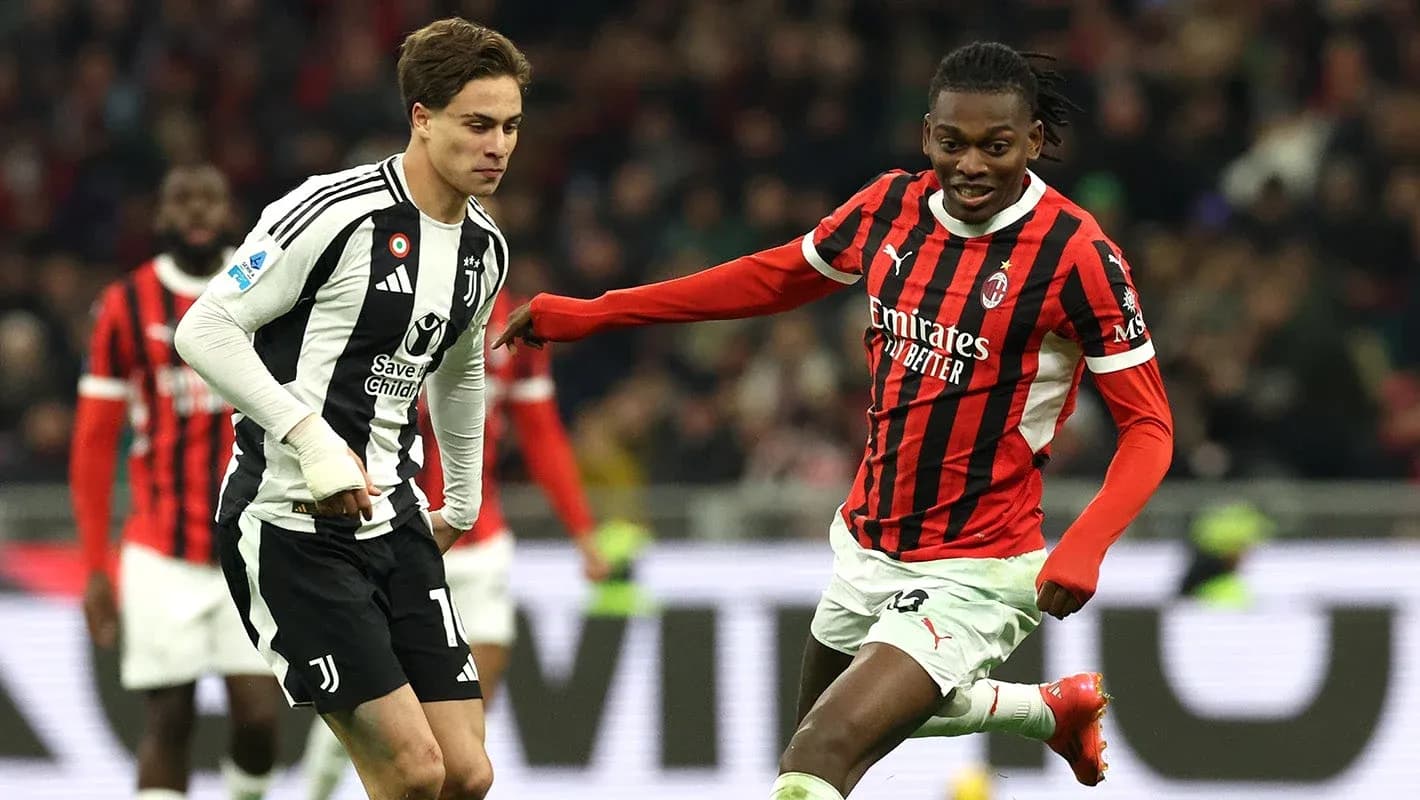
For Milan, Rafael Leão and C. Pulisic carried the attacking burden. Leão, with 9 league goals and 3 assists, and Pulisic, with 8 goals and 3 assists, represent a dual-pronged threat from the front two. They were supported by a midfield spine of L. Modric and A. Rabiot, with Y. Fofana and A. Saelemaekers providing legs and width.
They were up against a Juventus defence that, on their travels, conceded only 0.9 away goals per game and just 16 away in total. Bremer’s central presence, flanked by Kalulu and Kelly, compressed the spaces that Leão typically exploits. Juventus’ defensive minute distribution – with goals against spread but peaking at 31-45' and 76-90' (both 20.69%) – met a Milan attack that usually surges between 31-45' and 46-60', where 24.49% of their goals arrive in each window. Here, the shield held: Juventus weathered Milan’s traditional mid-game waves without cracking.
On the other side, Juventus’ attacking trident of F. Conceição, J. Boga and J. David was designed to probe Milan’s lines. Juventus entered as one of the league’s most explosive sides, scoring 2.0 home goals on average and 1.4 away, with a pronounced late-game surge: 21.05% of their goals between 61-75' and 22.81% between 76-90'. That late push collided with a Milan defence that tends to wobble between 61-75' (23.08% of goals conceded) and 76-90' (19.23%). Statistically, this was the critical intersection where Juventus should have found joy. Instead, Tomori and Pavlovic’s aggression, backed by Maignan’s command, turned those minutes into a trench war.
Engine Room: Modric & Rabiot vs Locatelli & Thuram
The midfield battle was the game’s true narrative. Milan’s five-man band – Saelemaekers, Fofana, Modric, Rabiot, Bartesaghi – sought to overload the centre, rotate positions and free Pulisic between the lines. Modric’s role as tempo-setter, combined with Rabiot’s two-way running, aimed to stretch Juventus horizontally.
Juventus responded with a compact quartet: W. McKennie, M. Locatelli, K. Thuram and A. Cambiaso. Locatelli, with 2439 passes and 42 key passes this season, anchored possession and broke up play with 91 tackles and 23 blocked shots – each block a successful intervention. McKennie, with 5 goals and 5 assists, offered vertical thrust, while Thuram and Cambiaso provided balance and width.
The result was a midfield deadlock. Milan’s total attacking rhythm – 1.4 total goals per game, with 48 scored overall – never translated into clear numerical superiority between the lines. Juventus’ press and Locatelli’s positioning cut off the lanes into Pulisic and Leão, forcing Milan wide and into lower-percentage deliveries.
IV. Statistical Prognosis and xG Lens
Even without explicit xG numbers, the season data frames this 0–0 as an outlier on the scoreboard but not in structure. Two sides averaging a combined 3.1 total goals per game (1.4 for Milan, 1.7 for Juventus) met two defences conceding a combined 1.7 total (0.8 for Milan, 0.9 for Juventus). The clean sheet apiece feels like the defensive side of the equation won.
Heading into this game, Milan had scored in 28 of 34 matches (only 6 total failed-to-score games), Juventus in 27 of 34 (7 total failures). Both had 15 clean sheets overall. The most plausible xG reading is of a match where each side created moderate chances but were forced into sub-optimal shooting zones, with defences dominating the key minutes: Milan blunting Juventus’ late-game surge, Juventus neutralising Milan’s mid-game spikes.
Following this result, the tactical story is clear. Milan’s 3-5-2 remains a defensively robust platform but will need sharper mechanisms to convert territorial control into chances against elite blocks. Juventus’ 3-4-2-1 again proves structurally sound, but without J. Cabal and A. Milik, their attacking rotation leans heavily on fluidity rather than penalty-box presence.
In a title race framed by fine margins, this was not just a 0–0. It was a portrait of two Champions League-bound sides whose defensive solidity has become as defining as their attacking stars – and a reminder that sometimes, the most revealing battles are the ones that end without a shot rippling the net.