Seventy-seven days after the final whistle, Africa is still waiting for a champion. What should have been a showpiece turned into a legal and political minefield, with Senegal and Morocco locked in a bitter dispute and CAF caught in the crossfire.
The story, as detailed by Spanish newspaper AS, does not begin with a disallowed goal or a disputed penalty. It starts days earlier, the moment Senegal landed in Morocco and felt the ground tilting beneath them.
A Final Week Steeped in Suspicion
The “Lions of Teranga” arrived expecting the standard treatment for a continental finalist: top-class facilities, neutral conditions, a level playing field. Instead, they were moved from a luxury hotel in Tangier to the Al-Rihab complex, a venue that was not even on CAF’s official list of approved accommodation.
Senegal protested. Officially. Loudly. CAF responded with a compromise: the Amfitrit Hotel on the outskirts of Rabat. It was better, but not what Senegal believed a finalist deserved. The sense of grievance hardened. A final was already being played in their heads, and it had nothing to do with tactics.
Then came the training ground row. Senegal were assigned the Mohammed VI Sports Complex, the same facility used by the Moroccan national team as their base. On paper, it was a world-class venue. In reality, Senegal saw something else: an opponent with home advantage and access to the same environment where they were now expected to prepare in secrecy.
Equal opportunity? They didn’t think so. Concerns about prying eyes, monitored sessions, leaked tactical plans – all of it fed into a growing belief that the deck was being stacked against them.
The off-field tension did not stop there. On arrival in Rabat, Senegal complained of chaotic organisation, fraught security, and what they called an “unfair distribution” of match tickets. Hours before kick-off, they went public, warning of “irregularities” around the final. The match had not started, but the trust had already broken.
Chaos Under the Floodlights
When the teams finally walked out at Moulay Abdallah Stadium, the football was supposed to take over. It never truly did.
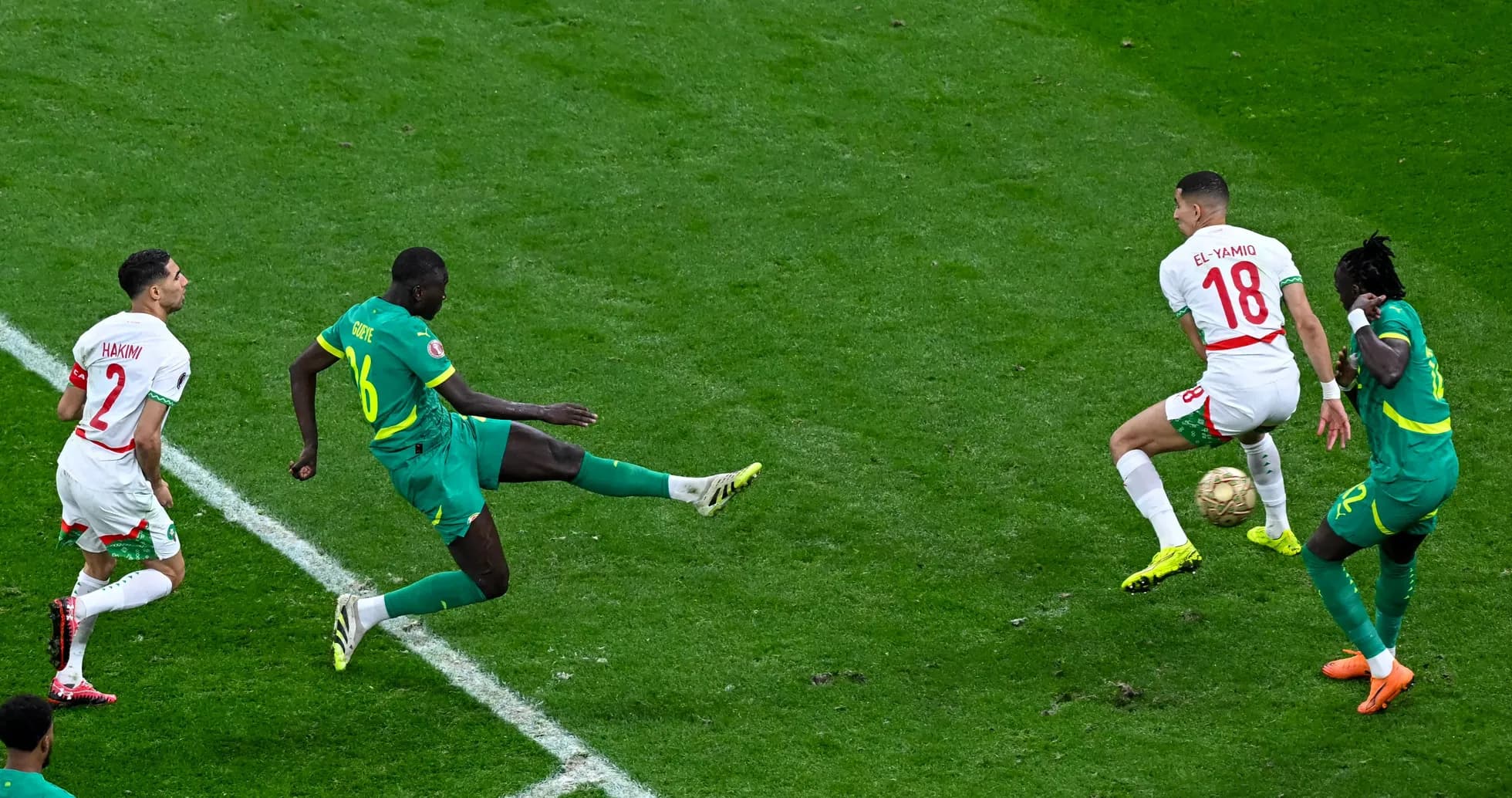
The night unraveled in bursts of controversy. A Senegalese goal was ruled out, sparking anger on the pitch and fury on the bench. Then Morocco were awarded a penalty, a decision that detonated the simmering frustration.
Senegal snapped.
The protests escalated into something rarely seen at this level: a full squad walk-off. Players and staff left the pitch en masse, accusing the referee of “blatant refereeing injustice”. For a moment, the final seemed dead.
When play resumed, it did so under a cloud. Ibrahim Diaz stepped up and attempted a Panenka-style penalty, a moment of audacity in a match already dripping with drama. He missed. Senegal survived, regrouped, and in extra time, they made their stand on the pitch count, scoring and holding firm to claim the win with a clean sheet.
On the grass, they were convinced they had done it. Champions of Africa. Job finished.
Morocco saw something else entirely.
A Walkout, a 3–0, and a Courtroom
From the Moroccan perspective, the walkout was not a protest but a formal withdrawal. In their view, the laws of the game were clear: abandon the match, lose by default. They pushed for a 3–0 win to be recorded in their favour.
CAF agreed. Initially, at least.
The confederation’s first decision sided with Morocco’s interpretation, treating Senegal’s walk-off as grounds for a 3–0 defeat. The trophy, on paper, belonged in Rabat.
Senegal refused to accept that. They took the fight to the Court of Arbitration for Sport (CAS), arguing that the match had been completed on the field, that they had won it there, and that the walkout formed part of an ongoing protest in a game that ultimately resumed and finished.
CAS later overturned CAF’s original ruling, a major twist in a case already laden with distrust. The decision did not settle the matter in the court of public opinion. It only deepened the sense that something had gone badly wrong in the way African football’s biggest night was handled.
The Dar es Salaam Revelation
Then came the revelation that shook CAF’s own corridors of power.
According to AS, during a CAF Executive Committee meeting in Dar es Salaam on 13 February, Olivier Safary, head of the Referees’ Committee, admitted that the match referee had received “institutional instructions” not to send off any Senegalese players during the suspension of the game, so that the match could continue.
Those words cut to the heart of the sport’s credibility.
If true, it meant that refereeing decisions had been influenced not solely by what happened on the pitch, but by directives from above. The aim, on the surface, was to avoid the spectacle collapsing completely. The cost was trust.
The admission, reported by the newspaper, ignited internal controversy within CAF and opened the door to accusations of direct interference in refereeing decisions. For a confederation already under scrutiny from both finalists, it was a brutal blow.
A “Disastrous” Appeal and a Conflict of Interest Storm
The battle then shifted to the legal arena, and even there, the storm refused to ease.
At a press conference in Paris on 26 March, lawyers for the Senegalese Football Federation did not mince their words. They described the appeal hearing before CAS as “disastrous”, claiming the judge seemed to have reached a conclusion before arguments were even fully heard.
Senegal also attacked the composition of CAF’s Appeals Committee. Their focus fell on Moez Nasri, a lawyer who also serves as president of the Tunisian Football Federation. For Senegal, his dual role was indefensible.
They called it a “clear conflict between his role as a judge and that of a party to the competition”. Even CAF President Patrice Motsepe, according to their account, expressed surprise at Nasri’s presence on the committee.
In a case already riddled with allegations of bias, that detail only poured fuel on the fire.
A Continent Waiting
So here Africa stands: 77 days on, with no official champion.
Senegal insist they won where it should matter most – on the pitch, in extra time, with the scoreboard in their favour. Morocco hold to the letter of the law as they see it, arguing that the rules grant them the title after Senegal’s walkout.
CAF, meant to be the arbiter and guardian of the competition, finds itself accused by both sides of “mismanagement” and a “lack of transparency”.
The trophy sits in limbo. The questions do not. How long can a continent live with a final that produced a winner, a loser, and still no champion?