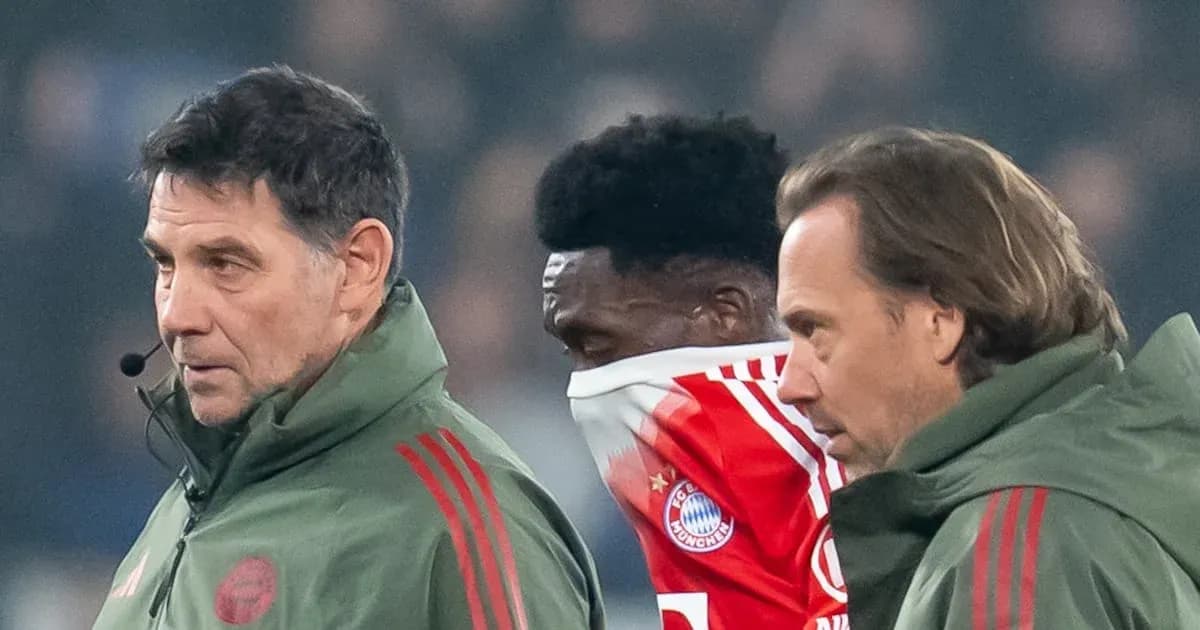
Alphonso Davies Injury Hits Canada Before World Cup
Alphonso Davies’ latest injury setback has hit Canada like a punch to the ribs, arriving just five weeks before the country opens its World Cup campaign against Bosnia and Herzegovina in Toronto.
Bayern Munich confirmed the left back will miss four to five weeks with a left hamstring injury, suffered late in Wednesday’s Champions League semifinal second leg against Paris Saint-Germain. Davies pulled up after one of his trademark surges down the left in the 86th minute of Bayern’s 1-1 draw, a result that sealed a 6-5 aggregate defeat.
For Bayern, it’s a blow. For Canada, it’s a crisis of timing.
Canada and Bayern close ranks
Canada Soccer moved quickly, making it clear they will work hand in hand with the German champions to try to salvage Davies’ World Cup.
“We’re in close contact with Alphonso and remain in touch with Bayern’s medical team following his recent setback,” read a statement provided to TSN. The federation stressed its focus on supporting his recovery with “every available resource, including specialized soft tissue expertise,” to give him the best possible route back to full fitness before the tournament.
The calendar offers little comfort. Canada opens against Bosnia and Herzegovina on June 12 in Toronto, then faces Qatar in Vancouver on June 18 and Switzerland on June 24. A four-to-five-week layoff drops Davies’ availability for the group stage squarely into the realm of doubt.
If Canada reaches the Round of 32, potential knockout dates of June 28, 29, July 1, or July 2 in Vancouver dangle as possible targets. But that’s a long way down the road for a player whose last two years have been a grind of rehab, relapse, and return.
A body pushed to its limits
This is not an isolated problem. It’s the latest chapter in a worrying pattern.
Davies missed nine months after tearing the ACL in his right knee while playing for Canada at the Concacaf Nations League Finals in March 2025. He returned to Bayern in mid-December, only to suffer a muscle fibre tear in his right hamstring by the end of February.
He came back just over two weeks later. In his first game, another hamstring strain. That setback kept him out until early April. Since then he has made nine appearances in all competitions, four of them starts, but has not played more than 62 minutes in any match.
This is already his second long absence from the national team. In late 2021, myocarditis sidelined him for seven months and forced him to miss Canada’s final six qualifiers for the 2022 World Cup.
The numbers underline his importance, but they also complicate the narrative. With Davies on the pitch, Canada has played 41 matches: 20 wins, 12 losses, nine draws, 74 goals scored, 44 conceded. Without him, in 36 games, Canada has 20 wins, six defeats, 10 draws, with 68 goals scored and only 26 allowed.
The team can survive without him. It is not the same team.
At full fitness, few players in world football can match Davies’ ability to explode into space with the ball at his feet. That unique threat now vanishes from Canada’s left flank just as Jesse Marsch tries to lock in his final World Cup roster by the June 1 deadline.
Questions everywhere on the left
Davies’ absence doesn’t just remove a star. It forces Marsch to rethink the entire left side of his team and his leadership structure.
Will Davies miss the entire group stage? If he returns, will he be reduced to a late-game weapon rather than a 90-minute starter? Who steps into the starting XI? How does that change Canada’s patterns on the left? Who wears the armband on June 12?
Davies has not played for Canada in 14 months, so Marsch has already been living in a world of contingencies.
Richie Laryea, Ali Ahmed, Liam Millar, Junior Hoilett and, most recently, Marcelo Flores have all been asked to keep the left flank stable and industrious in his absence. Each brings something different, none brings Davies’ chaos.
Even that list now comes with caveats.
Ahmed limped out of Norwich City’s final Championship match last weekend with an undisclosed injury. Laryea has missed Toronto FC’s last three games with a thigh issue, though TFC insist he will be ready for the World Cup.
If both Ahmed and Davies are limited or unavailable, Flores suddenly becomes more than a promising option. His direct running and creativity stood out in Canada’s March friendlies against Iceland and Tunisia, and he could now be pushed into a starting role on the left side of midfield.
Behind him, Laryea and Zorhan Bassong are in the mix, and even right-sided winger Tajon Buchanan is on the board. Buchanan did occasionally fill in at left back during his time at Club Brugge, a detail that might now matter more than anyone expected.
There is also a possible route back for veteran Junior Hoilett, used sparingly so far by Marsch but trusted in big moments over the years.
Sam Adekugbe sits as a long shot. The fullback is still working his way back from a torn Achilles suffered almost a year ago. His timeline remains unclear, as does the status of several other key players in Canada’s defensive core.
A squad held together by tape and resolve
Davies is not the only fitness concern on Marsch’s whiteboard.
Canada Soccer recently sent medical staff to Nice to assist with Moïse Bombito’s recovery from a broken leg suffered last fall. The centre back is back in training and could feature only when Canada plays pre-tournament friendlies in June against Uzbekistan in Edmonton and Ireland in Montreal.
His partner, Derek Cornelius, has also spent a long spell out with a muscle injury and is only now back training. Yet a reported dispute with his head coach has left him without a single appearance for Rangers FC since last November.
Up front, Promise David’s situation offers cautious optimism. Multiple sources told TSN that his recovery from hip surgery three months ago is ahead of schedule, with an MRI later this month set to determine his World Cup availability. Even if cleared, the expectation is that he would be limited to late-game attacking cameos.
Layered on top of that are those who have just returned and are still finding rhythm: Buchanan, who recently missed time with an undisclosed injury; Stephen Eustáquio, back after a hematoma; defender Luc de Fougerolles, recovering from groin and ankle issues; and Jacob Shaffelburg, fresh off his own groin problem.
For Marsch and his staff, the last few months have been less about fine-tuning and more about triage.
Leadership without the star
And yet, inside this group, there is a belief that predates Marsch and even Davies’ rise to superstardom. The camaraderie and resilience forged during the run to the 2022 World Cup still shape this dressing room.
Without their captain, Canada will lean heavily on its leadership council. Eustáquio, the vice-captain, anchors the midfield and the mood. Jonathan David, who wore the armband during last summer’s Gold Cup when both Davies and Eustáquio were missing, has already shown he can carry that responsibility.
Canada has learned to win without Alphonso Davies. It may have to do so again, on the biggest stage, while waiting to see if its most electric player can sprint back from the treatment room in time to change the story of this World Cup.