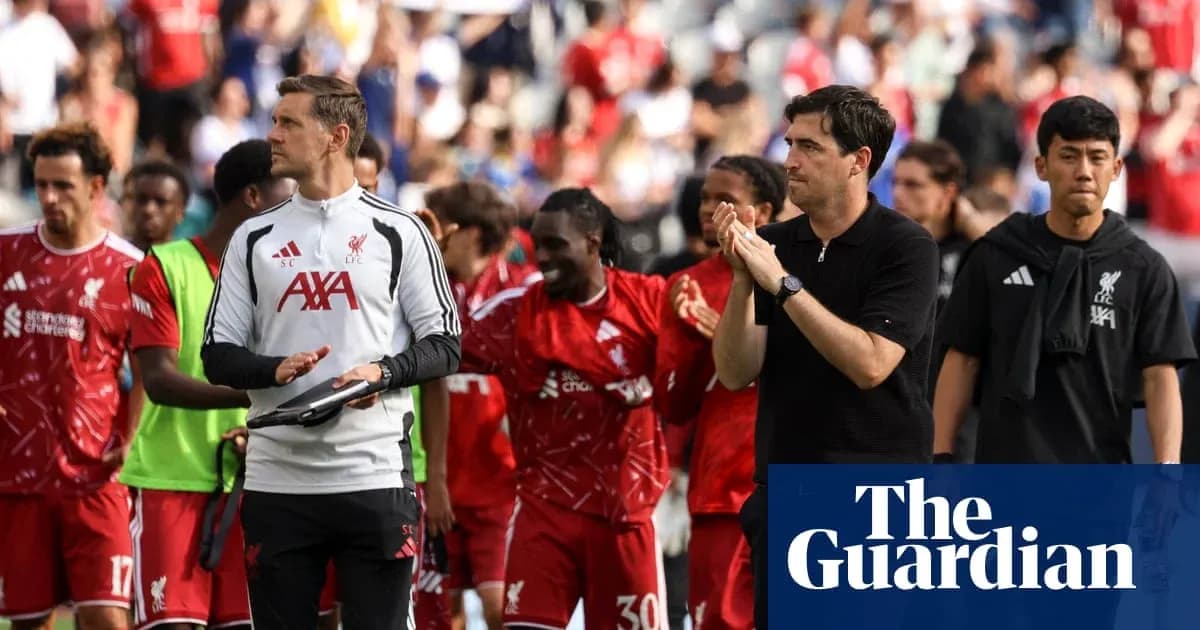
Andoni Iraola’s Liverpool Tour: Progress and Challenges
The new Liverpool era began in the heat and noise of an American summer: a win over Sunderland in Nashville, another against Wrexham in New York, and a wild 4-2 defeat to Leeds in Chicago. Three games, three cities, one clear conclusion.
This is going to take time.
A style with teeth – but still learning to bite
For 45 minutes against Leeds, Iraola’s Liverpool looked like a side that had been playing his football for months, not days. The press bit, the lines squeezed high, and the tempo went up a gear with the returning big names back on the pitch. It was front-foot, aggressive, and recognisably Iraola.
Then the changes came. So did the problems Liverpool thought they had left behind.
Set pieces – a recurring headache last season – hurt them again. Concentration slipped. A team that had looked so sharp suddenly looked vulnerable, and Leeds did not need a second invitation. For Iraola, that second half in Chicago was uncomfortable viewing, but also instructive. The flaws were familiar; the context was not.
He has barely had a squad to work with.
Virgil van Dijk, Cody Gakpo, Alisson, Alexis Mac Allister and new signing Víctor Muñoz have not yet taken a single training session under him. He has been Liverpool head coach for almost two months without even meeting some of his core leaders. That changes on Wednesday at the AXA Training Centre, when the full group finally comes together after the long flight back from Chicago. Mac Allister will still be absent after his World Cup exertions, but at least the spine of the side will be in front of him at last.
There are fewer than three weeks before Liverpool walk out at Newcastle to open their Premier League season. Only two more friendlies remain, both against Como at Anfield on the same day. Iraola knows what that means.
“I would like to say on the first day we are going to be perfect, everyone will be in place,” he admitted. “But probably it is not going to be like this.”
He is right. It won’t be.
A coach ahead of his squad – and ahead of his recruitment
Across the tour, Iraola operated with a patched-together group. Eight first‑team players were on post‑World Cup breaks. Six more were injured, including Joe Gomez, whose luck turned again in the US. Fourteen absentees at this stage of a stylistic overhaul is not a detail, it is the story.
Even when everyone is back, the gaps are obvious.
Mohamed Salah’s departure was announced in March. Talks to end his contract a year early started even earlier. Five months on, Liverpool are still without his replacement. The right flank, once the most predictable source of goals and chaos in English football, is now a question mark on the whiteboard.
Conor Bradley’s serious knee injury has left the squad light at right-back. In central defence, the picture is no clearer. There is genuine excitement about Jérémy Jacquet and Giovanni Leoni – the latter returning from an ACL injury looking like he has spent his recovery turning himself into a heavyweight – and 18-year-olds Ifeanyi Ndukwe and Mor Talla Ndiaye impressed across the Atlantic.
Promise, though, is not Premier League experience.
Ndukwe cannot play this season because of post‑Brexit work permit rules. Gomez, given his injury record, has to be treated as a bonus option rather than a pillar. It leaves Liverpool short of hardened, top‑flight central defenders. Short on certainty. Short on margin for error.
Iraola’s explanation of how he likes his wingers to operate – both flanks, constant switching, defenders dragged into places they do not want to go – was one of the more revealing tactical notes of the tour. It also underlined the problem. Even if Liverpool get Bradley Barcola from Paris Saint‑Germain, the right side of this team will go into the season under scrutiny.
The coach looks ready. The squad, less so. The recruitment, not yet.
Nyoni steps out of the shadows
If the tour exposed Liverpool’s thinness in some areas, it also shone a light on a midfielder who looks determined to change his status.
Nyoni arrived in the US as a promising squad player. He left as a footballer firmly in Iraola’s plans.
Forced to lean heavily on youth, the new head coach watched several youngsters rise to the level of the occasion. Ndukwe and Talla Ndiaye caught the eye. Lewis Koumas, Kieran Morrison and Luke Chambers all showed they belong in this environment.
Nyoni went further.
The 19-year-old, like Rio Ngumoha, was a regular presence in Arne Slot’s squad last season. Ngumoha made 19 Premier League appearances, including five starts. Nyoni had to settle for six league cameos from the bench. In the US, he looked like a player intent on changing that balance.
He took Iraola’s instructions and ran with them. Find the forward pass early. Play through pressure. Move intelligently to open the lane if it is not there. He did all of it with a calmness that belied his age. His pass in the buildup to Florian Wirtz’s goal against Leeds was the sort of ball that turns a coach’s head – threaded, decisive, perfectly weighted – and entirely in keeping with his overall contribution.
After the Leeds game, Nyoni said he knew he had to improve this summer. Across three cities and three very different matches, he backed his words with performances.
Jones at a crossroads
While one young midfielder surged, another stalled.
Curtis Jones goes into the final year of his Liverpool contract with Inter circling and his future up in the air. This tour was a chance to plant a flag in front of a new coach. He did not take it.
Unlike Nyoni or Dominik Szoboszlai, Jones struggled to fit into what Iraola wants from a central midfielder. The demands are clear: intensity without the ball, speed and verticality with it, constant awareness of the press. Jones never quite looked at ease, and his second‑half display against Leeds underlined the problem. He laboured, rather than led.
What really hurt him, though, came away from the tactical board.
Against Wrexham, when Szoboszlai passed on the captain’s armband, Jones reacted petulantly to being overlooked. He had already been bypassed in the opening game against Sunderland, when Gomez went off and the armband went instead to Kostas Tsimikas – a reserve left-back who spent last season on loan at Roma.
On both occasions, the message was stark. Seniority and local roots did not automatically translate to leadership in Iraola’s eyes.
For a boyhood Liverpool fan, that was always going to sting. Jones, Szoboszlai and Tsimikas all made light of the incident in the days after the Wrexham win, and the row grew bigger on social media than it did inside the camp. Still, it jarred.
In Chicago, Iraola spoke at length about the importance of the collective. The group above the individual. In that context, Jones’s reaction cut against what Slot’s successor is trying to build. With a year left on his deal and a new regime taking shape, his place in the project looks more fragile than ever.
Szoboszlai steps into the void
If there was one constant across the tour, it was Dominik Szoboszlai.
With Salah, Andy Robertson, Van Dijk and Alisson all absent, Liverpool needed a standard‑bearer. The Hungary captain embraced the role. Everywhere Liverpool went, he was the face on the screens and the name on the shirts. Every touch drew a roar. Every appearance, a swarm of cameras.
The noise did not distract him. It fuelled him.
Szoboszlai trained like the player who had just been rewarded with a new five‑year contract and wanted to justify every line of it. In a young, patched-up squad, his leadership was not cosmetic; it was essential. He set the tempo in sessions, demanded standards, and gave Iraola a voice on the pitch when experience was thin around him.
On and off the field, he behaved like a future pillar of the dressing room. With Salah and Robertson gone, Liverpool suddenly have two vice‑captain vacancies. It is hard to imagine a more obvious candidate than the 25-year-old who spent the summer showing he is ready to carry more of the load.
Three games in America do not define a season. But they can reveal its fault lines and its foundations.
Iraola’s idea is clear. His squad is not. The football has a sharp new edge, yet the structure around it still looks unfinished. Liverpool return from the US with a coach who knows exactly what he wants, a handful of youngsters who proved they belong, and a transfer to‑do list that can no longer be ignored.
The question now is simple: will the club move as quickly and as bravely as the football their new head coach is trying to play?