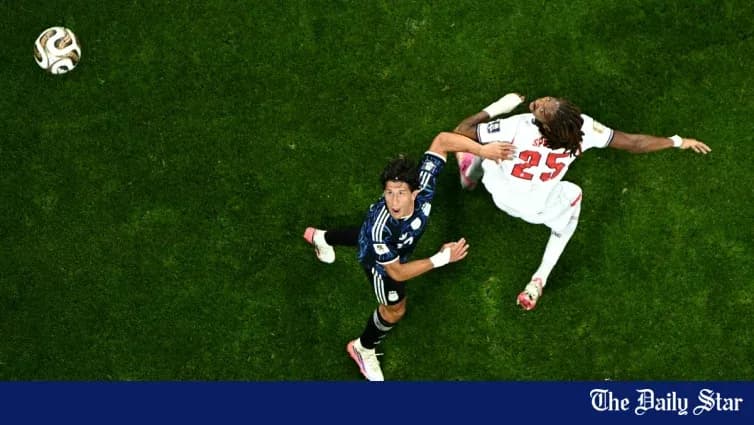
Argentina's Seismic Comeback Against England in World Cup Semifinal
They might need to check the foundations of the Mercedes-Benz Stadium.
When Lautaro Martinez’s 92nd-minute header ripped past Jordan Pickford, the roar from the Albiceleste end felt less like celebration and more like a seismic event. Blue and white shirts flew in every direction. England players sank to their knees. Argentina, dragged to the brink and staring at the exit, were in the World Cup final again.
A 2-1 comeback. A semifinal that turned into a street fight. And at the heart of it, as ever, Lionel Messi – 39 years old, still dictating the script.
Messi did not glide through this game. He clawed his way into it. For long stretches, Argentina looked like the version critics had picked apart all tournament: heavy, reactive, waiting for late magic to bail them out. Lionel Scaloni refused to let that story repeat. He tore up the cautious blueprint and unleashed something far more primal.
This was chaos by design.
Simeone name, old scars
For England, the psychological games began before kick-off. One surname on the Argentina team sheet sent a chill through their fanbase: Simeone.
Memories snapped back to Saint-Etienne, 1998. Diego Simeone on the turf, David Beckham sent off, a World Cup campaign derailed and a rivalry poisoned for generations. That history hung in the air in Atlanta.
This time, the Simeone in question was Giuliano, Diego’s 23-year-old son, handed a surprise start. It was a selection that felt like a provocation, a reminder that Argentina understand the emotional weight of this fixture as well as its tactical demands.
Giuliano played as if someone had pressed fast-forward on his internal settings. From the opening whistle, he hunted. Loose balls, second balls, third balls – they were all his to chase. On the right flank, in tandem with Nahuel Molina and with his Atletico Madrid teammate Julian Alvarez ahead of him, he stretched England’s left side to breaking point.
He didn’t just run. He harassed. He snarled into duels, snapped into tackles, and refused to let England settle. The midfield trio of Enzo Fernandez, Alexis Mac Allister, Leandro Paredes and the ever-combative Nicolas Tagliafico all joined the fight, but Giuliano operated at a different frequency, like a man playing for something deeper than a semifinal.
Three years ago, he was recovering from a horrific leg fracture. In Atlanta, he played as if every stride was a defiant answer to that trauma. His relentless pressing gave Messi the oxygen he needed, creating pockets of space where Argentina’s captain could finally turn and face England’s back line.
England strike, Scaloni gambles
For all of Argentina’s fury, it was England who landed the first clean punch. In the 55th minute, Anthony Gordon struck, and suddenly Thomas Tuchel’s side had the lead they wanted and the script they trusted.
England retreated. Lines dropped. The bus was parked with ruthless intent.
For Scaloni, that was the cue. Giuliano Simeone had emptied the tank by the 73rd minute. He left the pitch with four ball recoveries, the second-joint-highest total among Argentina players on the night – a statistic that barely captured the emotional weight of his shift.
On came Rodrigo de Paul.
The substitution carried its own poetry. De Paul, once Diego Simeone’s iron-willed lieutenant at Atletico Madrid, the man who built his reputation on warfare in midfield before joining Messi at Inter Miami, stepped in for the younger Simeone who had taken his starting place. One enforcer replacing another, but with a different brief: not just to destroy, but to create.
De Paul immediately picked up the same ferocious work rate. He matched Giuliano’s four ball recoveries in a frantic cameo and nearly carved England open with a curling effort. The change didn’t just keep Argentina’s intensity high; it sharpened it.
The pressure finally told.
Messi, Enzo, Lautaro – and mayhem
By the 85th minute, England’s resistance began to creak. Messi, who had been probing without reward, finally found the angle. He teed up Enzo Fernandez, and the midfielder detonated a rocket past Pickford. The stadium erupted. Argentina were level, and the entire dynamic of the night flipped in an instant.
England, who had tried to suffocate the game, suddenly found themselves gasping for air.
Argentina smelled blood. They did not retreat. They did not manage the moment. They went for the throat.
Deep into stoppage time, Messi again took command, delivering the decisive ball that led to Lautaro Martinez’s towering header. The contact was brutal, the finish emphatic. Pickford could only watch as the ball crashed into the net and the Albiceleste section exploded into wild, disbelieving joy.
From 1-0 down to 2-1 up. From criticism about fatigue and complacency to another World Cup final. This time, there was no waiting around for destiny. Argentina forced the door open and tore through it.
A rivalry that never cools
Argentina and England do not simply play football matches. They reopen old wounds.
This rivalry lives far beyond the white lines, shaped by the Falklands/Malvinas conflict of 1982 and the political tension that still simmers decades later. Every tackle, every decision, every celebration between these two nations carries an extra layer of meaning.
In Atlanta, that history crackled again. Messi will own the back pages – he always does, especially after a night like this, with a late assist, a decisive role, and another final added to his extraordinary catalogue.
But inside Argentina’s dressing room, another name will be spoken with a different kind of pride.
Giuliano Simeone did not score. He did not assist. His contribution will not dominate highlight reels. Yet he ran until his legs gave out, fought for every yard, and set the emotional tone for a team that refused to die.
On a night when Argentina dragged themselves back from the edge, the son of Diego Simeone carved out his own chapter in this ferocious rivalry – and ran his way straight into Argentine folklore.