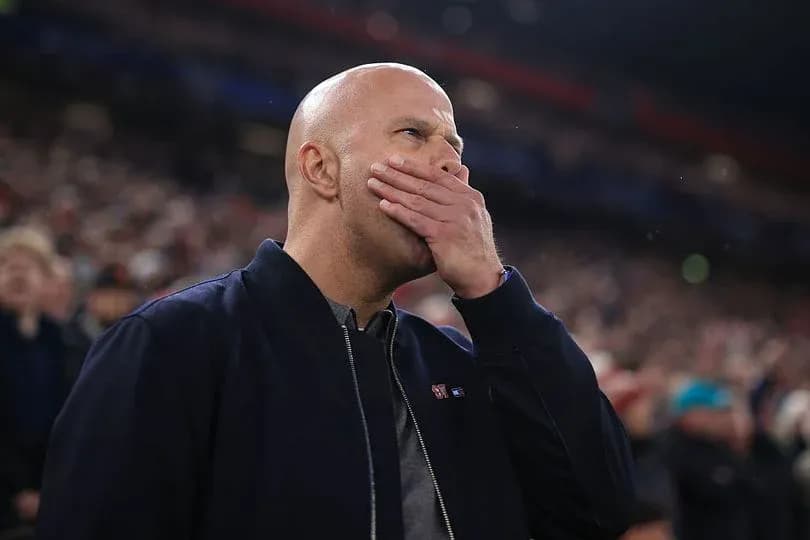
Arne Slot’s Season of Excuses: Liverpool's Year of Frustration
The numbers are brutal. Over £450 million spent in the summer, a squad rebuilt at huge cost, and yet Liverpool’s 2025-26 campaign under Arne Slot has drifted into something far closer to an inquest than a title charge.
Out of the Champions League. Nowhere near a convincing top-four push in the Premier League. Anfield, a place once defined by defiance, has instead become the backdrop to a season of explanations.
Slot has been clear on one thing. He refuses to lean on the sudden preseason death of Diogo Jota as a shield.
“The last thing I would do is use it as an excuse,” he said back in November.
On almost everything else, though, the Liverpool manager has reached for a reason, a reference, a mitigating factor. The pattern has become familiar. Lose the game, win the argument. Or at least try to.
No. 4: Brentford 3-2 Liverpool – Lineups, Travel, and a “Soft” Call
The tone was set before a ball was kicked at Brentford in October.
Liverpool arrived on the back of a 2-1 defeat to Manchester United. Slot’s focus was not on his own side’s failings, but on how others approached facing Liverpool. United’s tweaks, he argued, were part of a wider trend.
“We've seen Sesko play the last three, four, five or six times, but they go to Liverpool [and] they change the line-up,” he said. “That's not the first time we've faced a team, and they've done that.”
The implication was clear: teams raise their game, alter their plans, distort the rhythm of their seasons just to face Liverpool. When Brentford then beat his side 3-2, the London club went straight for the obvious punchline, posting: “Must have been that unchanged team then.”
Slot did not back down. He called the penalty Liverpool conceded “soft,” then pointed to a punishing schedule — five of six fixtures away from home — and the impact of sweeping summer changes on a side still trying to find itself.
“It definitely (our form) also has to do with if you change quite a lot in the summer. I think it’s not a surprise that it can go a bit like this,” he said, as Liverpool’s losing run stretched to four games.
The message: new team, rough schedule, harsh decisions. The table, though, showed only another defeat.
No. 3: Crystal Palace 3-0 Liverpool – The Guardiola Benchmark
Later that same month, in the League Cup, Slot went with a heavily rotated XI against Crystal Palace. The result was a 3-0 defeat and another post-match reference point.
This time, it was Pep Guardiola.
“I saw [Manchester] City’s line-up, and I don’t think they had one starter from the weekend, but it felt as if – if you look at their line-up – that they had played with their 11 starters,” Slot said.
The logic was that if Guardiola could rotate heavily and still win, then Liverpool’s changes should be viewed in the same light. The problem: City had handled their business. Liverpool hadn’t.
City did rest most of their regulars, even starting 18-year-old Divine Mukasa in midfield, yet still found a way through their tie. Liverpool’s second string, by contrast, were brushed aside by Palace. Slot’s justification leaned on comparison with the champions, but the gulf in performance on the pitch told its own story.
No. 2: Manchester City 4-0 Liverpool – The xG Complaint
By April, Liverpool’s season needed a statement. Instead, they were taken apart 4-0 by Guardiola’s Manchester City in the FA Cup.
Slot turned to the numbers.
“Again, we are facing a team that outperformed their xG by a mile, and that is happening constantly,” he said after the game.
On the night, he had a point. City scored four times from 1.97 expected goals. Clinical finishing punished Liverpool’s looseness. Yet the broader narrative was less forgiving.
A week earlier, Brighton had beaten Liverpool 2-1, generating 2.17 xG. There, the numbers did not flatter the opposition. They underlined it.
And three weeks before the City defeat, Liverpool themselves had exploded against West Ham, scoring five from 1.84 xG, while the Hammers produced 1.86 xG and scored twice.
When the numbers favoured Liverpool, they were a sign of attacking verve. When they favoured the opposition, they became part of an ongoing complaint. The pattern fed the perception: Slot always had a statistic to hand, but not always a solution.
No. 1: Bournemouth 3-2 Liverpool – Tired Legs and the Wind
The most striking episode came in January, away at Bournemouth. On the data, Liverpool were second best by a distance: 0.83 xG to Bournemouth’s 2.30. On the touchline, Slot again reached for context.
“It is safe to say a few players of ours ran out of energy. I cannot criticize them for that because two days ago we played an away game in Europe,” he said.
Fatigue was the first line of defence. Fixture congestion, another. Yet the game will be remembered for a different explanation entirely.
Virgil van Dijk, usually the calm at the heart of Liverpool’s back line, came under scrutiny for his role in the first goal. Slot stepped in.
“It is not completely fair to Virgil to blame him for the first goal,” he insisted. “You can see throughout the game how much impact the wind had. He wasn’t the only one who struggled with the wind.”
The conditions, he argued, had distorted the contest. The sight of a Liverpool manager talking about the wind after a defeat only fuelled the comparisons with Jurgen Klopp’s more colourful post-match assessments over the years.
A Season Drowning in Explanations
Across these flashpoints, the theme is unmistakable. Lineup changes from opponents. Soft penalties. A heavy travel load. Summer upheaval. Rotated squads. xG anomalies. Tired legs. The wind.
Slot has carefully avoided leaning on the most human and tragic element of Liverpool’s season — the loss of Diogo Jota — and on that front, his stance has been resolute. But he has filled the space with a steady stream of other reasons, each one chipping away at the sense of control.
Liverpool fans have seen this play before. Under Klopp, the complaints were often wrapped in charisma and delivered alongside trophies and title challenges. Under Slot, the excuses are landing in a vacuum of success.
The bill for this season’s failings will arrive soon enough. The real question is whether Slot can move from explaining defeats to preventing them — or whether this campaign will be remembered as the year Liverpool talked more about the wind, the numbers and the schedule than about winning.