Arno Jacobs: From Player to Umpire at St George's Park
St George’s Park has framed most of Arno Jacobs’ cricketing life. It was there in 1997 when he arrived as a young batter from North West for a List A game. It was there again six years later, by then an Eastern Province player in a four-day fixture against Boland. It was still there in 2013, when he turned out in whites for the Warriors against the Lions and walked off thinking his work on that ground, at least as a player, was done.
He was wrong.
Jacobs’ career has been stitched together across 28 venues in South Africa, England, Ireland and Scotland, but nowhere did he belong more than at St George’s Park. Thirty first-class matches, 32 List A games, 14 T20s as a player. Then the second act: 45 games as an on-field umpire, 17 as television official, 14 as fourth umpire. Add it all up and you get 152 professional matches at the country’s oldest Test ground.
So when the phone rang at half-past seven on the first morning of a Test between South Africa and Australia in October, it wasn’t just another work call. It was St George’s Park calling him back to the middle.
The emergency call
Jacobs was supposed to be the fourth umpire. Richard Illingworth and Chris Gaffaney had the on-field duties, Richard Kettleborough the television role. Routine, at least by modern international standards.
Then Gaffaney fell ill before a ball was bowled.
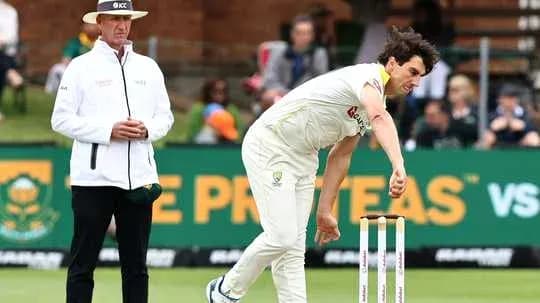
Normally, the script is simple: the TV umpire goes out to the middle, the fourth umpire moves upstairs to the technology and replays. This time, the script was torn up. Kettleborough stayed in the booth. Jacobs, the local, went to the middle for his first Test as an on-field umpire.
He had barely stepped out of the shower when match referee Javagal Srinath called: one of the on-field umpires was out, he was in, and by the way, could he also find a new fourth umpire?
Jacobs did both. He arranged for Dan van der Merwe to fill the fourth-umpire role, then turned inward and started preparing himself to walk back into the arena that had defined so much of his career.
For those on social media who rushed to explain the decision, the story quickly went skew. Some claimed Jacobs was chosen because he had never done TV work before. The facts say otherwise. He had already served as television umpire in two first-class matches, eight List A games and 44 T20s, including four internationals and 21 franchise fixtures. He knows his way around the replay screens.
The choice was about something else entirely.
“The TV role can be tricky,” he said. “There’s a lot you need to keep an eye on, and you need to communicate on air with the TV director. It can be an overwhelming thing to get your head around.
“And, you know, for umpires our home is in the middle. That’s what we’re used to. If they had asked me to do TV that would have been fine. But I think I was more comfortable going out to the middle.”
That comfort mattered. So did experience. Once the ICC officials weighed it up, they kept Kettleborough in the booth and sent Jacobs into the heat.
The rise of the TV specialist
Jacobs has seen the game from every angle, and he can see where the role is heading.
“The TV role could become a specialist function. I can definitely see that happening in future. Especially for the longer formats,” he said.
T20 cricket, he pointed out, often leaves the third umpire as little more than a timekeeper on flat pitches with few referrals. Test cricket is different. It demands constant attention, layers of timekeeping, and a stream of decisions that can shape the rhythm of a match. That’s not a side job anymore. It’s a discipline.
On this occasion, though, the so-called “boring Dutchman from Potch who moved to GQ”, as he jokingly calls himself, went where umpires truly live: into the centre.
Neutrality under the microscope
The decision to send a South African onto the field in a Test involving South Africa and Australia was always going to raise eyebrows. Neutrality sits at the heart of the modern umpiring model, and this was a South African, at his home ground, officiating his own country’s Test.
“I understand there was a bit of pushback initially,” Jacobs said. “But it’s not to my benefit to give the South Africans an advantage. I mean, I’m trying to further my own career. If you think of it from the perspective of ‘this guy’s just trying to make his way’, [bias] couldn’t be an issue.”
He knows the tightrope. The danger of overcompensating, of trying so hard not to favour one side that you lean too far the other way, is real.
“It is a thought at the back of your mind; that you don’t want to be seen as favouring one side and so you almost go the other way. But you make a decision based on how you see a situation play out in front of you, and DRS is there to assist if you do make mistakes. I just try and make the best decision I can. And whatever happens from there happens.”
On the field, he blended in. That is the highest praise an umpire can receive. He didn’t turn the day into a story about himself. He just worked.
Three of his decisions went upstairs. Two stood – one each for South Africa and Australia. The only one overturned came in the 10th over of Australia’s first innings, when he judged Travis Head not out, believing the left-hander had hit the ball before it thudded into the pad. Replays showed the contact came a fraction too late. Head had indeed hit it, but only after it had struck the pad. It was a mistake you could understand in real time.
The point was not perfection. It was control.
No lull, no hiding place
Jacobs has spent years in the provincial system, where matches can drift, sessions can flatten, and umpires occasionally get a breather. This was nothing like that.
“The intensity is so different compared to provincial level, where sometimes there’ll be a lull,” he said. “With this there’s no off period. So you constantly feel like you’re in the game. The nature of the pitch was that there was something for the bowler all the time. That also contributed to that. It was a great experience. I loved it.”
There was another layer of déjà vu at St George’s Park. Van der Merwe, the man Jacobs roped in as fourth umpire, had been through a similar scramble before. In March 2018, when South Africa and Australia met at the same ground, Gaffaney again fell ill, that time after the first day. S Ravi, then the TV umpire, went on-field, Bongani Jele moved upstairs, and Van der Merwe was hurriedly drafted as fourth umpire.
So when Gaffaney tried to return during the Australia Test in October, Jacobs watched him closely.
“I could see he was there in body, but he didn’t look great to me,” he said. “So I prepared myself for the eventuality that I might go back onto the field.”
At lunch, while he supervised the marking of creases and sweeping of the pitch, he got the call. He was needed back in the middle, and this time for good. Srinath and the ICC officials opted for continuity and kept him on-field for the rest of the match rather than risk further disruption.
It was, in umpiring terms, a marathon. He emerged without fuss, without drama, and with the respect that comes when nobody notices you too much.
From middle-order grafter to man in the middle
Cricket has been good to Arno Jacobs, and he has paid it back in full. As a left-handed middle-order batter he compiled 17 first-class centuries and 48 fifties, averaging 38.08. In T20s he shifted up the order and attacked. He bowled off-spin, dabbled in seam, and even kept wicket when needed.
He has never been just one thing.
Now he coaches when he isn’t umpiring. The transition from player to official, often a financial gamble, was eased by Cricket South Africa’s decision in the late 1990s to place a small group of umpires on 12‑month retainers. It allowed him to treat officiating as a profession, not a side hustle. It also helped that his wife, Chantal, built a solid career in the fruit exporting industry.
“I’ve never worked an actual job in my life, like a real person,” he said, half-mocking himself. His one serious attempt to escape cricket’s orbit came after graduating from Potchefstroom University with a degree in financial accounting, when he considered starting a telecommunications business. The game pulled him back.
He signed off a recent conversation with a line that sells himself short: “Thanks for your interest in a boring Dutchman from Potch who moved to GQ.”
Boring doesn’t walk into a Test match at short notice and make it look routine. Boring doesn’t turn 152 games at one ground into a living, breathing relationship with the place. Boring doesn’t stand in the middle of a South Africa–Australia Test and disappear, in the best possible way.
Cricket, including Test cricket, is fortunate that Arno Jacobs never found that “real job.”