Arsenal Reach Champions League Final After 20-Year Wait
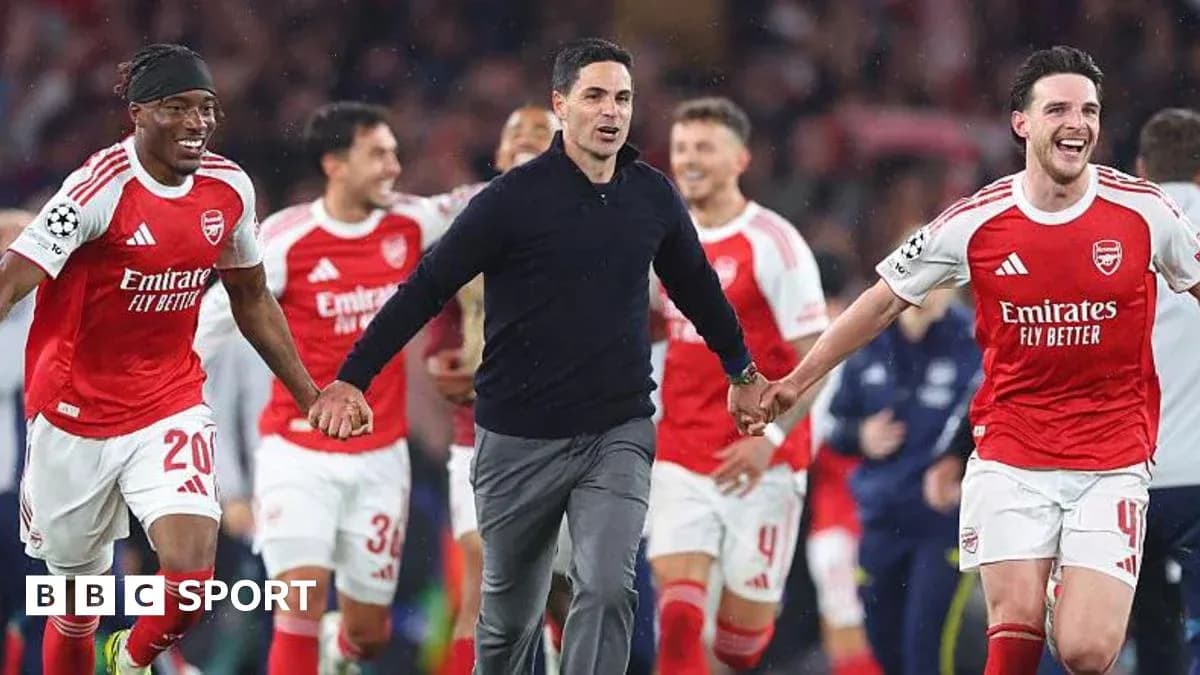
The final whistle had barely cut through the north London night when Emirates Stadium erupted. Not a polite cheer, not a routine roar, but a full, shaking, cathartic release 20 years in the making.
Arsenal are back in a Champions League final.
They have waited two decades for this stage, 140 years for this kind of chance. A 1-0 win over Atletico Madrid sealed a place in Budapest on 30 May, just the second European Cup final in the club’s history, and with it came a surge of emotion that nobody in red seemed inclined to suppress.
Within minutes, fans were on their phones, hunting flights and hotels in Hungary. The songs rolled around the stands long after the players disappeared down the tunnel. The club that has worn the accusation of “nearly men” like a scar now stands one match away from becoming champions of Europe for the first time.
And one step away from something even bigger.
Arsenal sit top of the Premier League. A domestic and European double – the preserve of Liverpool, Manchester United and Manchester City in the English game – is suddenly not a dream but a live possibility. Win the league and the Champions League and they join the heaviest of heavyweights.
Yet even as the confetti settled, the argument began.
The ‘celebration police’ clock in
Wayne Rooney has been here before. He knows what it takes to win this competition and a league title in the same season; he did it with Manchester United in 2007-08. From the Amazon Prime studio, he watched Arsenal’s players and staff soak in the moment and bristled.
“They deserve to be in this position but they haven't won it yet,” Rooney said. “I think the celebrations are a little bit too much. Celebrate when you win.”
It was not the first time he had raised an eyebrow this season. When Manchester City beat Arsenal 2-1 last month to haul themselves back into the Premier League title race, Rooney thought their response also went too far.
“I think it was a little bit over the top,” he said of City’s scenes at the Etihad. “It is obviously a big win. I just think it's a little bit premature and it might come back to bite them.”
Danny Murphy, watching on for the BBC, felt City’s jubilation “looked a bit excessive, like maybe they had already won [the title]”, though he softened the blow by suggesting it was really a celebration of the realisation that the title was in their own hands again.
The theme is clear. To some, there is a right way to celebrate, a correct time. Anything else is indulgence.
‘Do not get nicked’
Inside Arsenal’s orbit, the response was instant and defiant.
Ian Wright, who has lived the club’s highs and lows more viscerally than most, went straight to X with a message for supporters.
“Arsenal fans, let me tell you something: enjoy this. The celebration police will be out in force. Do not get nicked!” he wrote.
“Enjoy yourselves, football's about moments and this is a big moment. Enjoy it and let's hope that in the final and after the final we have another massive moment. It's a great day.”
For a fanbase that has spent years being mocked for “bottling it”, for daring to believe, for singing too loudly too soon, Wright’s words landed like permission. This, he insisted, is what football is for.
Arsene Wenger, the architect of Arsenal’s only previous Champions League final appearance in 2006, struck a more measured note, but even he understood the release.
“They celebrated well tonight, which is normal,” he told beIN Sports. “But you want more to focus already on the final and the next game.
“The celebration is deserved and happiness is absolutely normal, but now the next step is of course to go to the final and win it.”
Wenger knows better than anyone how thin the line can be. His 10-man side led Barcelona in Paris before losing 2-1. History remembers the result, not the journey.
Joy, after years of strain
If you have followed Arsenal closely this season, you understand why Tuesday night felt different.
For months they have lived under a strange pressure. Top of the table, but smothered by chatter of a quadruple-that-never-was, by endless “bottle” jokes, by the sense that any slip would be thrown back in their faces. The data has said this is an excellent team. The mood has often felt like a tightrope.
Scarlet Katz Roberts, from the Goal Difference podcast, put it bluntly: Arsenal should celebrate. The lesson from the days between the win at Fulham and the victory over Atletico, she argued, is that “vibes are paramount”.
She remembered watching Manchester City’s players and fans revel in a League Cup win at Wembley, the blue machine basking in another trophy as if it were oxygen. That kind of joy, that sense of invincibility, can carry a team.
At Emirates on Tuesday, Arsenal found their own version.
The players streamed on to the pitch at full-time as “Freed From Desire” rattled around the ground. “North London Forever”, once in danger of feeling forced, suddenly sounded like a genuine anthem. Supporters drowned out Martin Keown’s pre-match analysis and never really quietened down.
It did not feel choreographed. It felt like a club finally letting itself believe.
The science of letting go
Strip away the noise and there is another layer to all this: what that kind of celebration actually does to a squad.
Bradley Busch, a chartered sports psychologist who runs Inner Drive, a performance centre working with athletes, watched Arteta and his players form a line, join hands and sprint towards each end of the ground. To him, it spoke volumes.
He called it a sign of a “very healthy team and squad mindset”.
In his world, there is a term for what was happening: emotional contagion. Behaviours, attitudes, unity – they spread. One of the clearest ways to reinforce that connection is to celebrate together, visibly, unapologetically.
On a more basic level, Busch pointed out, players do not dance in front of their supporters as some kind of calculated performance trick. They do it because they have lived this pursuit, day and night, and for a moment the pressure breaks.
“In what is such a high-pressurised environment I think it's really healthy for it not all to build up and bubble, and to celebrate on the pitch,” he said.
So where, then, is the line? When does joy become a problem?
Busch suggested the only meaningful definition of “over-celebration” is anything that damages future performance. Showboating during a game, dropping intensity because a team thinks the job is done, or allowing the party to disrupt preparation for the next match – that is where danger lies.
“This is a world away from that,” he argued.
Then came the twist. Busch is a Tottenham fan. “As a Tottenham fan, I absolutely do hope it's a case of over-celebration – but that's more of my personal opinion than professional one!”
Budapest, and beyond
So where does that leave Arsenal?
They stand 90 minutes from the biggest prize in European club football, with Bayern Munich or Paris St-Germain waiting in Budapest. Win there and they will become the seventh English club to lift the European Cup or Champions League, and the fourth from this country to pair it with a league title in the same season, following Liverpool, Manchester United and Manchester City.
They have not, as Rooney rightly pointed out, won anything yet. The medals are still locked away. The season can still turn.
But on Tuesday night, under the Emirates lights, none of that mattered. A club, a manager and a fanbase that have carried the weight of expectation and ridicule alike finally allowed themselves to feel unfiltered joy.
The question now is not whether they celebrated too much.
It is whether that night of noise and colour becomes the spark that carries them over the line – in Budapest, and in the title race that still hangs in the balance.