Arteta Focuses on West Ham Amid Title Race and Champions League Final
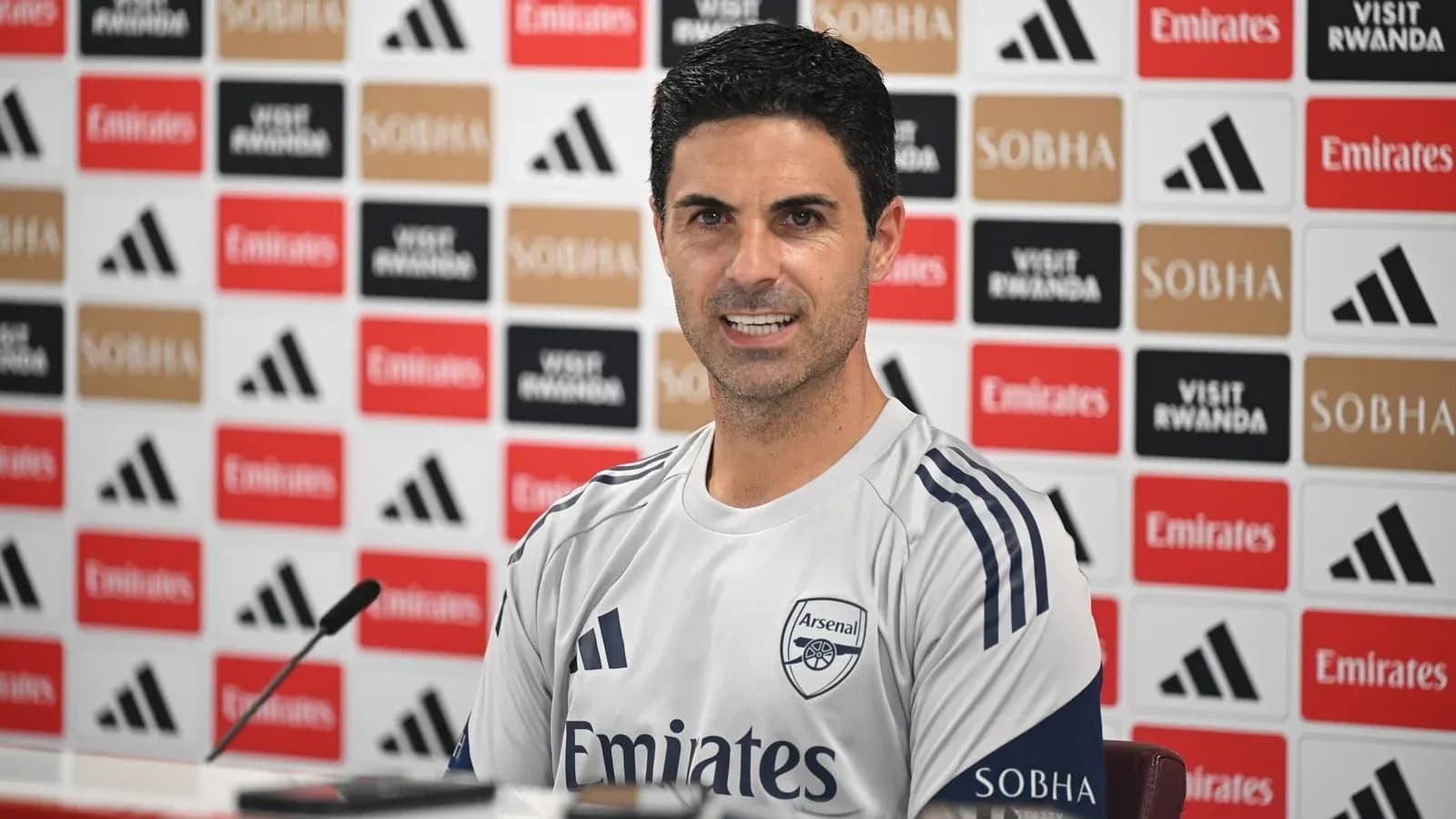
Mikel Arteta walked into his pre-match press conference with a Champions League final on the horizon and a title race at full tilt. He refused to indulge in either for long.
Four league games remain. West Ham United away on Sunday. That, he insisted, is the only thing that matters.
Paris can wait
The obvious question came early: Paris Saint-Germain in the Champions League final. A glamour tie, a defining night in the club’s modern history.
“It is what it is,” Arteta said, stripping away the drama. Bayern Munich or PSG, the level would have been the same. He acknowledged their quality, but quickly underlined Arsenal’s own belief that, when the moment comes, they will “deliver what we need to.”
Then he moved on. No grand build-up, no early narrative about Paris. The mental switch has already been made.
No new injuries, no Merino or Timber
On the immediate, practical side, there was good news. No fresh injuries from the midweek exertions, the squad emerging intact from a high-intensity night.
The exceptions are familiar ones. Mikel Merino and Jurrien Timber remain out of contention for the weekend. Asked if either might be seen before the end of the season, Arteta wouldn’t commit. There is “still a fair bit to do,” he admitted, and any late return would need everything to be “so smooth and quick” to offer even a few minutes.
Unity as a weapon
If the Champions League final sits on the horizon, the fuel for the run-in lies much closer to home. Arteta returned several times to the power of the club’s unity – particularly inside the stadium.
He called it “crucial, immense and needed.” The players, he said, have spoken about the atmosphere in recent games as something they had never felt before, a connection that has made them better footballers in real time. The emotional state of the stadium has become part of the game plan.
That emotion, of course, has drawn criticism from outside. Some questioned the scale of Arsenal’s celebrations after beating Atletico Madrid. Arteta claimed not to have seen the noise around it, and refused to be drawn into a row. Opinions, he said, have to be respected and “placed where they belong” – and then left there.
What does matter, in his eyes, is that all forms of criticism, positive or negative, drive higher standards. If you want to compete for the two biggest trophies in Europe, you live with the scrutiny and use it.
“Everything has to be West Ham”
The risk this week was obvious: emotional overload after reaching a Champions League final. Arteta moved quickly to cut that off.
He spoke to the players immediately after the game. Enjoy the moment, recognise what they have earned, but park it. “The focus, the attention, the detail, the energy, everything has to be put into West Ham,” he told them. “There is nothing else there.”
His message to both players and supporters is simple: stay present. Live this moment, not the one in Paris. Bring the same energy, hunger and desire as all season – “or more” – because now every action could decide whether they win the league or not.
Sunday’s London derby, he knows, carries weight for both clubs. The jeopardy is high, the context “huge” for each side. Arsenal know exactly what they need and what it will take to get it.
Lewis-Skelly’s leap – and the reality check
One of the most intriguing strands of Arsenal’s season has been the emergence, and then careful management, of Myles Lewis-Skelly.
Arteta described the timing of his move into midfield as a process built on understanding the player and the level. Lewis-Skelly’s attitude in training, his support for team-mates when not playing, and the way he responded once given a chance all convinced the staff he would deliver.
He did more than that. Coming in with limited minutes behind him, he looked “confident, energetic,” playing with a determination that even surprised his manager.
Yet Arteta made clear this has not been a straight-line rise. Lewis-Skelly was playing for the under-18s and under-21s, sometimes out of position, then suddenly everyone was talking about him and he was in the national team. When he returned from pre-season and realised he might not start regularly, the emotional test began.
Arteta spoke of pushing him, understanding his feelings, and guiding him through that dip, not just the player but those around him who offer advice. The temptation, when things go against you, is to point fingers. The manager had to explain, repeatedly, the reasons behind selection. “After three or four times,” he said, Lewis-Skelly accepted that if it wasn’t done in a certain way, “I don’t think it’s going to happen.”
Now, the rewards of that hard conversation are visible on the pitch.
Saka, Rice and leaders in plain sight
If Lewis-Skelly represents the future, Bukayo Saka embodies the present. Arteta spoke about him with obvious warmth. Working with Saka, he said, has been “a joy” from day one.
He leans on him “at any level,” trusting his values, his education, his principles. On a human level, the club knows him. On the football side, what he has given Arsenal – and what he produced “the other night” – he described as remarkable.
Declan Rice, returning to his former club this weekend, has moved into that leadership bracket as well. Arteta stressed that Rice arrived already “really well developed,” but what he has done since has been “outstanding.” One of Arsenal’s main players, one of their leaders, and “very powerful” in what he brings to the team and club.
On the right flank, Ben White and Saka finally have a sustained run together again. Their minutes as a unit have been “extremely low” this season for various reasons, but years of playing side by side are starting to show again in their understanding and connection.
Gyokeres, intuition and the manager’s feel
Arteta’s eye for detail extended to Viktor Gyokeres. He has noticed improvements in the striker’s hold-up play from the start, but pointed out that such development never happens overnight. The work, he said, is done over months.
Gyokeres, in his view, has driven that change himself: demanding more, asking questions, doing extra, constantly searching for better connections with team-mates – in the canteen, the dressing room, or on the pitch. Behaviours like that, Arteta argued, eventually bring rewards.
Selection decisions, such as using Eberechi Eze on the left at Manchester City and Lewis-Skelly in midfield against Fulham and Atletico, he linked to intuition. It is about what the game will require, the state of the players, and where they can have the most impact. You can be right or wrong, he admitted, but you must at least know you have done the thinking and preparation. Delivery is another matter.
Raya’s level and a deeper bench
In goal, David Raya’s season has quietly built towards something formidable. Arteta called his consistency since joining “exceptional,” reaching a level “incredibly high.” Some of his work, he suggested, has started to look normal simply because he produces it so often, when in reality it is anything but.
He highlighted the collective effort behind Raya’s likely Golden Glove success for a third consecutive season for the team. The defensive phase, he insisted, is a shared project.
The other major shift is depth. Arteta pointed to the quality on the bench in midweek and compared it to a year ago. The picture, he said, is “very different.” More players are fresher, the squad feels stronger, and that, from his perspective, is the single most important factor in giving Arsenal a bigger chance to hit their targets.
He doesn’t think the players see the remaining league matches as auditions for the Champions League final. Their trial, he said, is every day in training, where they keep giving the staff “headaches” with their level.
The five-phase plan can wait
Arteta’s long-discussed “five-phase plan” resurfaced, briefly. He parked it just as quickly. Can we talk about it? “At the end of the season.” What phase are Arsenal in now? “I don’t know, I’m lost! It doesn’t matter.”
What matters, he stressed, is the outcome at the end of May. Six years of planning will be judged then, not now.
Living in the biggest weeks
Are these the biggest weeks of his career? Yes, he admitted. But he instantly dragged the conversation back to the present. What they did today, what they will do tomorrow to be in the best mental and physical state for Sunday’s battle – that, to him, is the only fact that counts.
Arteta insists he enjoys every day: the work with the players and staff, the privilege of his role. The enjoyment, he says, lies in preparation – in picking the right topics for West Ham, predicting how the game might unfold, and planning how to change it if needed.
The Champions League final can wait. The five-phase plan can wait. The verdict on this project can wait.
West Ham away will not.