AS Roma Dominates Fiorentina 4-0 in Serie A Showdown
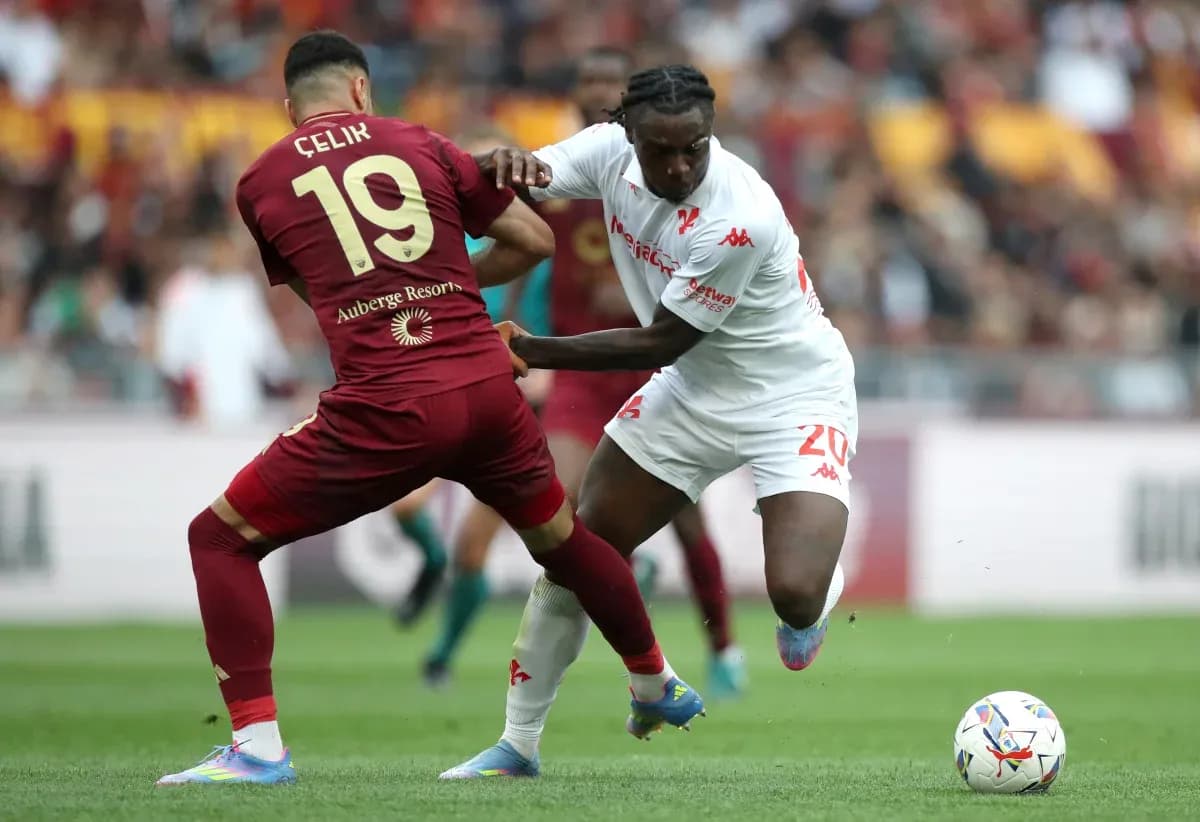
AS Roma dismantled Fiorentina 4–0 at Stadio Olimpico in Serie A Round 35, a match defined by structural superiority rather than just clinical finishing. With a 3-4-2-1 against Fiorentina’s 4-3-3, Roma imposed control early, raced to a 3–0 halftime lead, and then managed the second half with authority. The statistical profile – 61% possession, 14 total shots to 4, and xG of 2.14 to 0.16 – underlined how thoroughly Roma dictated territory, tempo, and duels. Fiorentina’s adjustments after the break could not disrupt Roma’s defensive block or generate sustained pressure, and the hosts closed out a statement win with minimal defensive stress.
Scoring Sequence
Roma’s scoring sequence reflected a well-rehearsed set of patterns in possession. The opener on 13' came from a set-piece-style situation with centre-back G. Mancini (#23) advancing aggressively into the box. N. Pisilli (#61) supplied the assist, highlighting Roma’s intent to push central midfielders high between the lines and use them as technical launch points. Mancini’s goal was not a random defender strike; it illustrated how Roma’s back three were encouraged to step into advanced zones whenever Fiorentina’s front line failed to apply coordinated pressure.
Just four minutes later, on 17', Wesley Franca (#43) doubled the lead, assisted by fellow defender M. Hermoso (#22). Again, a defender’s involvement in the final action showed Roma’s comfort in overloading wide and half-space channels. Hermoso advanced from the left of the back three, exploiting the space behind Fiorentina’s right-back Dodo (#2), and linked with Wesley Franca arriving from the wing-back/midfield line. The pattern: Roma dragging Fiorentina’s 4-3-3 wide, then attacking the vacated central lanes with late runs.
The third goal on 34' was Hermoso’s own, assisted by M. Kone (#17). Here Roma’s structure was clearest: Kone, operating as a central midfielder in the 3-4-2-1, received between Fiorentina’s midfield and defensive lines, then played Hermoso, who had once more stepped into an advanced channel. Fiorentina’s zonal line was disorganized, with the left centre-back left untracked as he drove into the box. By 34', Roma had effectively turned their back three into a rotating back-two-plus-free-libre, with Hermoso the main progression outlet.
In the second half, Roma’s fourth goal on 58' – Pisilli from a D. Malen (#14) assist – showcased transition quality. Malen, the lone striker in the nominal shape, dropped and drifted to link play, then released Pisilli’s vertical run from midfield. Fiorentina’s midfield line, already stretched by chasing the game, failed to track the late runner. Pisilli’s involvement in both the first and fourth goals encapsulated Roma’s plan: central midfielders as dual-role players, both screeners and penetrators.
Disciplinary Events
Disciplinary events followed a clear pattern of frustration and tactical fouling. Fiorentina’s first yellow came on 25' to Marin Pongračić (#5) for a foul, a sign of the away side’s difficulty handling Roma’s rotations in the half-spaces. Roma’s first caution came on 48' to Mario Hermoso (#22) for a foul, immediately after halftime, reflecting the defender’s aggressive front-foot defending as Fiorentina tried to increase tempo.
Fiorentina’s second booking, to Fabiano Parisi (#65) on 66' for argument, was revealing: a substitute yet to fully settle, reacting emotionally rather than structurally, symptomatic of a side losing control of both scoreboard and game narrative. Roma’s second yellow, to Stephan El Shaarawy (#92) on 90+2' for a foul, was a classic game-management infringement – a late, tactical intervention to halt any counter and preserve the clean sheet.
Substitutions
Substitutions followed the event order and tell the tactical story. At 46', Fiorentina made a triple change: R. Braschi (#61) (IN) came on for J. Harrison (#17) (OUT); F. Parisi (#65) (IN) came on for A. Gudmundsson (#10) (OUT); P. Comuzzo (#15) (IN) came on for M. Pongracic (#5) (OUT). This was a structural reset: fresh legs in wide and defensive zones, with Comuzzo shoring up a back line repeatedly exposed by Roma’s advancing defenders.
Roma’s changes were more about control than rescue. On 64', S. El Shaarawy (#92) (IN) came on for M. Kone (#17) (OUT), shifting Roma towards a slightly more counter-oriented front line while preserving the three-man defensive base. On 72', P. Dybala (#21) (IN) replaced M. Soule (#18) (OUT) and D. Ghilardi (#87) (IN) came on for G. Mancini (#23) (OUT), indicating a move to manage minutes and maintain defensive solidity with fresh legs. Fiorentina responded on 75' with J. Fazzini (#22) (IN) for N. Fagioli (#44) (OUT) and G. Fabbian (#80) (IN) for M. Brescianini (#4) (OUT), trying to inject energy into central midfield. Roma’s final double change at 83' – J. Ziolkowski (#24) (IN) for M. Hermoso (#22) (OUT) and R. Vaz (#78) (IN) for D. Malen (#14) (OUT) – locked in defensive stability and gave Vaz a chance to press from the front.
Goalkeeper Perspective
From a goalkeeper perspective, the numbers underline how lopsided the defensive workload was. Roma’s M. Svilar (#99) registered just 1 save, aligned with Fiorentina’s xG of 0.16 and their 1 shot on target. Roma’s defensive index in this match was extremely high: the back three of Mancini, Ndicka (#5), and Hermoso controlled depth so effectively that Fiorentina’s front three of Harrison, Gudmundsson, and Solomon (#19) rarely received in dangerous central zones. Most Fiorentina possession was sterile, in front of Roma’s block.
At the other end, D. de Gea (#43) made 3 saves but conceded 4, with Fiorentina’s defensive structure allowing Roma to generate 7 shots on goal from just 2.14 xG. The negative goals-prevented value for both keepers (-0.74 each) suggests that finishing slightly outperformed model expectation at both ends of the pitch, but the volume and quality of Roma’s chances were decisive.
Statistical Overview
Statistically, Roma’s 61% possession and 599 total passes at 91% accuracy paint a picture of controlled dominance. Fiorentina’s 39% possession, 373 passes at 84% accuracy, and only 4 total shots show a side unable to translate buildup into penetration. Roma committed 12 fouls to Fiorentina’s 10, reflecting an assertive, not passive, defensive approach. Corners (4 for Roma, 5 for Fiorentina) suggest Fiorentina had some territorial moments, but without the structural tools to break Roma’s compact 3-4-2-1.
Overall form-wise, Roma delivered a complete performance: efficient in attack, disciplined in defensive structure, and tactically flexible with substitutions that preserved intensity. Defensively, their index in this match – limiting Fiorentina to 0.16 xG and 1 shot on target – was elite, anchored by the back three’s control of depth and the midfield’s work in screening central lanes.