Athletic Club vs Valencia: Tactical Analysis of a 0-1 Match
San Mamés under grey Bilbao skies, La Liga’s Regular Season - 35, and a match that finished 0-1 yet felt far heavier than the scoreline. Following this result, Athletic Club remain 9th on 44 points, their goal difference fixed at -11 after 40 goals scored and 51 conceded. Valencia, 12th with 42 points and a goal difference of -12 (38 for, 50 against), stole an away win that fits neatly into their season-long identity: cautious, reactive, and opportunistic on their travels.
I. The Big Picture – Two 4-2-3-1s, one decisive moment
Both coaches mirrored each other on the tactical board. Ernesto Valverde stayed loyal to his season’s default, rolling out another 4-2-3-1 – the same structure Athletic have used in 34 of their 35 league matches. Carlos Corberan, more flexible across the campaign, chose 4-2-3-1 for this trip despite using 4-4-2 as his primary shape overall.
For Athletic, Unai Simón anchored a back four of Álvaro Odriozola-style width in theory but here represented by A. Gorosabel on the right and Yuri Berchiche on the left, with Yeray Álvarez and Aymeric Laporte as the central pairing. Ahead of them, Mikel Jauregizar and A. Rego formed the double pivot, tasked with both launching and shielding the line of three: R. Navarro to the right, Oihan Sancet centrally, and Nico Williams wide left, all servicing lone striker Gorka Guruzeta.
Valencia’s mirror was just as clear. S. Dimitrievski in goal, a back four of Renzo Saravia and José Gayà on the flanks, with C. Tárrega and Eray Cömert inside. The double pivot of Pepelu and G. Rodríguez underpinned a creative band of three: Diego López to the right, Javi Guerra between the lines, and Luis Rioja on the left, supporting Hugo Duro as the reference point.
Heading into this game, the numbers painted an intriguing clash of flawed but dangerous mid-table sides. Athletic’s attack at home averaged 1.2 goals per match (21 in 18), while conceding 1.1 at San Mamés (20 in 18). Valencia, on their travels, carried a more modest attacking threat at 0.8 away goals per match (15 in 18), but also leaked 1.6 away goals per game (29 in 18). On paper, this was a stage tilted slightly toward the hosts’ attacking ambition – yet the scoreboard told a different story.
II. Tactical Voids – Absences that reshaped the chessboard
The team sheets were defined as much by who was missing as by who started. Athletic were stripped of central control and rotation options: U. Egiluz (injury), B. Prados Díaz (knee injury), Iñigo Ruiz de Galarreta (personal reasons), and M. Sannadi (coach’s decision) all absent. The loss of Ruiz de Galarreta in particular removed a metronomic presence; he has accumulated 1,117 passes in the league, with 24 key passes and an 82% accuracy, alongside 58 tackles and 4 blocked shots. His 10 yellow cards underline how often he plays on the edge, but his absence forced Valverde to trust Jauregizar and Rego to manage tempo and transitions.
Valencia’s injury list was even heavier in the defensive and structural zones: L. Beltrán (knee), J. Copete (ankle), M. Diakhaby (muscle), D. Foulquier (knee), and T. Rendall (muscle) all missed out. Corberan had to rely on C. Tárrega and Cömert as his central pairing and trust Gayà’s leadership on the left.
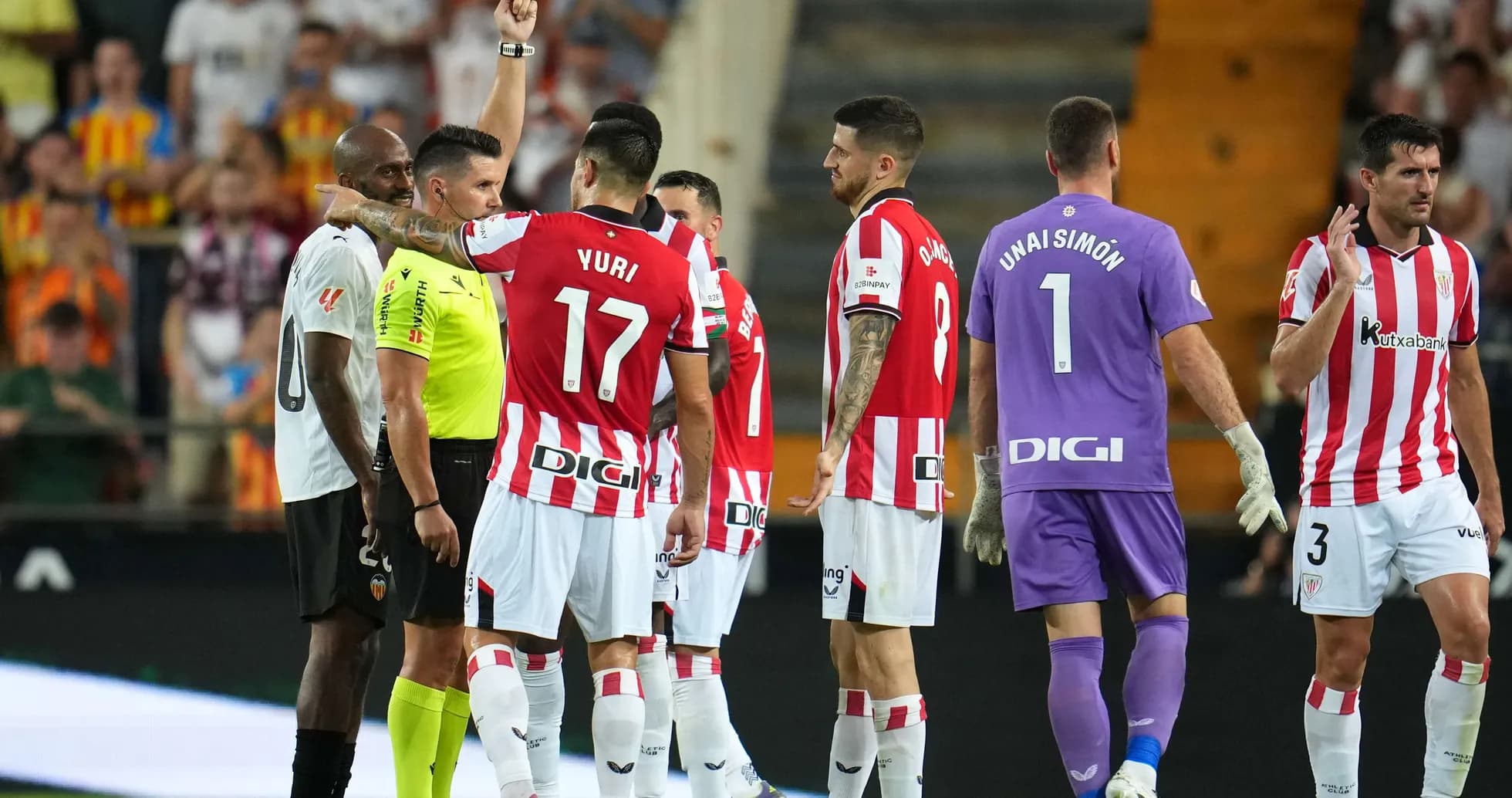
Disciplinary trends added another layer. Across the season, Athletic’s yellow cards cluster between 61-75 minutes, where 22.37% of their bookings arrive, and 46-60 minutes with 18.42%. Their red cards spike in the 61-75 window too (28.57%), suggesting that as matches stretch, their aggression can turn rash. Valencia’s yellows peak late: 23.19% of their bookings come between 76-90 minutes, with 20.29% in the 46-60 phase. Both sides, then, tend to play the second half on the disciplinary edge, and San Mamés duly became more fractured as fatigue set in.
III. Key Matchups – Hunter vs Shield, Engine Room vs Enforcer
With no official top-scorer data provided, the “Hunter vs Shield” duel is defined more by structure than by individual numbers. Guruzeta, as Athletic’s lone forward, was the spearhead of a home attack that, overall, averages 1.1 goals per match in total. His task: puncture a Valencia defence that, away from home, concedes 1.6 goals per game but has still managed 5 away clean sheets in total.
The “Shield” for Valencia was not just the central duo but the entire compact block. Pepelu and G. Rodríguez sat deep, screening passing lanes into Sancet’s feet. Their job was to deny the vertical pass that unlocks Nico Williams and R. Navarro running inside the full-backs. When they succeeded, Athletic were pushed into slower, more predictable wide circulation, where Gayà and Saravia could engage in set defensive positions.
In the “Engine Room” battle, Athletic’s Jauregizar–Rego tandem faced Pepelu–Rodríguez. Without Ruiz de Galarreta, Athletic lacked a high-volume distributor who also bites in the duel. Valencia, by contrast, could lean on the wider squad’s disciplinary and defensive specialists: Gayà, for instance, has 67 tackles and 7 blocked shots in the league, with 6 yellow cards and 1 red, emblematic of a defender who defends front-foot but is willing to take cards to stop transitions.
Further forward, Luis Rioja was the creative compass. Across the season he has produced 6 assists and 35 key passes, with 770 total passes at 79% accuracy, and 34 successful dribbles from 60 attempts. His duel with Gorosabel on Athletic’s right was pivotal: whenever Rioja escaped pressure, Valencia could progress cleanly into the final third, forcing Laporte and Yeray to defend facing their own goal.
IV. Statistical Prognosis – xG by proxy and the story behind 0-1
We lack explicit xG numbers, but the season-long patterns allow a reasonable tactical reading. Athletic, at home, are used to creating enough to average 1.2 goals, yet they have also failed to score 5 times at San Mamés in total. This match fell into that darker category: territory and structure, but not incision.
Valencia, whose away attack averages only 0.8 goals per game, executed the classic underdog away blueprint: keep the game narrow, trust the double pivot, and wait for one high-value moment. Their 5 away clean sheets overall indicate that when their block holds, they can ride out pressure and convert one of their limited chances.
Penalties did not tilt this particular contest, but season data is telling: both sides have taken 5 penalties in total and scored all 5, with no misses. Had a spot-kick arrived, the statistical edge would have been neutral.
Following this result, the goal differences remain perfectly aligned with the raw numbers – Athletic’s -11 (40 for, 51 against), Valencia’s -12 (38 for, 50 against) – but the psychological swing is anything but neutral. Athletic’s form line, a jagged “WWWLLDLWDLLWLWLWLLDLLDWWWDLLWLLWLWL”, speaks of streaks and sudden drops; another home defeat, despite a familiar 4-2-3-1, reinforces the sense of a side that can dominate phases but not always manage moments.
Valencia’s own form – “DLWLWDLLDLLDWDDLDLDWWLLWLWWLWLLDWLW” – is chaotic, yet this win at San Mamés fits their emerging away identity: resilient, structurally disciplined, and reliant on the creative clarity of Rioja, the defensive intensity of Gayà, and the collective buy-in to Corberan’s reactive plan.
On the tactical ledger, the prognosis is clear. Athletic’s structure is sound, but without Ruiz de Galarreta’s control and with a tendency toward late-game disciplinary spikes, they remain vulnerable to being picked off in tight matches. Valencia, meanwhile, may not produce high-volume chances on their travels, but their defensive solidity and capacity to protect a one-goal lead make them a dangerous opponent whenever the game drifts into a low-xG grind – exactly the kind of contest they turned this 0-1 into at San Mamés.