Atletico Madrid Defeats Sevilla 3–1: A Tactical Analysis
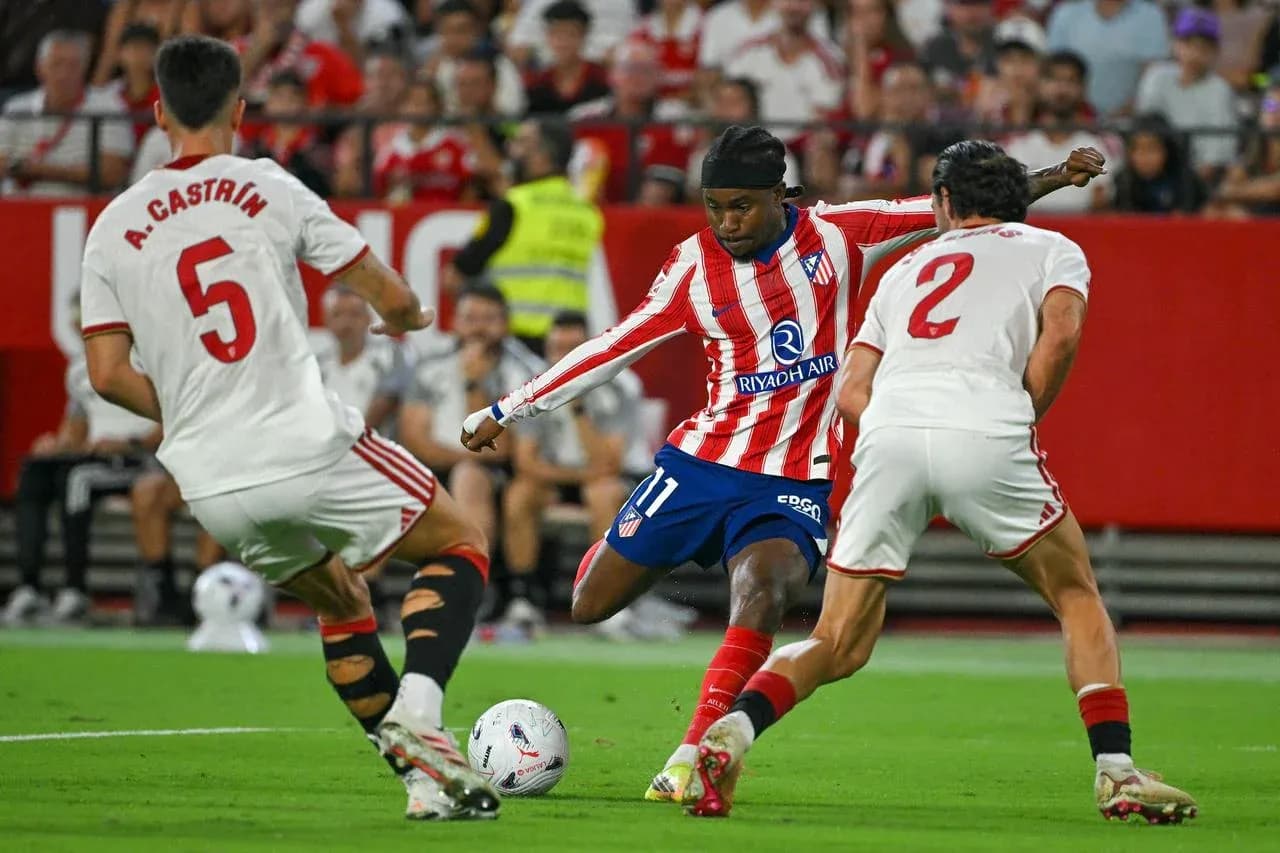
Under the late-summer lights of the Ramón Sánchez Pizjuán, this Regular Season - 3 clash in La Liga ended with a stark reminder of where each project currently stands. Sevilla, coming in with momentum and a Europa League trajectory, were cut open early and often, losing 3–1 at home to an Atletico Madrid side that already looks like a polished Champions League contender.
Following this result, the table snapshot is revealing. Sevilla sit 5th with 6 points, their overall record now two wins and one defeat, six goals for and five against for an overall goal difference of +1. Atletico Madrid, unbeaten and efficient, are 2nd with 7 points, seven goals scored and three conceded, an overall goal difference of +4. On their travels, Atletico have been ruthless: one away match, one win, three goals for and one against.
I. The Big Picture – Identities in Conflict
Luis Garcia Plaza stayed loyal to Sevilla’s seasonal template, rolling out the familiar 4-2-3-1 that has been used in all three league fixtures so far. Odisseas Vlachodimos anchored a back four of J. Iglesias, Castrin, Kike Salas and G. Suazo, with L. Agoume and Jon Guridi as the double pivot behind a creative band of three: M. Sierra, Peque and J. Diaz, supporting lone forward R. Ure.
Across the technical area, Diego Simeone chose a bold, front-foot 4-4-2. Jan Oblak was protected by a back line of Marcos Llorente, M. Pubill, D. Hancko and A. Grimaldo. In midfield, G. Simeone and P. Barrios patrolled centrally, flanked by M. Hjulmand and A. Lookman, with Lee Kang-In and Álex Baena forming a fluid, roaming front two.
Atletico’s season-long numbers framed what unfolded. Heading into this game, they averaged 2.3 goals per match overall and just 1.0 conceded, with no defeats in three (two wins, one draw). Sevilla, by contrast, were more volatile: 2.0 goals scored per match overall but 1.7 conceded, with a worrying home profile of 1.5 goals scored and 2.0 conceded per game at the Sánchez Pizjuán.
II. Tactical Voids – Absences and Discipline
Both squads carried notable absences. For Sevilla, R. Vargas was unavailable due to transfer negotiations, removing a potential attacking alternative from the bench and narrowing Garcia Plaza’s options to change the game state.
Atletico’s list was longer and more structurally significant. J. Alvarez (personal reasons), Robin Le Normand (suspended after a red card), T. Lemar and O. Vargas (coach’s decision), and A. Sorloth (muscle injury) all missed out. The absence of Le Normand, one of La Liga’s leading red-card stories already this season, forced Simeone to lean fully into the Pubill–Hancko axis at centre-back. Sorloth’s injury meant Atletico’s central threat had to be reconstructed through mobility and interchanging rather than a traditional target man.
From a disciplinary perspective, both teams arrived with warning signs. Sevilla’s yellow-card distribution this season skews late: 27.27% of their cautions have come between 76–90 minutes and another 27.27% between 91–105, with a red card already in that 76–90 band. Atletico mirror that late volatility, with 28.57% of their yellows between 46–60 minutes and 28.57% in added time (91–105), plus a red between 76–90. This is not just trivia: it speaks to how both sides tend to suffer as intensity peaks and legs tire.
III. Key Matchups – Hunter vs Shield, Engine Room Wars
The headline duel was always going to be Atletico’s attacking trident of Baena, Lee Kang-In and G. Simeone against Sevilla’s back four and double pivot.
Baena entered as one of the league’s standout performers: three goals and one assist in three appearances, from just four shots on target, and a 7.63 average rating. He is both hunter and creator, with seven key passes and an 82% passing accuracy. Against a Sevilla defence that had already conceded four goals at home in two matches, Baena’s intelligence between the lines was always likely to find seams.
Lee Kang-In, officially listed as a midfielder but used here as a forward, is the connector. With one goal, one assist, 77 completed passes at 88% accuracy and four key passes this season, he offers control and incision. His 28 duels contested and 16 won underline how he sets the tone in both directions, a pressing trigger as much as a playmaker.
For Sevilla, the “shield” is imperfect. G. Suazo has been heavily involved defensively, with 36 duels and five tackles, while Kike Salas has already blocked two shots and made two interceptions, but the collective record is blunt: four goals conceded at home, zero clean sheets anywhere. The double pivot of Agoume and Guridi was tasked with screening central lanes, yet Guridi’s season so far – 22 duels contested, only four won – hints at why Atletico found joy between the lines.
In the engine room, P. Barrios and M. Hjulmand formed a hard-edged core for Atletico. Their job was to suffocate Peque and M. Sierra, preventing Sevilla’s 4-2-3-1 from ever truly becoming a 4-2-4. With Atletico having allowed just three goals overall and 1.0 per match both home and away, the structure held: Sevilla’s central creators were crowded, forcing them wide and into low-percentage crosses.
On the Sevilla side, the notable attacking spark in the wider squad remains Isaac Romero, who came from the bench here. With one goal, one assist and three shots this season, plus a league-leading three yellow cards, he embodies their chaotic edge: dangerous but ill-disciplined. His presence hints at a Plan B built around direct runs and emotional surges rather than controlled possession.
IV. Statistical Prognosis – Why Atletico’s Plan Prevails
Even without explicit xG data, the season’s trends and this match’s 3–1 scoreline align. Atletico’s overall scoring rate of 2.3 per game, combined with Sevilla’s overall concession rate of 1.7 and specifically 2.0 at home, always suggested that if Simeone’s side scored first, the contest would tilt sharply.
Atletico’s clean-sheet record is modest (one overall, none away), but their defensive averages – just 1.0 goal conceded per match overall and away – point to a team that limits high-quality chances. Sevilla, meanwhile, have failed to keep a single clean sheet and rely on outscoring opponents; they have yet to fail to score in any match, but when the attacking rhythm is disrupted early, their back line is exposed.
In narrative terms, this fixture was a collision between a side whose structure is already fully formed and another still stitching its identity together. Atletico’s 4-4-2, with Baena as the hunter and a compact, disciplined shield behind him, exploited every seam in Sevilla’s 4-2-3-1. The early 0–3 deficit by half-time told the tactical story: Simeone’s men pressed high, attacked quickly and trusted their defensive block to absorb the inevitable Sevilla response.
Following this result, the prognosis is clear. Atletico Madrid look set to sustain a Champions League-level campaign, their blend of efficiency and control reflected in a +4 goal difference (7 scored, 3 conceded). Sevilla, with a slimmer +1 (6 scored, 5 conceded) and a fragile home record, must tighten their defensive spacing and find more balance in midfield if they are to convert Europa League promise into something more enduring.