Barcelona Triumphs in Champions League Quarter-Final Against Atletico Madrid
Under the Metropolitano’s lights, a quarter-final with the weight of a final tilted Barcelona’s way. Following this result, a 2–1 away win in regular time, the story of the tie was not just the scoreline but how each squad’s structural strengths – and absences – shaped ninety minutes that felt like a referendum on two footballing identities.
I. The Big Picture – Contrasting seasonal DNA
Atletico Madrid came into this Champions League campaign as a paradox. Overall they had played 14 fixtures, winning 7 and losing 5, but their split personality was stark: at home they were devastating, with 5 wins from 7, scoring 21 goals and averaging 3.0 goals at home, while conceding 10 at 1.4 per game. On their travels they were far less secure, yet in Madrid they had largely been a storm.
Barcelona, ranked 5th in the wider Champions League standings with 16 points and a goal difference of 8 (22 goals for, 14 against overall in that table snapshot), travelled with a different kind of authority. Across 12 fixtures in total, they had 7 wins and just 3 losses, scoring 32 goals at an overall rate of 2.7 per game. On their travels they were still dangerous, averaging 2.0 away goals and conceding 1.8.
The match itself echoed those numbers but flipped the usual script. Atletico, whose home goals-for rate had been explosive, were held to a single strike. Barcelona, who had not kept a clean sheet at all this campaign (0 clean sheets home or away), still conceded – but crucially, they survived the Metropolitano with just one goal against, an away performance built more on control than chaos.
II. Tactical Voids – Absences and discipline
The team sheets told their own story of what was missing. For Atletico, the defensive core had been hollowed out: J. M. Gimenez and D. Hancko were both listed as “Missing Fixture” through injury, while M. Pubill was suspended due to yellow cards. P. Barrios, out with a muscle injury, removed another option for Diego Simeone in terms of midfield balance and late-game legs.
Those absences forced Simeone into a back four of N. Molina, R. Le Normand, C. Lenglet and M. Ruggeri. Without Gimenez’s aggression or Hancko’s presence, Atletico’s defensive line lacked a natural field general. The choice of G. Simeone and A. Lookman as wide midfielders in a 4‑4‑2 was a nod to energy and verticality, but it also meant Koke and M. Llorente had to cover enormous central ground without a pure destroyer behind them.
Barcelona were hardly untouched. A. Christensen was out with a knee injury, Pau Cubarsí suspended after a red card, and Raphinha missing with a thigh problem. M. Bernal’s ankle injury further trimmed Hansi Flick’s options. That context made the starting defensive unit of J. Kounde, Eric García, G. Martin and J. Cancelo more fragile on paper – especially given that Eric García himself appears in the red-card leaders list with one dismissal this campaign. Discipline and decision-making from him were always going to be a subplot.
Card trends across the season hinted at where the game might boil. Atletico’s yellow-card distribution shows a clear spike between 46–60 minutes, with 29.17% of their bookings arriving just after half-time – the classic Simeone period of emotional surge. Barcelona’s yellows cluster between 31–45 minutes (26.09%) and 76–90 (21.74%), suggesting that their most combustible phases tend to be right before the interval and in the closing stretch. In a knockout tie, those windows were always going to be flashpoints.
III. Key Matchups – Hunter vs Shield, Engine Room vs Orchestrators
The purest “Hunter vs Shield” duel was built around J. Álvarez. With 9 goals and 4 assists in 13 Champions League appearances, 32 shots with 20 on target, and a strong 7.62 average rating, he is Atletico’s reference point. He had also been flawless from the spot in this campaign, scoring 2 penalties from 2. Around him, A. Griezmann’s roaming from the second striker role and A. Sorloth’s presence from the bench offered different profiles of threat.
Their collective task was to crack a Barcelona defence that, heading into this game, had conceded 20 goals overall in 12 fixtures at 1.7 per match, with no clean sheets. Eric García’s profile underlines both the strength and the risk: 702 passes at 92% accuracy and 11 interceptions show composure and reading of the game, but 14 fouls committed and a red card in this competition hint at a defender who can be drawn into duels he does not need to fight.
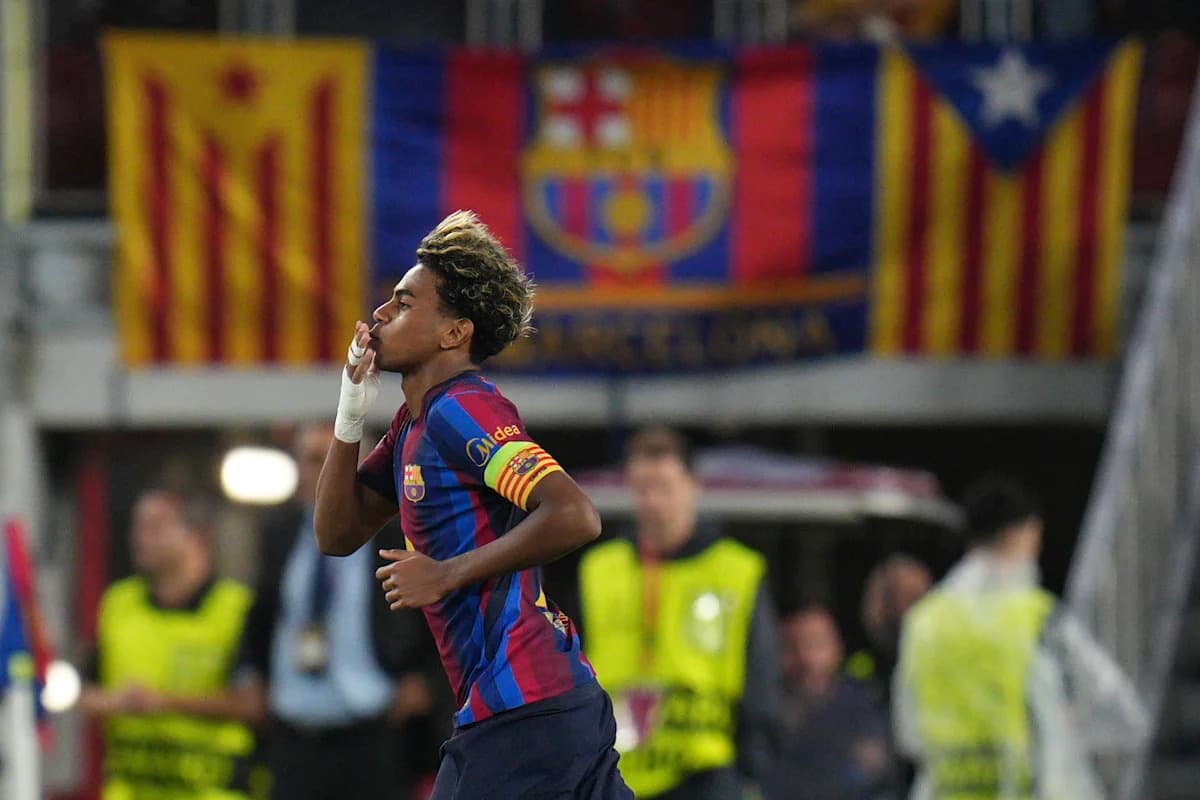
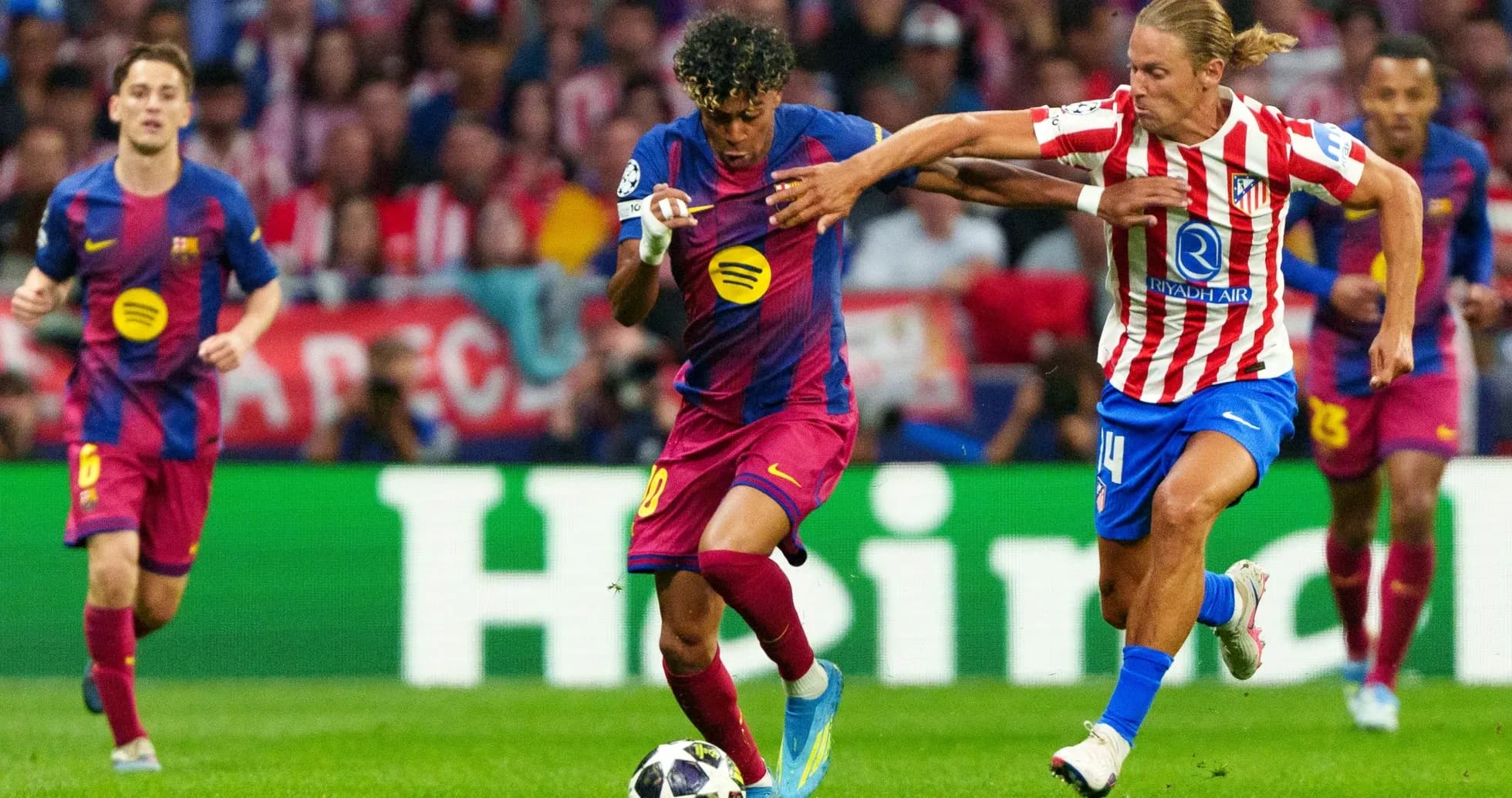
On the other side, Barcelona’s attacking trident between the lines – Lamine Yamal, Fermín and D. Olmo behind F. Torres – posed a very different type of problem. Lamine Yamal’s campaign has been outrageous: 6 goals, 4 assists, 82 dribbles attempted with 45 successful, and 89 duels won from 149. He is also their top yellow-card collector with 4 bookings, a winger who lives on the edge of confrontation and risk.
Fermín, with 6 goals and 4 assists of his own, plus 23 tackles and 4 interceptions, embodies Flick’s hybrid idea of a midfielder who can both attack the box and counter-press. The “Engine Room” battle was therefore not just Koke and Llorente against Gavi and Pedri in a traditional sense; it was Atletico’s double pivot trying to stem the rotations of these young creators while still feeding Álvarez and Griezmann quickly enough to punish Barcelona’s high line.
IV. Statistical Prognosis – xG shadow and defensive solidity
Even without explicit xG data, the shot and goal profiles give us a proxy. Atletico, across the campaign, had scored 34 goals from 14 games overall – roughly 2.4 per match – while conceding 26 at 1.9. Barcelona’s 32 from 12 (2.7 per game) against 20 conceded (1.7) suggest a side whose attacking output is more consistently above average than their defensive concessions.
In that context, a 2–1 away win for Barcelona fits the underlying pattern: both teams likely generated enough to score, but Barcelona’s superior attacking ceiling and the individual quality of Lamine Yamal and Fermín tilted the balance. Atletico’s usual home storm – 21 goals in 7 home fixtures – was reduced to a single strike, a testament to Barcelona’s game management rather than a sudden collapse of Simeone’s attacking structure.
Looking forward in a tactical sense, Barcelona’s inability to keep clean sheets remains a structural concern, but their offensive spine – F. Torres’ movement, Lamine Yamal’s chaos, Fermín’s late runs, with R. Lewandowski and M. Rashford as high-impact options from the bench – gives them enough firepower to ride out volatility. Atletico, by contrast, will need the return of their missing defenders and perhaps a tweak in the balance of their midfield if they are to convert their ferocious home attacking numbers into knockout control rather than glorious, narrow defeats like this one.